Showing posts with label Stratfordians. Show all posts

Monday, December 19, 2022

Aggie Morton & the Seaside Corpse


The Seaside Corpse / Marthe Jocelyn
Toronto : Tundra, ©2022.
354 p.

I couldn't resist quickly reading the fourth (and sadly last) book in the Aggie Morton series. In this one, Aggie and Hector are going to be "junior scientists" at a fossil dig at Lyme Regis. There is a team of scientists getting ready to remove their discovery of a large ichthyosaur from the sea, and Aggie & Hector, along with two other young boys (Arthur & Oscar) are going to camp there for a week and help out. 

Because of this set-up the story feels more adventurous than straight mystery. Hector has to contend with a camp cot in a shared tent with other boys, not his natural milieu. And Aggie, observant as ever, begins to see how women had their work overrun with men claiming credit, and how they manage it. The dig is run by the husband and wife team of the Blenningham-Crewes, but Mrs. does the work while much older Mr. takes the credit. Aggie also notes that Helen, the camp cook, has her life constrained by her father's wishes, and of course we also see the return of Gus Fibbley, the journalist who isn't really a Gus. 

There is infighting at the camp, as well as the frequent visits of an American millionaire and a sideshow impressario, both interested and competitive potential buyers. Thankfully Grannie Jane also makes a visit to help Aggie and Hector out when they need it. 

The mystery comes a few chapters into the book, when Aggie and Hector stumble across a dead body on the beach -- it is Mr. B-C. But who could have wanted to murder this often angry, bullying, drunk? Well, that's the question -- pretty much everyone. Aggie and Hector work their way through the list of suspects, and eliminate them slowly. It's tough when it could have been anyone! The conclusion is startling and rather sad. 

I enjoyed this one. There is lots of info about fossils and about the most famous fossil hunter of Lyme Regis, Mary Anning. There are great side characters and lots of humour. And there is also a very touching conclusion to the last mystery of this childhood team of sleuths. I thought this series was well done, with many nods to the great Agatha Christie that adult readers will enjoy picking out. But the main characters hold their own, and you get attached to them. It's sad that this is the last one, but it was perfectly concluded. Highly recommend the whole series for the adventurous middle grade reader who loves mystery, strong girls, cleverness and humour. 

Tuesday, December 13, 2022

The Dead Man in the Garden

The Dead Man in the Garden / Marthe Jocelyn
TO: Tundra, c2021
368 p.

Taking a break from older classics to catch up on the Aggie Morton series! I really enjoyed the first two novels in this series, The Body Under the Piano and Peril at Owl Park, so when this one was available I thought it was the perfect time to take a break with some delightful middle grade mystery. This series features a young girl inspired by Agatha Christie, and for adult readers and Christie fans, there are lots of subtle references to her works to enjoy in each book.

Moving from the Christmas setting of the Owl Park volume, in this adventure, Aggie and her friend Hector are at a resort hotel in Yorkshire so her newly widowed mother can rest. Aggie and Hector, as usual, get up to mischief investigating rumours of a dead body, and then discovering a second corpse themselves. They are assisted in their investigations by Grannie Jane and their new friend George, a resident of the hotel who is in a wheelchair. His situation provides them with some great angles to snoop and explore, and Aggie uses all those opportunities to their fullest. 

This restful interlude at the spa hotel turns less restful and more dangerous and the three young people poke and prod and uncover corruption, conspiracy, and cold-blooded murder. 

The pace and characterizations in this volume are all really well done. George is a clever new addition to the main characters, and adds more complexity to their interactions. The mystery is well developed and makes sense when all is revealed, which I always appreciate in a mystery novel no matter which age it is written for. And the conclusion is quite thrilling and uses the setting to its fullest advantage. 

Another title in this series that I can highly recommend. Very enjoyable, and I have the fourth volume in the series to look forward to shortly.

Tuesday, December 21, 2021

Aggie Morton, Mystery Queen

TO: Tundra, c2020
325 p.

And now for some more middle grade mystery writing, this time by an author who is local to me & a delight to read. These books are similar to the Myrtle Hardcastle series, but set a little later (1902) and for a slightly younger crowd. The writing is pitched at about the 9-13 age range, and there are illustrations included which are pretty charming. 

The main character, Aggie Morton, is inspired by Agatha Christie; in the first book she stumbles across a young refugee from Belgium, Hector Perot, in a candy store, and they befriend one another since they are both slightly odd in comparison to other 12 year olds around. There has been been a murder in the room that Aggie's dance class meets in, and before they are all sent away she's able to dash in and get a good look at the dead body. She's the classic cerebral, socially awkward, gawky girl who is interested in poisons, death and other "morbid" things. 

There are references to people and places from Agatha Christie's life and her later novels throughout the series, which you'll only catch is you are yourself a big Christie fan -- fun for the adult readers but which will almost certainly be missed by younger readers. In this intro to the series, the action gets going a little slowly, but it's a credible and interesting set-up overall. I found the characters a little hard to handle in the beginning but by the end it felt like the reliance on Agatha Christie and Hercule Poirot was loosening up a bit and these characters were becoming more themselves. I enjoyed it enough to immediately pick up the second book in the series, which was perfect because it is a Christmas themed novel! 

Peril at Owl Park / Marthe Jocelyn
TO: Tundra, c2020
256 p.

This second novel was just great! It's set at Owl Park, the manor house that Aggie's older sister Marjorie lives at now that she's Lady Greyson. Aggie and her grandmother have been invited to spend the Christmas holiday there, and Aggie manages to get Hector invited as well as a poor lonely refugee with no family. 

It's classic British country house mystery, and even better because it's so very Christmassy. The house is decorated up, they do Christmassy things, there's snow and a Christmas performance by a travelling theatre troupe, in addition to hidden passages, mysterious Indian jewels, and murder. Aggie and Hector investigate the crime, and here it feels likely that they are the only ones able to do so, since the adults are all running around concerned with adult things but the children are essentially invisible as they move around the house. Nobody pays any attention to them at all. A grave error...

This was a real delight. The enclosed space makes the plot tighter than the first, and Aggie is forced to face her own shortcomings as well as her cleverness; it adds more to her character. There are faint shades of Charles Dickens and Wilkie Collins in the theatricals and the jewel subplot, and so many great characters among the manor house staff and the theatre performers. The mystery is a solid one, and the book itself has a great atmosphere which I really enjoyed - all the elements of British Christmas closed room mystery here. The characters come into their own in this second book in the series and are very entertaining and more rounded somehow. A great Christmas read! 

Tuesday, June 20, 2017

Book Artisan Gerard Brender a Brandis


Photo via WEN blog
 (the Wood Engraver's Blog)
Local artist, printmaker and bookmaker Gerard Brender a Brandis is a legend. He makes his own paper from plants he grows himself; he does glorious he has a press upon which he makes his prints and produces books of his own and those he creates alongside his sister, also a prolific author; he has an artist's studio which is open to the public for part of the year, and where you can see his artistic process and talk to him directly. 

There's a beautifully in-depth visit and interview with him posted by a visitor to his studio recently - lots of images of his stunning work and his charming self. Check it out!

He also has many books that have been published by various Canadian small presses, highlighting his art in different ways. Porcupine's Quill Press, which is located quite close by, has put out a few titles by Gerard Brender a Brandis, and I'll highlight two that I own and that I've just gone through again. 


A Wood Engraver's Alphabet is a perfect introduction. He's an expert on botany and many of the prints you can buy at his studio are studies of flora in its many guises. (The only print I own is a small lily of the valley which is so delicate and superbly beautiful). This book takes the structure of an abecedarium and illustrates it with multiple floral images - a multitude of options here. 

A brief introduction explains his choices and why he made them, as well as giving a lovely nod to his writer sister, Marianne Brandis. It's a  pretty book which really highlights his skill at this art and rewards close observation. There's not any text besides the intro, so this small book (61 p.) is really just for visual delight.


A Gathering of Flowers From Shakespeare (with quotations selected and interpreted by F. David Hoeniger) (143 p.) is exactly what it sounds like. 

It's the perfect Stratfordian mix, with many images of Shakespearean settings and botany alongside mentions of those flowers in the plays. If you want something that evokes Stratford and its best known arts, try this book! 

Hoeniger gives excerpts of a few lines of play, and then explains the import of the plants that Shakespeare chose to refer to -- why they might be important in context, what the deeper meanings were to each reference -- all in brief companion pages to the images. Most are florals, though as you can see from this cover there are also a few others; houses, sundials, bridges, interiors. It's charming and a must-read for Shakespeare aficionados. 

Stratford really is an artistic place, and I'm fortunate enough to know many artists and authors here. I'm happy to share these two books by an artist whom I admire for his kindness and his skill. 


Thursday, April 07, 2016

Miss Moon

Miss Moon: Wise Words from a Dog Governess / Janet Hill
Toronto: Tundra, c2016
48 p.

This charming art book is written and illustrated by Janet Hill, a local painter & bookish type. Miss Moon is a dog governess, who has taken on the responsibility for training 67 unruly dogs belonging to a family on a small island of the coast of France.

It shares life lessons in brief vignettes; things like "With a little creativity, the impossible can become the possible" -- or, "Respect the property of others" -- or, "A Good walk is not a race". The focus and the prime attraction of the book is most definitely the full spread illustrations. They are replete with little details tucked away which requires serious perusal of the pages to make sure you find every one of the delightful surprises and personalities that Hill includes. If you love art and think there is a thoughtful child or art-loving adult in your life who'd appreciate this, do share it.

Janet is a local, and an acquaintance, but I hope you will still take my review of this book as an objective one. I am not a dog person, but I did find this book a lot of fun. Now if only Miss Moon could take on the onerous job of herding cats...

This book was first published in French as Mademoiselle Moon, about a year before this version -- if you like quirky and elegant art, and think reading the 20 life lessons imparted in this book in French would make them even more apropos, you can still find it for sale.

Also, if you just want to explore more of Hill's artworks, check out her website, Janet Hill Studio, and her Etsy store. She has many illustrations of many different subjects, all reasonably priced as well.

I'd recommend this book to older children and adults; it might work well to read together, examining the illustrations and trying to guess what happens next. Each page is just a quick capture of one moment in what seems to be a very busy life!

Saturday, June 15, 2013

Confessions of a Fairy's Daughter

Confessions of a Fairy's Daughter: growing up with a gay dad / Alison Wearing
Toronto: Knopf Canada, c2013.
292 p.

To provide full disclosure, I must tell you that I've met Alison, and have featured her on our local blog, Stratford Authors. Thus, I will not be 'reviewing' this book as much as highlighting it. I think it is a worthwhile read, interesting and evocative of her unusual life experience.

This memoir of a woman growing up with a gay father is a fascinating read: while it was a shock for the entire family for her father to come out as gay in the 80's, there is a calm about the book, an understanding of having gone through something that is not a tragedy, that has turned out quite happily in the end.

Wearing takes us through her childhood, to that moment of change, and beyond, to how their life is now. She begins with her own experience, then lets her father tell his story in the second section of the book, finishing up with a short section about how her mother was affected by all this. The book concludes with a "happily ever after" kind of ending -- everyone in the family gets along, including her father's partner of 30 years who is a part of the clan.

There are family photos interspersed in the book, as well as wonderful endpapers that are entirely photos. The cover image also comes from a family photo, and altogether, the book feels like a fabulous family album.  I loved this design element, and thought it was a brilliant idea.

I most enjoyed the beginning of the book, Alison's own story, perhaps because I could most relate to her perspective. Her father's story runs parallel to the history of gay experience in Toronto, and Canada in general, so provides a look at the way gay and lesbian life has changed immensely in the past 30 years. There is no earth-shattering drama here, simply a well-told story of upheaval in one family's life.

To follow along with her adventures being interviewed about this book (and her one-woman show of the same) along with her father, check out her Tumblr page. Lots of links and fun pics, too.

Friday, April 01, 2011

Marthe Jocelyn's Scribbling Women


Toronto: Tundra Books, c2011.

198 p.


This post is part of a blog tour for Marthe Jocelyn's latest book. Today is the final and fifth day of the tour, which has been going on all of this week. A list of all the participating blogs can be found at Tundra Books -- check out all the posts for many perspectives on this book and various interviews and special features by the bloggers involved.


To summarize this book quickly, it is a collection of eleven biographies of women who wrote, sometimes for publication and sometimes simply in private. The key connecting factor is that their writing was saved for future generations -- us -- to be able to read and feel that perhaps we now know a little more about the women of our collective past. It is aimed at middle grade/high school readers, and the level of detail and writing style are perfectly matched to this audience. I'd easily give it to any girl I know; actually, for that matter, any boy as well, because why should girls be the only ones to be interested in women's lives? I think opening our eyes to other lives and other ways of living is vital for both genders, at all ages.


The title comes from a dismissive comment made by Nathaniel Hawthorne in 1855, at a time when many women were making their meagre livings by writing for papers and magazines -- he refers to them as a horde of scribbling women, interfering with the potential popularity of his own works. As another blogger suggested earlier in the week, perhaps it was sour grapes?


In any case, this book is a delight to read. Jocelyn explores the lives of women of many cultures and many eras. It is organized chronologically, which works well, and begins in distant Japan with Sei Shonagon, famous list maker. It moves through women who were journal keepers, letter writers, journalists, a slave making a record of her life, adventurers and writers of fiction and facts. Although I found all of the very different women's stories fascinating, I was most engaged personally by Isabella Beeton's story. Isabella (1836-1865) was an amazingly energetic woman, who grew up in a very unconventional setting -- a very large blended family whose stepfather moved them all in to his workplace at the Epsom Racetrack. They lived in the racetrack buildings, offices and halls. At a fairly young age she married and became the business equal of her husband, a magazine publisher who did alright in business but better once Isabella came along. She industriously wrote pieces for all of his papers. She also solicited and edited pieces and eventually created her masterpiece, Mrs. Beeton's Book of Household Management. She edited this collection of columns from the magazine pieces they had published, and created a book the likes of which had never been seen before, a true compendium of household wisdom for new household managers (ie: young, unprepared newly married women). It included cooking advice from very basic on up, recipes for serving invalids, cleaning and household maintenance advice and much more. It was also a bestseller. Isabella was a genius at the modern advice offered to writers to "repurpose your content"! She used. rewrote and reused much of her work to profit from it in multiple ways. Sadly, she met the fate of many women of the era, clever and industrious and successful as they might be. She died of puerperal fever after giving birth to a fourth son, at the young age of 28.


There are thrilling lives outlined in this book, with just enough information given to whet the appetite. It won't overwhelm younger readers, and will hopefully inspire older readers to search out more information on many of these intriguing women. I really enjoyed reading this and found it illuminating both for the factual lives of these women and for the recognition of lesser known lives. The respect given to women's daily life shines through in Jocelyn's writing and is much appreciated.


I also had the chance to talk to Marthe about her own life as a "Scribbling Woman" -- the conversation follows:


ME: Something I found very appealing about your book was the wide variety of women you highlighted. There are both women who wrote in personal forms like letters or journals, and women who made their living by their words. This made me wonder, what inspired you to make a career as a "Scribbling Woman"? Can you give us a sense of how your career developed?


MJ: From when I was about 25 until I was a little past 40, I had a small business designing and making toys and children's clothing. Choosing fabrics and combining odd patterns was part of that, as well as creating characters whose facial expressions changed with the tilt of a needle and thread. This was all background for when I had my own daughters and began to read them the stories I'd loved a kid, alongside the many brilliant new ones published in the intervening years. I was re-hooked on children's books, with the tickle of a thought that I might be able to write one. (That's a common thought, by the way, amongst people who become parents, but the truth is that children's books are VERY hard to write!) My toys were seen by an art director at Dutton who thought that the 'handmade' style would translate to illustration. I submitted a version of my collaged picture book, Hannah and the Seven Dresses, at about the same time I began work on a chapter book called The Invisible Day. The idea for that one came in response to my daughter's wish to walk to school alone in New York City. "Ha ha!" I said. "You'd have to be invisible!" And ping! That teeny idea grew into a story. Both books were bought by Dutton eventually, and I was on my way...


ME: I especially enjoyed the story of Isabella Beeton, who was a real powerhouse, equal to her husband in his publishing business. Did you come to have favourites among the women you profiled, or are all the women included some of your favourites among all the subjects you must have researched originally? How did you go about researching all of these varied lives?


MJ: The one question I dreaded most on this blog tour was that I'd likely be asked to choose a favourite. But, as you suggest, these eleven were all favourites, winnowed out of a field of about forty considerations. I didn't necessarily 'like' all these women, or want them as friends, but something about their stories I already knew of the more renowned women - Nellie Bly, Harriet Jacobs, Isabella Beeton - but as soon as my radar was turned on to receive signals about obscure women writers, I began to get recommendations from friends and friends-of-friends for possible subjects. I also made a point of seeking out odd documents in historical societies and places that might have been ignored by most other children's writers so far.


ME: I think you created a really great mix of women's lives in this book - have you ever considered creating a second volume with more of the women you have looked at during your research?


MJ: YES, I'd love to do a follow-up volume. I have many more women & girls deserving attention.


ME: I have a particular interest in both letter writing and journaling. Considering that some of the Scribbling Women in this book were journalers, and that your teen novel "Mable Riley" is a fictional diary set in our own town of Stratford, I am guessing that you find journals interesting as well. Do you keep a journal, and if so, how important is it to a writer to have such a resource?


MJ: I have kept a diary at a couple of points in my life, both times when starting a new chapter - moving to a new place - but each time I soon felt self-conscious and lost interest, finding that it took too long to put into words the fleeting and intangible sensations I was having. Point-form lists of impressions were more lasting for me, even re-reading later. What I could see from a train window, for instance, or the foods offered for breakfast in a foreign city. Maybe that's why Sei Shonagon's lists appealed to me so much, in her collection called The Pillow Book. Even her list headings are evocative: Repulsive things, Elegant things, Things that make me happy, Things that cannot be compared... I do keep a "writer's notebook" which is a little different from a personal journal. It contains lists - from shopping lists and to-do lists to the 'impression' lists I mentioned before, as well as snatches of overheard conversation, the occasional drawing, notes scribbled down when I attend talks by other writers, and random snatches of stories I'm working on. So, it's a record of sorts, but mostly of the disarray of my own thoughts.


ME: You've written many different kinds of books, from picture books to juvenile and teen novels to nonfiction books such as this one, and they are all equally impressive. How do you approach each kind of writing project -- is there a difference in how you create each kind of book?


MJ: Yes, every book is different of course, even within the same genre. And as you say, I like to try many types of books, usually more than one at a time. It is hard to work on one thing for more than two or three hours a day because the brain gets tired. I find if I have a novel unfolding alongside a picture book where I'm working on illustrations, I can go back and forth easily, mulling one subconsciously while working on the other and doubling my work day.


ME: Do you have any specific writing 'rituals' that you are superstitious about, or that help you get your writing done, besides having more than one project underway at a time?


MJ: I'm not really superstitious - except of course believing that if I don't write then nothing will get written. I often try to set a daily word count or a number of hours or a certain section to finish, just so it feels like a do-able amount and not a whole book! I tend to drink tea while I work, but I know it's just tea and not a magic potion...


ME: Well, I'm not sure I can totally agree with the idea that tea isn't a magical potion! It is certainly one of the necessities of my bookish days as well.


You conclude this book by making a Sei Shonagon inspired list of Things I Want To Learn More About (which, as a librarian & research addict, I loved!) Is this kind of curiosity vital to being a writer? Or are there other traits or habits that you think are essential for writers to have?


MJ: Hmm, I think curiosity IS essential, especially for a non-fiction writer. And I think we have to be good listeners, not always concerned with telling our own story but caring more about hearing what other stories are unfolding around us.


ME: I love the idea of listening to the other stories unfolding around us. That is kind of what we do as readers as well, don't you think? Thanks, Marthe, for answering a few questions and giving us a glimpse of your own writing life.


*****************************


Marthe Jocelyn is a Stratford based writer and illustrator whose latest book is on "tour" of many blogs this week. Don't forget to check out Tundra's great contest to win a copy of each of Marthe's 28 books -- just leave a comment on this post or on any other Scribbling Women post that's been part of the tour. (details here)

I can personally recommend Earthly Astonishments, Mable Riley, and Folly... three of her teen novels that I really, really enjoyed! And her picture books are great fun as well :)


Don't forget to follow the blog tour on to the next stop, at The Nervous Marigold.


Wednesday, August 04, 2010

Fairies and Frights: two young adult novels


Wayfarer / R.J. Anderson
Toronto: HarperCollins Canada, c2010.
304 p.

Book Two of Anderson's series (Faery Rebels), this has quite a different feel than the first in the series, Spell Hunter (or Knife in the UK). This one is known as Rebel in the UK, and as with Knife, I really like the UK cover better. Much more magical and representative of the story!

This book continues the story of the fairies of the Oakenwyld. In the first book, Knife has to reach out and break the isolation of her community in order to save it. She was a tough, decisive character, and I kind of missed her presence in much of this one. However, as this story opens, Timothy, a relative of Knife's husband Paul, is coming to live with them for a while. He has been suspended from school and needs a place to stay, so appears without an invitation. One of the reasons houseguests are not generally welcome is because Knife does not want anyone messing around with the oak in the back yard, and she tells Timothy (a rebellious teenage boy) that he must stay away from it. Of course he doesn't.

He meets Linden, one of the fairies from the Oakenwyld, and they head off on an adventure together, seeking the fabled Stone of Naming. This is a magical object which will free all fairies from the yoke of a disturbed and powerful queen who has most of Britain's fairy population in thrall. Timothy and Linden's travels provide a way for Anderson to explore and illuminate different kinds of fairies and communities, whether tiny forest dwellers like the residents of the Oakenwyld, or more urban fairy gangs of glamoured misfits. The fairies who supposedly hold the Stone of Naming are more like the elves of Lothlorien in Tolkien; they've taken themselves out of the world and live on a magical, invisible island which is the final destination for our two travellers.

This tale is a bit more modern feeling and dark than Knife was, as we get a glimpse of the wider world. It was just as exciting and well crafted, however, with many elements that allow the reader to ponder right and wrong, or questions of identity. I look forward to the next installments to be published in 2011/12, Arrow and Swift.


Nieve / Terry Griggs
Toronto: Biblioasis, c2010.
250 p.

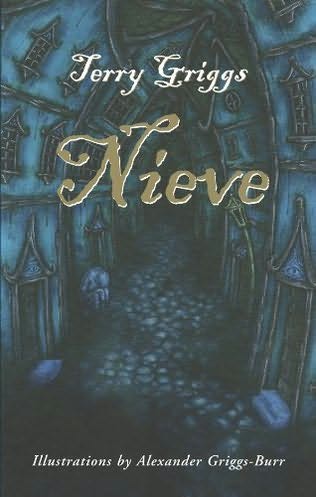
Griggs, known for her wordplay and inventive turn of mind, has written a teen novel that exploits all her strengths. This is a tale of Nieve, a young teen whose parents are professional weepers. They are busy at funerals and dolorous occasions, but Nieve starts to notice that work is getting busier even as her parents' relationship is struggling. She also starts to notice strangers in town -- like a substitute teacher who rewards the class with jawbreakers that unfortunately resemble eyeballs, or a man on the road who tosses out wriggling seeds that grow into thorny, leathery black plants that choke out everything else. The sudden descent of her town into darkness and gothic horror leads her to discover, with the help of her grandmother and another stranger, young Lias, that she must save them all.

The story is delightfully inventive, and has illustrations by Grigg's son Alexander which are also dark and creepy. Gothic weirdness and reliance on Celtic myth make this into a puzzle of creative proportions. I like Nieve herself, especially at the beginning when she seems to have more self-sufficiency. The only reservations I had here were that the set-up wasn't clearly explained; why does Nieve have to save the day? How does she suddenly have access to magic and how does it work? And for that matter, how does she know how it works? Why exactly are these creatures from the Black City infesting their town? This one was fascinating and inventive, but I would have enjoyed more explication and background to deepen the story and provide more of a hook for the reader. This is the first in a projected trilogy, however, so perhaps with the next we'll learn more about the very odd place known as the Black City.

Sunday, June 20, 2010

Jocelyn's Folly


Folly / Marthe Jocelyn
Toronto: Tundra, c2010.
256 p.

Folly, the latest teen novel by local-to-me author Marthe Jocelyn, is an historical novel set in late Victorian England. It is inspired by Jocelyn's family history: her grandfather, known to the family as an orphan, turned out to be a foundling -- upon research, she discovered the name and family situation of her great-grandmother. This inspired a tale of a young woman caught up in circumstances which end up forcing her to give up her young infant son to Coram's Foundling Home, and then about what happened to him there.

I'm not a huge reader of historical novels, so was pleased to find this an absorbing and atmospheric read. I like Jocelyn's style (other favourites of hers are Earthly Astonishments and Mable Riley) and so was sure that this book would be a great read, and was very correct in that guess.


The style is straightforward; we meet young Mary early on, and her voice as a young girl being sent out to service is blunt and believable. She is a young teen when her mother dies and she takes over caring for her siblings. Her father decides to marry again, however, and the stepmother is not overly fond of Mary. From a loving childhood she moves into a cold and difficult adolescence and then is expected to go out to work.We see how she could have easily fallen victim to the blandishments of a handsome young man, and have ended up with a son whom she loved but could not care for. Her story is told in the first person, and her speaking voice is captivating.

Her chapters are interspersed with third person chapters focused on her unusually clever son who is growing up in Coram's foundling home. These chapters paint a clear picture of what these children went through; being nursed in foster homes until the age of 6 when they were ripped away from what they thought of as their families and sent back to the home for schooling. The essential loneliness of such a life comes through, but James is a survivor and finds what he needs through a steady love for his distant foster mother and an attachment to Oliver, a kindly young schoolmaster.

There are also brief chapters throughout (in third person as well) from the perspectives of Oliver and of Eliza, a maid Mary works with who is jealous of her charms and their appeal to the man Eliza has her eye on, a situation which leads to Mary's eventual troubles.

Both stories come together near the end when a new nurse with a kindly eye for young James appears at the school. She and Oliver are James' supports as he struggles to make a life for himself, and there is a hint of potential romance between these two adults. However, the story does not lazily conclude with the easy, sentimental scenario which it very well could have. It recognizes the complexity of love and of family feeling, and the social conditions within which all the characters move, and concludes with a satisfying, believable and hopeful situation.
I don't want to say too much for fear of ruining the plot and the reading experience. I will say it is an engaging read which I sped through, and the setting and voice of each of the characters is clear and individual. Historical novel fans will love it.

If you want to learn more about Coram's Foundling Hospital, try reading A Home for Foundlings, also written by Marthe Jocelyn.


Other opinions:

Passionate Booklover calls it "a gripping tale that left me longing for more".

Lavender Lines says "I stayed entranced with her story. Love, lust, longing, deceit, envy. This book has it all."

Emily at Emily's Reading Room states "Marthe Jocelyn has created a masterpiece of historical fiction that I will not soon forget."

Saturday, January 09, 2010

Quickening


Biblioasis, 2009.
156 p.

This is the first short story collection I've finished in 2010 - and it was overall quite an enjoyable discovery! Griggs has a style which, as she puts it, "can be somewhat textured or layered, what a friend once described as a 'thicket' ... Another friend has described these stories as 'wide tales' as opposed to tall ones, and that nicely covers the stretch in them. I've always been a bit of a fantasist, wanting to let in what lurks on the edges of vision, just beyond view". Her style is definitely more playful, linguistically, than many stories I've read lately which seem to believe in the Hemingway approach to literature - the fewer words the better. Let's just say that I am not a big Hemingway fan.

This is a grouping of stories first published in 1990, and republished by Biblioasis in 2009. This new edition has an extra story added in for good measure. It shows the range and variety of Griggs' tales, full of strange happenings and odd characters, told from a variety of perspectives, most with a sense of the unknown hovering atmospherically. They are entertaining and full of clever wordplay, and some move so quickly that it feels as if the narrator is not going to pause for breath.

There are 17 stories in this collection, each fairly short. Several of them revolve around a family of females, and each has its own distinctive strangeness - in one, a baby girl is christened Michael Gabriel rather than given the name of any of her great-aunts, who all disapprove, and she must then live up to her unusual name. In another, four daughters are left an inheritance of a hotel each, the style of the hotel -- from elegant to a haunted dive -- matching each of their personalities. In the final story, Tag, a reserved woman who both loves and hates her flamboyant, demanding sister (who is fatally attracted to dangerous living and dangerous men) has to deal with the sudden disappearance of said sister. The slightly dimwitted boyfriend is under suspicion and is brought in to the police station for questioning. The investigator has found what he thinks is damning evidence at boyfriend Romeo's apartment:


Thatcher held out a tattered object and shook it vigorously at Romeo. "Just how do you explain this?"

It was a child's library book.

"The Runaway Bunny!" Romeo was thrilled. "Ok, right... uuh well, it's about the transforming power of love, and, ahhh, on the other hand, it's about how you can never escape your mother, you see --"

"What I mean, Dorkhead, is that it's twenty years overdue."

"Yeah? Gee, guess I forgot to return it."

He forgot. Sure. Thatcher knew the type. They broke spines, they dog-eared pages, they scribbled obscene comments in the margins and squashed bugs between the covers, they branded the text with coffee rings, flicked ashes in the binding, wiped freshly excavated ear wax on the end papers, used rusty bobby pins and strips of bacon for bookmarks. Small potatoes, he realized, petty vandalism, but not unconnected to greater offenses. Thatcher had a panoramic vision when it came to crime, a comprehensive view that took in the roots of evil as well as the fruit. All thanks to the firm, guiding hand of his mother, a long-suffering librarian who filled him in like the empty pages of a notepad, sparing no detail. A child who forgets to return a library book, she had warned, may well grow up to be the kind of person who "forgets" to take a knife out of someone's back. Thatcher understood that Romeo was guilty wholesale, guilty in a universal sense if not specifically in this case, because felony was his medium, his oeuvre.


This is, of course, an irresistible appearance of occupational humour -- how could I not appreciate that scene? But there are other moments in other stories which are equally amusing, and then there are some moments which are quite beautifully rendered. The sadness which a middle aged woman feels when her young lover disappears is sketched out in a line or two, but hits hard. There is a real sense that the world is full of things unknown or unseen, and a few of those things make their appearance in these stories.

It was a good collection to muse over while I had time off, taking Mavis Gallant's advice to read a story, put down the book and read something else, then go back to the next. Story collections are not novels, and there needs to be time to appreciate each story independently; in this case, the ornate storytelling certainly benefited from that spaciousness of time -- as I thought back on each story, new angles and images arose. It was a thought provoking and rewarding find.

Tuesday, June 16, 2009

Faery Rebels: Spell Hunter


Faery Rebels: Spell hunter / R.J. Anderson
New York: Harpercollins, c2009.
329 p.

This middle grade fantasy begins with the premise that there really are fairies at the bottom of the garden; or, since it's told from the perspective of the fairies, that there are humans at the end of the garden! It is set in England and has an English sensibility which works very well with the storyline. The fairies live in an old oak tree -- their community is called the Oakenwyld, and has been isolated from other fairies for as long as they can remember. All the fairies are female, and they do not have any magic; it has been lost sometime in the past. They are ruled by a strict queen and have designated duties to keep the community running. Knife is unusual in that she is extremely curious about humans. When she is of an age to be apprenticed, she ends up training to be the Queen's Hunter, under Thorn, the wonderfully ornery current Hunter. This takes her outside the oak much more than she would have been able to access otherwise, and leads to much of the action that follows. She watches the humans, especially Paul, the college age son who has returned home and whom she thinks must be extremely important as he rides about in a 'throne' while everyone else walks. One day as she is hunting she is injured by a crow -- she literally falls into Paul's lap, he helps her recuperate and a friendship is born. The relationship between Knife and Paul is the impetus for her to raise many questions about the Oakenwyld, and to doggedly search for answers to the problems they have. She has to face the Queen herself to get answers, and through her bravery bring about some hope for the future of the Oakenwyld.

This is a very brief summary of a magical story that contains many wonderful moments. Knife is an amazing character, funny and brave and not too sweet or too obnoxious. Her relationship with Paul is developed nicely, and one element of that relationship that I enjoyed was the fact that they help each other to develop their creativity and that is important to both of them. The community of female fairies is a delight; there are personality conflicts but also alliances and some wonderful creations (like the librarian, who I SO wanted to be!) The fairies, being only female, now reproduce by egg -- when one comes to the end of their 300+ yr. life, she consciously gives up her life to create an egg, from which comes a new fairy. This elaborate routine is clearly explained and is sad and beautiful at the same time. The interrelations between the fairy world and the human world in the past are also of vital importance. All these questions are raised and resolved for the reader alongside Knife's discoveries, which makes for a great reading experience. I really enjoyed the story and the use of traditional motifs, as well as the accomplished writing style. I'm glad to hear that there's to be a sequel -- can't wait to hear more about the Oakenwyld!


Bart's Bookshelf said...
Ooh, I've got Knife in my TBR pile and read good things about it. I'd like to ask, what you thought of the other fairy characters in this book.

I enjoyed the way all of the characters were individuals in this story. Bryony, who becomes Knife, is a strong lead, but there are also other fairies who are quite different from her in personality. Thorn, the Queen's hunter who takes Knife on as an apprentice, is a tough talking, straightforward kind of gal. Wink, Briony's foster mother, is a meek and rather scatter brained individual who is nonetheless eminently loveable. There is even a faery librarian who is quite protective of her books :) Each character fits in to the parameters of the world that's been created but it is not a homogeneous community despite the fact that the Oakenwyld is made up entirely of female faeries.


Kailana said...
Faery Rebels: Have you read any of the other 'popular' fairy books people are reading nowadays? If so, how does this compare? If not, why did you choose this one over the others and did it hold up to that?


I've read a couple of the other fairy books (such as Wondrous Strange) but not all of them. This one differs primarily in its audience; it's aimed at a middle grade market, so doesn't have the sleek, sexy love story approach that many of the teen ones do. I actually preferred the creativity in this one. Why did I choose it? Well, primarily because the author lives in my hometown and came in to the library to give us a review copy and chat about it. But then because it looked so great! And the author is so nice. :)


Dreamybee said...
I like the idea of fairies in the garden, so could you tell us a little more about Faery Rebels? What was the tone of this book-light and entertaining, dark and twisted, etc? I've never read much fairy literature? Fairy-tale-inspired? I'm not really sure what genre this book would fall into, but would you recommend this as an intro to the genre?

This story has a light tone, but with some serious issues (loyalty, bravery, independent thought, responsibility to one's community, etc.) in the plot as well. As mentioned, it is aimed at middle grade readers, so it doesn't have a sense of darkness or sexuality; but it is still dense with ideas and a well developed romantic storyline so that adults will enjoy it as well. (at least this one did!)

Eva said...
One more question!What did you enjoy most about Faery Rebels? There are so many YA faery books right now; did this one stand out?

I loved this one for the characterizations and the use of the traditional idea of fairies as little tiny winged creatures living alongside us. And then the breadth of the world created from that kernel of tradition. The writing was also excellent, smooth and well constructed with no awkwardness.

thedarkinthedark said...
It looks from the page you link to that the cover for Knife is way cooler than the other. Which do you feel portrays the book more accurately and why?

I personally prefer this UK version. I like the title's emphasis on Knife's role. And I think this cover is really magical, placing Knife as a very non-human character in an important element: darkness. Knife's going out in the dark, which is forbidden to the fairies of the Oakenwyld, leads to her connection with Paul. Also, she looks tough here! So I think this cover is really representative. The North American one is quite pretty but I think it makes Knife too pretty somehow.


So that's it for my opinion -- here are a few others:

A nice UK review by Scrap Girl at Serendipity
A teenager's review at Lauren's Crammed Bookshelf
Nicola's take at Back to Books
An interview by LisaMay at Look at that Book

Friday, November 14, 2008

Local Authors!


One of the really lovely things about working in a library is meeting the patrons. Today I met a very interesting patron, one who all you readers may be interested in hearing about!

She's a Stratford woman who is having her first middle grade fiction published in 2009 by HarperCollins. She tells us is about fairies, and if you're intrigued by this you peruse her books at R.J. Anderson.

She also told us she belongs to a group of new YA authors being published in 2009. If you want to hear some pre-pub author talk (and see some gorgeous new covers to make you drool) check their blog. I have already found some great new books to put on the want-list!
**Update: Thanks to Cat, who pointed out that there is both a different cover AND a different title to this book in it's US and Canadian incarnation. This is the North American version. Which do you prefer?

Wednesday, April 30, 2008

Gay Allison: a feminist and a poet


To finish off Poetry Month, a lovely occasion: a poetry reading at my library. Stratford is jam-packed with artists, and this one, Gay Allison , is a poet who has worked in the literary field for many years. This is a quick bio, as it appears on our library website:

Gay Allison was born in Saskatchewan and grew up on the prairies. She has lived in Saskatoon, Edmonton, Vancouver, and Toronto. She has an M.A. in English, and taught all Grade levels in schools across Canada. She has been fiction editor of The Canadian Forum, poetry editor of Waves and is founding editor of Fireweed. She is also a founding member of the Women's Writing Collective, and is on the Advisory Board of Tiger Lily, a magazine by women of colour. She was a poetry instructor for "The Women and Words Writing Retreat" in Vancouver in 1991. She conducts poetry workshops across Canada as well as in the Brunswick House B&B. She evaluates manuscripts and works with writing students on an individual basis. She lives in Stratford, Ontario


I'd like to share the opening poem from her 1986 collection, The Unravelling.


Holding the World

My mother unravels a sweater
And dyes it green
a pile of wool
at her feet
in the shape of butterflies
released from cocoons
and ready for flight

When she moves her chair
the threads shape into waves
that resemble the horizon
of a Saskatchewan sky

My father slams the front door
enters the kitchen with shirts
that need fixing
She gathers them in her lap
in the shape of a globe
She could be holding the world

Monday, April 28, 2008

A Stratfordian poet; not Shakespeare


Jane Urquhart is probably best known for her many novels, however, she is also a poet. She is also a Stratfordian, so in celebration of my current home town and of poetry month in general, I'll share one of her works. And to see how poetry plays into her fiction writing, take a look at this lovely interview from a few years ago.

Her husband, artist Tony Urquhart, collaborated with her on her first book, a limited edition (531 copies) of a book of poetry, I am walking in the garden of his imaginary palace : eleven poems for Le Notre. (Panoramas by Tony Urquhart. -- Toronto : Aya Press, 1982.) Copies of the 140 first-state books are going for an average of $530 these days. Nice!

Her first novel was Whirlpool, set in Niagara Falls, about a family of undertakers. The story was based on elements of her husband's family history specifically the existence of Morse & Sons Funeral Home in Niagara Falls, the oldest run family funeral home in Canada. It was well received critically -- now even considered a classic. This theme did not get used up with the novel, however; she was fascinated by Adeline, her husband's grandmother, who had kept a notebook with details of all the bodies fished from the river, which the undertakers then became responsible for. One section (The Undertaker's Bride) from her 1982 book of poetry, False Shuffles, is made up of poems based on Adeline's life.

Here are a couple of those poems, although I can't get the spacing quite right, due to the un-poetic nature of Blogger.

The Limit of Suspension

On three small scraps of paper
grandmother writes
how the suspension bridge
fell down

how the cotton wool
crash

pulled her from
starched sheets to the
lung-stopping chill
of the january night

how her shoes squeaked
in the snow

and looking at the
suspension bridge

lying
broken-backed against the ice
like an injured dragon

grandmother
must have wondered at
each of her magic crossings

but writes here
only
the suspension bridge
fell down
and it did make a noise.


Between Brothers

A fight starts
in a moment

travels all around the
yard

and ruins roses

involves two or three
dogs who
scare the goldfish

deeper in the pond
a fight speaks of
heat or play
or boredom

a fight lasts an
instant or an afternoon

and always finishes
with the loser in the trough
shaking his head like an animal

(the water scatters
through the vision of
his startled sisters
suddenly blooming
at the kitchen window and

grandmother shouting
as she dries the edges of
her hands

all around her apron).