Showing posts with label Korea. Show all posts

Thursday, July 09, 2026

Every Day I Read, by Hwang Bo-Reum


Every Day I Read / Hwang Bo-Reum
trans. from the Korean by Shanna Tan
London: Bloomsbury, 2025, c2021
240 p.


This is a beautiful book on reading, by a Korean writer. It is a series of small essays on a wide variety of topics related to reading - choosing books, paying attention, finding time to read and so on. The chapter headings are like prompts that she starts from, writing a short essay on each -- some more effective than others, but I enjoyed them.

I really liked this. It felt really simple but her love of the act of reading came through. It would be a great choice to read as a group project: there are 53 chapters, so you could read the intro and then read one a week for an entire year. I would do this as a reread! I'd love to hear people's individual responses on each theme in the book. 

I found it engaging, even with the sometimes overly serious statements about reading hard, important books. The author is just 30, and most of us who read regularly will have thoughts about these issues. The short chapters were perfect for listening to as an audiobook, which I did, although I want to reread it in book format as well, to go over the chapters a little more slowly. I felt like I was listening to a fellow reader who was reaffirming the joys of a reading life - nothing new but lots to nod along to, and nice to hear the thoughts of someone who was deliberately investigating their own reading life. There are also reading suggestions sprinkled throughout, but some of them aren't available in English so you'll have to pick and choose there!

It's light but satisfying. I would suggest it, when you are in just the right mood for some reading about reading. 


Wednesday, August 20, 2025

The Healing Season Of Pottery


The Healing Season of Pottery / Yeon Somin
trans. from the Korean by Clare Richards
NY: Algonquin, 2024, c2023.
272 p.


This recent Korean novel was really enjoyable. It falls into the healing fiction category, but it has a little more depth as well. This storyline is another example of the midlife crisis at 30 that I've been noticing in Korean novels of this kind recently. 

Jungmin has burnt out at thirty, and abruptly quits her job as a tv writer, ending up as a recluse in her small apartment for months. Spring comes and she finally stumbles out into the world, coming across a pottery workshop that she at first mistakes for a cafĂ©. The people inside are very welcoming, and somehow Jungmin finds herself joining some pottery classes. 

The regular schedule gets her out of her apartment, working with her hands provides her some calm and relief, and the small core of students she meets there give her new friendships and social interactions. She even ends up taking in a cat for one of them. 

The author clearly knows how to do pottery, and the details of the actual construction of pottery gives lots of opportunity for metaphors for life. I thought this worked very well. It's a nice change from the cafes, cats and bookshops that populate most of the books in this genre. Although there are cats and coffee here too ;) 

Through the year of making pottery and making a new place for herself in the world, Jungmin gets a sense of what she wants to do next, and what will be meaningful for her. There is a small thread of romance in the story, but she is not saved by falling in love or finding a relationship; she makes her own path, particularly focused on her work life. I really appreciated that, and felt that it gave integrity to this story. We also get a little bit of insight into the other characters and their big changes - they all have something that they are facing up to. I thought the interactions between the characters were lovely, each one an interesting person and no nastiness going on. Even when a heavy incident from Jungmin's past  arises again, there is a resolution to the lingering bitterness. The reader is left with a sense of uplift and a feeling that these characters are going to be okay. 

The translation is a little noticeable at times, with many Korean words left untranslated, to give the flavour of the original, I assume. A small glossary would have been nice to include, but there is always google. Some of the choices definitely reflect the UK English of the translator, as well. And I found it interesting that this book talks about celebrating Christmas in Korea (they have a pottery booth at a Christmas fair) and various other elements of contemporary life like international travel, the business world and more. I really liked this one. 


Saturday, August 16, 2025

Counterattacks at Thirty

Counterattacks at Thirty / Won-Pyung Sohn
trans. from the Korean by Sean Lin Halbert
Toronto: HarperVia, 2025, c2017.
240 p.

I like workplace novels; there is something that intrigues me about the daily life of other people. So when I saw this Korean book, I knew I had to read it. 

Kim Jihye is around 30 but she's still an intern at a small college. She can't quite figure out where she's gone wrong, career-wise, but just goes along with the role and its menial tasks and hopes for the best. Then a new intern shows up, Gyuok Lee. He's about her age but doesn't seem to mind being an intern, in fact he is so calm and helpful everyone loves him. But Jihye has seen him before. 

Gyuok Lee is a rebel, he quietly stirs people up to some kind of rebellion, some kind of striking back against an oppressive system. Jihye, however, is a rule-follower, and is shocked to find she is drawn to Gyuok's ideas. One of the benefits of their internship is that are allowed to take one free class a term at their college. Jihye has never taken advantage of it, but Gyuok says they should take the most expensive one, which turns out to be a beginner ukulele class. In this class they meet two other disaffected men. 

Gyuok uses this small group to stir up small acts of opposition to those who use power to oppress, from the smallest example (their boss who doesn't do much work but burps and farts all over the office) to larger, corrupt organizations. We don't see the actual acts they perform, after the first couple, but  they do escalate to bigger efforts, until they are all briefly arrested at one of them. And when they find the full background of  the others, this little band breaks down. 

This was an interesting novel, and an interesting concept. It seems to combine the darker side of Korean fiction with the lighter, "healing novel" side. There is a bit of both and they balance each other so that this book ends up somewhere in the middle. Jihye is pushed out of her rut - she moves on to a better, real job and is able to use her skills and experiences creatively. The other three sort of fade out, until Gyuok reappears, calm as ever, at the end. There is a small romantic thread going on but I was pleased that it wasn't the focus, and that Jihye finds herself by finding a new job and creating new experiences, not by falling in love. There are thoughtful issues in this story and a hopeful conclusion. I liked all that. I did find that the plot was a little loose at times, and the pace of the novel was a little uneven. But the two primary characters were well drawn and moved the story. This is one of a number of Korean novels I have read recently that focus on being thirty as a turning point in life, it's like middle age crisis hits at 30 in Korea.  

In any case, I thought this was a good read, with thought-provoking points and a strong main character in the very ordinary Kim Jihye. 
 

Saturday, December 21, 2024

The DallerGut Dream Department Store

Dallergut Dream Department Store / Mi-Ye Lee
trans. from the Korean by Sandy Joosun Lee
Toronto, ON : Hanover Square Press, 2024.
287 p.

Just finished this charming little read -- part one of a two part series. It's definitely in the vein of all the Japanese cat/coffeeshop/cozy reads lately, even though it's Korean. It's set in a small country that exists in our sleep, where sleepers can go and pick out the kind of dream they want at many dream shops. And they pay in the emotions they experience thanks to that dream. 

The story starts with the introduction of Penny, our main character who is getting ready for her interview at Dallergut Dream Department Store. Dallergut has a good reputation and she really wants to get a job there. Luckily for her, and for the reader, she does get hired, and as she learns her new job, we follow along with her. This gives us a sense of the story in a natural way; as it's all new to Penny, the author can be more descriptive and explicit about the strange and unusual things she encounters. 

Along with the quirky Dallergut himself there are many Dream Designers, superstars of this world. From the flamboyant to the reclusive, each is famous for a certain type of dream -- whether a flying dream, memories of lost loves, dreams of success or more, people can choose a designer dream to suit their needs. And, the employees of the dream department stores are thrilled when one of the designers appears. 

Penny becomes an assistant to Dallergut & gets to go with him as he visits many of these designers. Maxim specializes in nightmares, but  is also a young and handsome man, who finds Penny easy to talk to; it's a nice area for development in the story. But I found one entertaining moment in this book to be the big gathering of important dream designers, which is in a winter chalet, home of winter dream specialist Nicholas -- aka Santa. 

This brings a bit of seasonal charm to the story and I loved the frosty themes in that section. I liked the book as a whole, although it was on the edge of twee for me. Lots of creativity in building that world though, and some really fun characters developed. I think I will most likely read the second one!  


Friday, October 25, 2024

A Magical Girl Retires


A Magical Girl Retires / Park Seolyeon
trans. from the Korean by Anton Hur
NY: HarperVia, 2024, c2022.
147 p.

Someone mentioned this on IG and I thought it sounded fun - and my library had it as an ebook! So I read it :) 

It was okay - a little short with a bit of an abrupt conclusion, but still a fun read. It's steeped in a timely setting: the main character, a 29 year old woman, has lost her job during the pandemic and is facing mounting credit card debt and climate anxiety. She decides to jump off a bridge in Seoul. 

But her guardian angel rescues her -- actually it's Ah Roa, a clairvoyant magical girl on a mission to find the greatest magical girl of all time. Usually magical girls are discovered much younger, but our heroine might just be a late bloomer, and the GOAT. 

As her life is upended and she begins to meet other magical girls and learn the tricks of the trade, she's faced with an end-of-the-world scenario that she manages to deal with almost accidentally, driven by her fear of Ah Roa's imminent destruction (there's a little side romantic theme going on there too). And she discovers her particular talent at the vital moment. But also wonders if she really wants these powers or not. 

As noted, the ending is a bit sudden or abrupt, at least to me. I wasn't positive I fully understood her powers. But the overarching story is entertaining and creative, and brings up lots of serious topics in an engaging and frothy way. A short but rewarding read. 


Wednesday, October 18, 2023

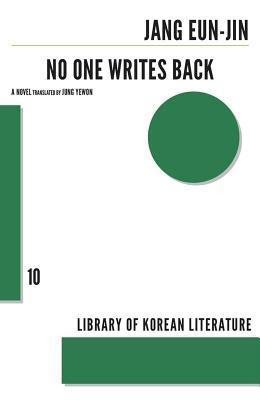
No-One Writes Back


No One Writes Back / Jan Eun-Jin
translated from the Korean by Jung Yewon
Funks Grove, IL: Dalkey Archive Press, 2013, c2009.
203 p.


This isn't an epistolary novel, but it does revolve around letters, both the writing and sending of them, and it also involves travelling. 

I first saw it mentioned by someone during a Women in Translation month. I found it in my library's online collection so decided to read it, and I'm so glad I did. It's a thoughtful and reflective read, with a lot to discover. 

Jihun left his home 3 years prior to the opening of the story; he brought along an MP3 player and his blind dog, Wajo. They've been travelling ever since, and as they go, Jihun lets chance lead him. If on any day he gets into conversation with a stranger, one who is willing to give him their address, he'll mentally assign them a number, and write them a letter. And each day as he leaves the random motel he's chosen for the night, he finds a payphone and calls his friend at home, who has agreed to check in and see if anyone has written back. If just one person writes, he will go home. But the title alerts us: no one writes back. 

We enter Jihun's story near the end of it -- one morning as he heads out with Wajo, a woman selling her book as a street vendor follows him. She sticks to him like a limpet and though mostly unwilling, Jihun ends up with a new travelling companion. She's number 751, and as it turns out, the last number he has to memorize. Her liveliness and engagement with life and the people around them drags him from his remote world of numbers into one of emotion and feeling. When they escape a crisis at a hostel, and then Jihun realizes that Wajo is getting old and sick, he comes to understand that it's time to head home. 

In the final pages of the book, we discover why Jihun left home in the first place, and why no one wrote back. And those final pages turn the whole story on its head and deliver a shock that should affect every reader. It's so powerful, and seems unavoidable once you know the whole story; it makes you go back and reread earlier bits in the light of what you've just read. It's beautiful, and melancholic, and so worth reading. This was an unexpected story, different from what I thought I was getting, and I highly recommend it. 

'Life is bearable when you have someone to write, and someone who writes you back. Even if it's just one person.'

Wednesday, August 16, 2023

White Book by Han Kang


The White Book / Han Kang
translated from the Korean by Deborah Smith
London: Portobello Books, 2018, c2016.
161 p.


I had to get this book via Interlibrary Loan after I saw someone talking about it on their book blog, but I don't remember who mentioned it, I'm sorry! 

In any case, they were correct - this was a beautiful read, poetic and striking. It's made up of short, reflective pieces, quite lyrical, on a range of topics. It explores the colour White, with a list of white things, and well as having this idea shape many of the other sections, as white objects lead to reflections on things in the narrator's past.

The narrator is living in Warsaw on a writer's residency, and wanders the city, thinking of her sister, a baby who had died at birth in tragic circumstances, but whose death made it possible for the narrator to exist. The short chapters build on one another until we have an idea of the full story. 

These reflections are sharp, involving grief over her family history, and death in a broader sense; she visits WWII memorials as she walks the city. The events are softened and blurred, rather like the whiteness of fog, by the introspective meditations of the author. 

The chapters are interspersed with black and white photos in soft focus, often of domestic themes. The first one is of a woman sewing something on her lap. These images evoke the feeling of memoir and veracity of this fictional story. It also feels like the book has shades of Sebbald in the use of photographs, and walking through cities. 

This one has been nominated for and won many prizes, and I can see why. It's a fragmentary, dreamy read that lingers in the mind. The language is poetic and measured, the concepts are deeply resonant and visually rich. Read this if you are looking for a slower paced, meditative journey through personal history, which sheds light on universal concerns. 


Tuesday, August 15, 2023

Violets


Violets / Kyung-Sook Shin
trans. from the Korean by Anton Hur
NY: Feminist Press, 2022, c2001.
218 p.


San is a young woman, 22, estranged from her mother, living in the city and looking for meaning in her life. She's taken a typing course, but can't seem to find the work that she wants with that qualification. One day she sees a Help Wanted sign in the window of a florist shop, and decides to try it out. Luckily she is hired immediately, and begins working in a place that is all hands on, focused on earth and real things. She begins to learn flower names and settles in, despite being introverted and the kind of person who doesn't talk much, going straight home to her apartment each day. 

Her social round is focused on the shop; it's mute owner, the other florist, Su-ae, and varied customers. She has to deal with a businessman who is sexually inappropriate (and he turns up again), and develops a crush - obsession really - with a photographer who shows up one day to take photos of violets for the home magazine he works for. 

This obsession spirals, until San is putting herself in sexually dangerous situations and floundering in her lifestyle, despite having Su-ae (who is much more grounded) staying with her for a while. Her new closeness with the more extroverted Su-ae brings back memories of being rejected by her childhood friend Namae after a burgeoning romantic moment, and the hurt feels fresh again, driving her recklessness. San is full of repression, from her desires, to her voice, and this reflects the misogyny she experiences as a young woman in Korea, especially one who isn't naturally interested in men and their desires. 

It's slightly slow-paced, but with an increasing sense of dread. Many of San's experiences are laden with overpowering and dangerous metaphor as well as reality. The work in the flower shop and at the farm that supplies them gives her sustenance, nature as healer, but even then she focuses not on the gentle and beautiful but an unusual carnivorous plant. This is very much her personality. And the book doesn't give her, or the reader, an easy out. 

I found this a difficult read; there is so much despair in the character and in the story arc. It's very moving, as well as troubling. The writing style is fluid, not reflecting San's isolation or despair structurally, and I found that made it a bit easier to understand the flow of the story, in a really good translation as well.

Monday, August 14, 2023

The Color of the Sky is the Shape of the Heart


The color of the sky is the shape of the heart / Chesil
trans. from the Japanese by Takami Nieda.
NY: Soho Teen, 2022, c2016.
158 p.


Seventeen year old Ginny Park is Zainichi – an ethnic Korean born in Japan. As the book opens, she’s living in the US, attending a high school in misty Oregon. The reader follows along as Ginny outlines her past, and what event at her Korean high school in Japan led to her ending up in the US.  

This is a short book, and is a translation from Japanese; it's apparently semi-autobiographical, which adds to the emotional effect of the storyline. The style is a bit choppy at the beginning but readers who stick with it will be rewarded with a deeply affecting story of a young girl who is fighting against racism, prejudice and injustice. The choppy style may also reflect Ginny's unsettled experience of the events she's relating in these opening pages. 

 Ginny’s story illuminates the little known lives of Korean families who have been in Japan for generations but are still treated as interlopers. From her school uniform of traditional Korean garb (setting her apart visually) to the adoration of North Korea’s leaders by her school administration, Ginny’s narrative explains how these elements affect daily life for Zainichi teenagers.

The writing is confessional, with some letters from family members mixed in. Ginny has a raw and honest voice, not making excuses for herself, but placing her story within the wider context of society’s treatment of her community. But she’s also a teen, and so this is also an emotional story of how she overcomes racism and violence, which included a sexual assault.  But the conclusion is hopeful, even uplifting.

It’s a character-driven, thoughtful book, which strongly evokes Tokyo in the late 90s. It was immensely popular in Japan, and is now available in English translation thanks to Takami Nieda & Soho Teen. 

Sunday, August 21, 2022

The Old Woman with the Knife

The Old Woman With the Knife / Gu Byeong-Mo
trans. from the Korean by Chi-Young Kim
Toronto, Ontario : Hanover Square Press, 2022, c2013.
280 p.


When do you know it's time to retire, if your day job has been working as a stealth assassin for many years? Do you take advantage of your increased invisibility as an aging woman or do you call it quits and relax at home with your dog? 

This is the question that plagues Hornclaw, who worries that she's losing her edge. For example, her reflexes are slightly slower. And there is the fact that she's letting an emotional attachment to a stray dog develop; she's getting soft, even if she does name it Deadweight. But she figures she'll do one or two more jobs then think about a change. Unfortunately, there's a young and cocky new employee at her agency that seems to have it out for her, and she just can't back down. 

The story of these two, and how and why the antipathy between them exists, makes up the book. But we only get it in bits, between a lot of action -- her weak point is a doctor who saved her from an injury once, and this doctor's family gets caught up in the vendetta against her. Will this emotional attachment be the end of Hornclaw's career or will her experience prevail? 

I found this a quick and entertaining read. Despite the characters all being ruthless contract killers, and the inclusion of quite a bit of violence (not too gory), it feels like a lighter read. But aside from the action and dark humour, there is an undercurrent of thoughtfulness. Questions of aging, identity, power, women's roles and what society thinks women owe the world, and human connection all rise up. It's a great combo, and made this a memorable read - I'm still thinking about it and trying to decide what I think of the ending. Hornclaw is a cantankerous old woman and a remorseless killer, but she's still a compelling character that I couldn't help feeling compassion for. 

I'd recommend this to anyone who wants to dip their toes into translated fiction but reads mostly genre; it moves along and has strong plot as well as a couple of strong characters to draw you in, in addition to the intriguing setting. 

Thursday, March 31, 2022

Kim Jiyoung, born 1982


Kim Jiyoung, Born 1982 / Cho Nam-Joo
trans. from the Korean by Jamie Chang
Toronto: Anansi, 2020, c2016.
163 p.


Another book that examines the constraints on a woman's life, and in this case the effects on one particular woman. This Korean novel looks at Kim Jiyoung's life, and reveals her breakdown in the face of extreme societal misogyny. 

She's a thirty something office worker who leaves her job to care for her first child, but begins to exhibit strange symptoms; she is taking on the identities of other women, alive and dead, as she struggles to find a way to live. Her husband, who thinks she should be happy to give up her career and identity in order to stay home and care for him and their child, becomes alarmed and sends her to a psychiatrist - male of course. 

The novel is told is a spare and minimalist voice, that of the psychiatrist giving a report. This distancing from Jiyoung's own voice and own perspective just reinforces the complete societal blindness to the issues Korean women are facing. When as a young woman she was harassed, her father blamed her for being out at night. When coworkers shared pictures online from a hidden camera in the women's washrooms, they were not held responsible, the women just had to accept it. There's a litany of misogyny, from childhood when boys always go first at everything, from school grades to eating, to work where women are not recruited for good positions even if they have earned the highest grades in university, and even if they do find a job they are paid much less than men.

It's the accumulation of these many systematic misogynistic injuries that means "Jiyoung was standing in the middle of a labyrinth. Conscientiously and calmly, she was searching for a way out that didn’t exist to begin with." This is what is fueling her so-called madness, which in a stroke of brilliance is mansplained away by the male psychiatrist in the end. 

The cold and clinical tone, alongside the factoids thrown in, make this novel a bit of a fiction/nonfiction composite. But it really works as a novel, as we follow Jiyoung and become invested in her life and her experiences. I don't think there will be many women readers who can't understand her distress and resonate with her desire to escape this life. I found it really powerful, especially alongside the previous book I just reviewed, Invisible Women. We can't just look away.