Showing posts with label graphic novels. Show all posts

Friday, August 07, 2026

A Brief History of a Long War


A Brief History of a Long War / Mariam Naiem
illus. by Yulia Vus & Ivan Kypibida
trans. from the Ukrainian by Nata Hrytsenko
New York : Ten Speed Graphic, an imprint of the Crown Publishing Group, ©2026
105 p.

This is a short graphic novel that aims to give an overview of how long Ukraine has been resisting Russian aggression, for those who don't know Ukrainian history. Hint: this book starts in the Middle Ages and moves up to 2022 and the start of the most recent Russian attacks on the country. 

Written by an award-winning journalist, scholar and activist, it covers a variety of flashpoints in Ukrainian history. The illustrations are all done in tones of black/grey, white and orange, which reflects the role of the colour orange in freedom movements that the reader will learn about -- it also reflects the nighttime fire and destruction wrought by war.  

For those new to Ukrainian history, this will be a good introduction to the fact that Russia has been oppressing and attacking the country for a very long time. Moving from the middle ages and the rise of the Cossacks, to 19th C. Imperial decrees banning the Ukrainian language in a linguicide, then to the 30s and the Stalin-led Holodomor (death by famine), and continuing into the present invasion, this book will give a sense of Ukraine and all it has stood against for centuries. 

There is a bibliography, noting some of the writing that Naiem consulted for this book, including a couple of very respected Ukrainian historians - and one Ukrainian-Canadian one, too. This provides good resources for readers who are interested enough to read further and find out more about any of the things she shares in this graphic novel. 

I found that the text and imagery in this book worked well together; it was memorable and covered all the information without sounding like a dry list or textbook. There is a focus on the experiences of people during these events and what current wartime is like. Really solid intro, not too overwhelming. 

Sunday, June 09, 2024

Red Harvest

Red Harvest / Michael Cherkas
New York : NBM Graphic Novels, ©2023
145 p.

This graphic novel is a vital introduction to the Holodomor for those who don't know anything about it. It's told by Mykola Kovalenko, an elderly man in Canada, the only known survivor of his family, who is looking at a family photo and finally telling his story to his own children and grandchildren. 

The Holodomor (Death by Hunger) happened in 1932-33 in Ukraine, when Stalin's policies of forced large-scale collectivization of individual farms and farmers across Ukraine led to mass starvation, deportations and murder. It weakened Ukraine, a prosperous and productive farming society, making it impossible to stand against Soviet invasion and land theft. There were millions dead in horrific ways, and is a generational trauma. 

This graphic novel presents the truth of this in a way that makes it comprehensible and not too overwhelming for the reader. There are representatives of each position in this story; a son-in-law who is a Bolshevik idealist despite the realities of what their ideals actually meant, punitive government officials, innocent children (Mykola's siblings, who all die from some element of the situation), rich farmers, traitors, and those who still found kindness within themselves despite conditions. 

It's powerful and disturbing. The artwork is simple, monotone colours and sketchy lines. The author & artist talked about his thought process coming to the decision on how to render the story, and that the stark lines were the most truthful way he could share this book. It does have an impact and I think it reflects the content well, supporting it, and not distracting from the facts. Cherkas is a Canadian of Ukrainian heritage, and has spent his whole life in the graphic design/art/cartoon field, and his skill really made this book something special. 

This is an important book to read if you are wondering about the past relationship between Ukraine and Russia and why Ukraine is so adamant about its sovereignty. It gives some context to a centuries old conflict. But it's not very pleasant reading; history is not always easy. 

If you're interested in learning more, True North Country Comics interviewed Cherkas on their podcast in 2023, and you can listen to it here

Saturday, March 16, 2024

Shubeik Lubeik

Shubeik Lubeik / Deena Mohamed
trans. from the Arabic by the author
New York : Pantheon Books, 2022.
518 p.

What would you wish for, if you knew your wish would come true? This is the question asked by Deena Mohamed in this imaginative graphic novel, set in an alternative Cairo, where wishes are real, regulated, bottled and licensed.

There are three classes of wish: first class, second class and the banned third class wish (due to their malicious unreliability). Wishes can be tricky and deceptive; the wording has to be just right for optimal results.

The story follows three characters as they each decide to use a First Class wish for different reasons, mainly non-material desires, like forgiveness or health. They each struggle with the ethics of wishing, with discussion of the religious or philosophical elements of a wish. How will it be interpreted, and will it actually give them what they need or want? Their stories cover a wide range of human experience, and bring up many aspects of the meaning of life, in a way that is accessible and sometimes humorous as well.

The artwork is a lively mix of colour and black and white, dependent on context. There are some extra nice touches – for example, when a wish bottle is opened, the Wish appears as a bubble of Arabic calligraphy. The translation (done by the author) has also left as much of the original unchanged as possible, with the book reading from right to left, as it does in Arabic.

With the engaging artistic style, and the deep themes that the storyline explores, this might be a great choice for any thoughtful reader interested in family stories, the Egyptian setting, or just the artwork itself. It might also raise philosophical questions about what we want, or need, out of life -- and what the right way is to achieve our desires.

Wednesday, August 23, 2023

Social Fiction: a graphic novel


Social Fiction / Chantal Montellier
trans. from the French by Geoffrey Brock
NY: NYRB, c2023.
191 p.

This was a chance discovery from the new books arriving at my library. It's a collection of 3 graphic novels written by French writer/artist Chantal Montellier: Wonder City, Shelter, and 1996. It also includes an introduction by the translator, and a short interview with Montellier at the end. 

Montellier is a feminist and a woman who made her way in the very male world of French comics in the 70s and 80s. She's tough, and you can tell. All three of the stories here are futuristic and dark, and the drawing style is stark, in black and white, naturalistic. Wonder City has pink accents, which works with the story, but the others are monochromatic. 

I found these stories a little shocking, hard-hitting at times, a bit twisted, in the best ways of course. I think Shelter was the one that was most unsettling to me personally, but each of them has something to say about rich and poor, about totalitarian instincts, about herd mentality, and societal structures. The characters don't necessarily fight fascism or government control, they are mostly subsumed by it. 

I hadn't heard of this author previously, and so found the intro helpful to place her in context, alongside the brief interview at the conclusion. This is an activist who is writing her imagined futures, in a chilling way. I had no expectations at all going in to this, and so was able to experience these all new and fresh to me. Wow, it was a reading experience. Definitely recommended if you'd like to see the visions of a future coming to us from a prescient writer of the 70s and 80s. 


Saturday, March 11, 2023

Five Stalks of Grain


Five Stalks of Grain / Adrian Lysenko;
illus. by Ivanka Theodosia Galadza
Calgary: U of C Press, c2022.
152 p.


This is a hard hitting graphic history -- a story set during the Holodomor in Ukraine. This was an artificial famine, one created by Stalin's policies in the 30s, as part of the ongoing attempts at genocide of the Ukrainian nation. There are in-depth histories of this, one of the best known being Anne Appelbaum's Red Famine, if you want an in-depth study of this horrendous time. However, here we have a personal story being shared, to introduce people to this event in a way that will be striking and unforgettable. 

The illustrations are simple and realistic, all in black and white. We follow Nadia and Taras, two young children who strike out on their own when both of their parents are arrested and killed. They try to walk to somewhere safer where there will be food. They encounter dangerous situations with other starving people, and with soldiers looking for 'enemies of the state'. At one point they are separated, and despite the guilt Nadia tries to keep going. 

This isn't a book about overcoming trauma as much as about explaining and illuminating the trauma. The finale of the book is a scene in contemporary times, in which a couple of Canadian young people are visiting Ukraine, trying to find the home of their relatives lost in the famine. 

It's sad, and stark, but also very necessary to keep these stories alive. The Holodomor was one in a long line of Russian attacks on the existence of Ukraine and Ukrainians, which is still going on. This book gives a glimpse into how it affected one family, in a story that will not be quickly forgotten. 


Monday, March 06, 2023

Enemy Alien: a true story of life behind barbed wire


Enemy Alien / Kassandra Luciuk; illus. by Nicole Marie Burton
TO: Between the Lines, c2020.
140 p.

This is an interesting read -- it is based on the memoir of a Ukrainian man, but the authors note that it's not clear who exactly the author was. They've given the main character the name John Boychuk, partly because he's the most likely candidate for author, and because the name is a kind of "John Smith" name.

In any case, it is based in the first person, contemporary account of the experience of Ukrainians in Canadian internment camps during WWI. There were a number of these camps across Canada, with many new Canadians locked up because they'd come from Galicia, then part of the Austro-Hungarian empire. And in this book, it's also shown that other men, even some Americans, were randomly caught up in the sweep to intern anyone "foreign". The illustrations are straightforward, black and white, and clearly representative of the people and the camps.

For those of us who like to think that Canadians are wonderful, kind, sweet etc., we just need to take a look at our history (both older and recent) to see how that's a false narrative. These camps resulted in the expected behaviour that crops up when some men are put into a position of power over others - lots of sadism, abuse and everyday bullying by guards, including withholding food, or making men undress in the middle of winter and run around on a frozen lake until they agree to camp demands. There were men who died due to untreated illness, or who were shot trying to escape. This book focuses on the camp at Kapuskasing, which was full of only men, but there were also other camps like the one at Spirit Lake which interned whole families. The book also shows that once they left the camp, they were sent to factories and industries far away from their homes, as forced labour -- and the end of the war was not the end of this practice. 

If you didn't know about the internment of Ukrainians during WWI already, this is a good introduction to the topic. There is an introductory essay that is a few pages long, which situates the story and provides historical background to the issue and to the specific source for this story. There is also a page long bibliography at the end if you then want to read more on this subject. I would also recommend Barbara Sapergia's novel Blood & Salt, for a fictional look at Ukrainian internment in Western Canada. 


Saturday, August 17, 2019

Marzi

Marzi: a memoir / Marzena Sowa; illus. Sylvain Savoia
trans. from the French by Anjali B. Singh

NY: Vertigo Comics, 2011, c2008.
240 p.
I picked this one up by chance when it was recommended to me by a coworker. I loved it! I've been reading a string of novels about the USSR and the Soviet lifestyle -- this one carries on from early and mid-Soviet life in Russia to late communism in Poland. 

Marzi is a small girl during this time; born in 1979 she's recalling her childhood in communist Poland as things are starting to crumble and people are getting sick of the constraints and rules and lack of everything they need. 

The book is organized in a series of interconnected short stories, I'd say. They are brief flashes at moments in this child's life, from the mundane to the terrifying, like when her father doesn't come home from work and she's imagining the worst. It's a straightforward narrative, in a confessional tone, nothing overly literary or experimental about it. Even the illustrations are consistent, always in a six block panel per page, with grey, brown, black dominating, with hits of red/orange and brighter colour here and there. It feels like normal life although joy isn't always in evidence, even in the colour scheme. I am quite taken by the way that Marzi is drawn with huge eyes while everyone else is portrayed in a more realistic style. It's a great image for a child who is always watching everything and telling us about it now. 

There are delightful memories; sledding with her father, visiting her grandmother's village, taking a trip to Krakow with her grandmother, playing silly games with the other children in her apartment block -- and darker ones where we are suddenly introduced to the history of Poland's uprising, albeit from a child's viewpoint. 

I found that it worked well. It was engaging, with the narrator acting in a believably child-like way, bringing her naive perspective to all the things around her that she didn't understand. It feels thorough, and it is fascinating to see how her memories and the only lifestyle she knew are portrayed, looking back.

This makes a great final Soviet era read for this month, showing yet another facet of life under Russia's control. Recommended for fans of memoir or graphic novel style stories. 


Saturday, August 10, 2019

The Mental Load

The Mental Load / Emma; 
trans. from the French by Una Dimitrijevic
Seven Stories Press, c2018.
224 p.

I had this book on hold for a while at my library and it just came in this week. I didn't realize that it was originally French & had been translated. Perfect for Women in Translation month -- written and translated by a woman, and all about women's lives in our world. 

It's made up of a series of comics that a writer known only as Emma has been writing and sharing online for a while. The title story, The Mental Load, went viral and catapulted her and feminist thought about women's labour into everyday discussions. You can read the complete title piece, and probably the best known of all her work, over at her own blog. It gives a clear sense of her writing and drawing style, and the pedagogical tone that is consistent throughout the book.

I found that it was also the strongest piece in the book. There are others about topics like universal income, women's sexual health, domestic violence, birthing and motherhood and maternity leave, and a fable about a woman's right to cover up or reveal her body and how that's socially controlled. 

I enjoyed this book, and found lots in it to think about. But it's probably best as an intro to these topics for people who haven't engaged with them a lot, as they're very introductory and top-level. It would be an excellent first-year reader at college, for example. What I think is the strongest element of them is the way that Emma can talk about serious issues facing women today without being confrontational in a way that cuts off discussion; rather, she seems to invite conversation with her work, without watering down her feminist message. 

That's quite a skillful balance and I found this book engaging. You can find more by and about her at her blog, also simply called Emma. 


Friday, August 17, 2018

Exquisite Corpse

Exquisite Corpse / Pénélope Bagieu; translated from the French by Alexis Siegel
New York : First Second, 2015.
124 p.

I enjoyed Brazen, Penelope Bagieu's graphic novel biography collection, so much that I quickly picked up another of her books from my library as well. 

It's the story of Zoe, unhappy in her life as a product model, enduring sexism on the job and a disgustingly sexist, boorish boyfriend. While wandering around Paris she encounters a reclusive author when she spies him in his window and asks to use his bathroom. Her youthful and uneducated mien inspire him, and when she throws off her job and boyfriend, she goes back & is taken in by Thomas Rocher, a best-selling and famous author she does not recognize at all - one of her charms for him. 

However, she is quickly bored and annoyed when he will never leave the house for any reason, and then his ex-wife Agathe, also his editor, starts hanging around once more, now that he has a new novel on the go, thanks to Zoe's inspiration.

Zoe begins to read, and to read, and to read. She educates herself and slowly she and Agathe come to a detente, mostly over their shared annoyance with Thomas. Then Zoe discovers the big secret -- Thomas Rocher "died" a few years ago, and the posthumous novels that his editor brings out are bigger hits than ever thanks to that. 

What to do? Especially since Thomas is starting to ignore her and treat her poorly... Zoe must make a choice, and with some surprise support from Agathe she makes her move.

But you'll have to read it yourself for the twist, and the way in which Zoe decides to reclaim a life for herself. The writing in this brief story is wry and amusing, and the characterizations are not complex but they are fun. Bagieu plays with literary cliches and truisms, and has fun with it. I enjoyed the surprise ending - well, it was a surprise to me - and laughed a lot at the skewering of literary pretensions and the interplay of the characters. I also enjoyed the style of the art; it is bright and expressive and fits the storyline well. 

If you are in need of a fun, light read, which is both very French and very much set in literary circles, this one is a great choice. 


Saturday, August 04, 2018

Brazen by Penelope Bagieu

Brazen: Rebel Ladies Who Rocked the World / Pénélope Bagieu; translated from the French by Montana Kane
New York : First Second, 2018.
291 p.

What better book to start off a month of reading women than this compilation of biographies of notable women by Pénélope Bagieu?

I loved this quirky selection of lives, shared in an entertaining voice with snarky asides and wonderful art. The commentary by the characters while the "official" biography is being told is a great touch -- really fun to read.

The collection of women that she chooses to highlight include a few who are well known - Josephine Baker (though I didn't know until now that she'd adopted a bunch of orphans), Peggy Guggenheim, or Hedy Lamarr, for example. But she also includes some unusual choices - Margaret Hamilton, the actor best known for her role as The Wicked Witch of the West, Tove Jansson the Finnish creator of the Moomins, or Mae Jemison, astronaut extraordinaire (the only woman to have actually been in space AND guest starred on Star Trek!). There are many other unknown women here; my favourite discovery was Frenchwoman Clémentine Delait, the bearded lady -  her story of making the most of herself was charming and wonderful.

I loved the different selection of women from a French perspective - there was variety between well known and lesser known names, great diversity of kinds of lives, eras, and accomplishments, and a clear fondness for all of them on the part of the author.

There's also a list of women at the back who she couldn't fit in - this time. This gives me hope that there will be a second volume - I would snap it up.

If you can find yourself a copy, grab it and dig it. Pure joy to read this one. 


Saturday, June 10, 2017

Two Indigenous stories with art

Finishing off my week of reading graphic novels, I picked up two titles which have been getting a lot of attention (and prizes) lately. Both are on my library shelves, but I hadn't got to them yet.

First I picked up The Secret Path, by Gord Downie and Jeff Lemire. This is the story of Chanie Wenjack, a young boy who tried to walk home from the residential school he was sent to in 1966 - though his home was 400 miles away. Sadly he didn't make it. 

This is now a well-known story, and Downie's dedication to sharing this story and giving all the proceeds to The Gord Downie Secret Path Fund for Truth and Reconciliation via The National Centre for Truth and Reconciliation at The University of Manitoba is admirable. You can learn more about how and why it was written, and hear the music and watch the animated CBC version over at the Secret Path website.

The book itself is oversize, quite large and unwieldy. It's laid out with one poem/song on a page and then illustrations to follow, with no words or dialogue. Chanie's experience is all drawn in blue/grey/white and his memories are in colour. Despite the importance of the story and the good intent behind it I didn't love this book. I think it works better in its online format, with music, as an animated short etc. rather than an oversized softcover.


Then, I read Patti Laboucane-Benson's The Outside Circle. This is based in her work with the Warrior
program focused on healing and reconciliation of gang-affiliated or incarcerated Aboriginal men. 

In this story, two brothers struggle against a life shaped by crime and addiction. The eldest, Pete, joins a gang and eventually goes to prison. The youngest is left to manage on his own, until finally they reunite and find a long lost uncle who was separated from his siblings (their mother) as a child in residential school. 

Much of the book is about Pete's journey to self-awareness and a knowledge of his identity as an Indigenous man. The book lays out history and reasons for the social conditions they face in this story, and a move toward a more stable future as someone with a strong and respected cultural identity.

I found it very interesting, and a really good blend of text and illustration. It held a sense of hope and meaning that really touched me. There are links and information about the services that the author has been involved in at the end, as well, for anyone who wants to learn more. 

Thursday, June 08, 2017

Two by Two Tamakis

Two more graphic novels to add to my recent reading streak: I was told I must read some Mariko Tamaki. So I checked my library and behold, two titles by cousins Mariko and Jillian Tamaki. 

This One Summer / Mariko Tamaki & Jillian Tamaki
Toronto: Groundwood, c2014.
319 p.
First I read this longer book. And really liked it. Rose and Windy are summer friends whose families have been vacationing at Awago Beach for years. This year, Rose, who is older, is starting to notice boys. She and Windy observe the development of a local crisis as the weeks go by, while Rose also tries to manage her parents who are arguing and distant. 

Both of these storylines meld, coming to a head in one incident at the shore. It's a simple book, with sketched blue & white illustrations, but with so much feeling in it. The drowsiness and pace of a summer at the lake is clearly evoked, as are all the relationships that drive the story. Rose and Windy's friendship is realistic and engaging; the story that emerges to explain Rose's mother's depression and anger makes so much sense. And the local drama between teen lovers is both everyday and intense. These young girls are realizing that everyone around them has a secret, and in their own friendship there are things they don't tell others about, nothing scandalous, just their own.

I thought it was lovely, intriguing, and evocative. I really enjoyed this book. If you want to feel like you've had a trip to the lake this summer, read this book.


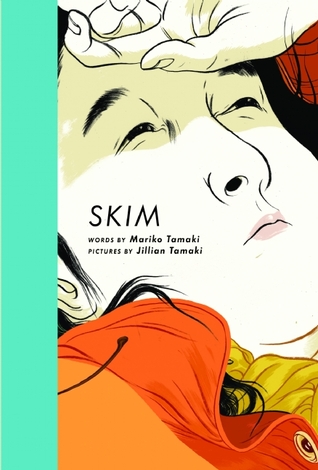
Skim / Mariko Tamaki & Jillian Tamaki
Toronto: Groundwood, c2008.
143 p.

This much briefer book is for a slightly older crowd. In it, Skim is a teen goth at a fancy private girl's school. When one of the cool girls, Katie, is dumped by her boyfriend - who then goes on to kill himself - it upends the school. A clique of cool girls starts a club, Girls Celebrate Life!, which strangely enough Katie doesn't feel like joining when she finally returns to school with unresolved anger and two broken arms. Skim, generally a bit of an outsider as a wannabe Wiccan Goth, befriends her, understanding her emotional upheaval.

Skim herself is going through quite a bit of emotional stress. She's fallen in love, with someone she really shouldn't have, and any relationship will be doomed from the start. This book is darker and more steeped in the angst and heartbreak of being young and questioning everything, including your own sexuality, identity, and reason for living. It wasn't all gloom, even if the subject matter was very serious - there was a touch of lightness and a sympathy with the reader inherent in it. Although the subject was darker than the first book I read by the Tamakis, the illustrations were brighter, more intense. I did feel, though, that the ending was inconclusive and a bit unsatisfying for me. 

It was well done and absorbing, but in the end I think I preferred This One Summer just a bit more. Still, both are really worth exploring.


Sunday, June 04, 2017

Seconds & Snotgirl

Seconds / Bryan Lee O'Malley
Toronto: Random House Canada, c2014.
322 p.

This is a graphic novel that was on the 2016 Ontario Library Association's Evergreen Award list, and I read it then but never reviewed it. I've just picked it up again for a reread and realized what a great story it is.

I really enjoyed the philosophical underpinning of this tale -- the idea that our life is what it is and do-overs aren't really that helpful -- and enjoyed the fun illustration style as well. 

Katie is head chef at Seconds, a fashionable restaurant. But that's not enough, she wants to start her own restaurant where she'll be owner as well. While she waits, she lives in the tiny apartment upstairs. But Seconds is an old building, and there is a house spirit living there. Lis appears when something goes terribly wrong, and a server is burned. She gives Katie a magic mushroom that will give her a chance at a do-over - in the morning, none of the disaster had happened. 

But Katie gets greedy, wanting her new restaurant to be ready sooner, wanting to get her ex back, wanting, wanting, wanting. And when she finds more mushrooms in the cellar, there's nothing to stop her from eating them and shifting reality every night.

But changing history is not so easy or so result-free. Katie gets more and more tangled in alternative timelines and spirits, until things are a confusing mess. Only when she accepts that her original life is good enough and should be lived as is, do things fix themselves. 

This was a clever, funny, visually interesting and magical story that read quickly. It was entertaining and thought-provoking and just as good on the second read. 


Snotgirl v.1: Green Hair Don't Care / Bryan Lee O'Malley & Leslie Hung
Portland, OR: ImageComics, c2017.
unpaged.

Snotgirl just arrived in my library, and was the incentive for me to pick up Seconds again. Snotgirl is quite different, though with some similiarites, both in drawing style and in the main character as a messed up 20 something with an ex, who gets involved with something perhaps supernatural, and definitely beyond her ken. 

Lottie Person is a fashion blogger, living the glamorous life... until you get to see her off screen. She refers to others, especially other fashion bloggers, by cutesy nicknames, since that's the only way she can remember anyone. Have I mentioned that Lottie is just a little self-absorbed? Her friends are Cutegirl, Normgirl, etc etc. Then she meets Coolgirl, a truly glamorous It Girl who seems interested in her as an inspiration and mentor. But Lottie's allergies and her emotional swings lead to Coolgirl giving her a nickname: Snotgirl. 

With an ex and his new girlfriend in the picture, and an incident with frenemy Coolgirl that Lottie can't quite recall the facts of, she is a mess. When Normgirl has a fancy engagement party, and they all end up in the same place, disaster strikes -- and the volume ends! Can't wait to get my hands on Vol. 2. This volume includes comic books 1-5, as it originated as a monthly comic book series.

This was a lot of fun, with some more touching bits thrown in about Lottie's questions about real life vs. blog life, and the quest for authenticity.

I enjoyed the style of it and thought it captured the modern existence of the lifestyle blogger effectively -- and humorously too. Lottie is a good balance of popular and messed up, not too much of either, and the story has legs. While I don't usually read a lot of graphic novels, I've had fun with both of these this week.


Tuesday, April 11, 2017

Tangles: a Story about Alzheimer's, my Mother and Me

Tangles: a Story about Alzheimer's, my Mother and Me / Sarah Leavitt
Peterborough, ON: Broadview Press, c2010.
132 p.

When the author's lively, clever mother starting showing signs of forgetfulness, her family thought it was probably just stress or overwork or something like that; sadly, it was the beginnings of a diagnosis of early onset Alzheimer's.

This fearful situation is honestly and lovingly described in Sarah Leavitt's words and pictures. The art is very basic -- line drawings, sketches -- but it captures the charming silliness and connection of this family. Somehow the very simple drawing allows for the story to emerge more strongly. 

Sarah lives far away from her family's home, so is only there part of the time, while her father and sister are more full on caretakers. This means that she sees the changes more startlingly when she does get home. Her mother Midge was an active educator, involved in curriculum design and innovations, and cared deeply about social issues. She changes dramatically, as anyone familiar with the effects of Alzheimer's will recognize -- not only memory but personality changes are she becomes fearful and distrustful. The change is clearly shown, with sorrow and love, and yes, some rage as well. 

Sarah's partner Donimo comes home with her as well, and that relationship is examined here too. They both care for Midge, in one particularly difficult scene, Sarah worries that because she is a lesbian people might think that her physical care she provides for her mother is not 'right' somehow. It's sad that this was a valid worry for her amongst all the others they were facing.

The emotional effect of this story is powerful, and makes it well worth reading for the narrative alone. Leavitt gives a sense of the results of a diagnosis like this on a whole family, not only the one suffering from Alzheimer's. It's hard to read, and terrifying, and very sad. But it's also beautiful. 


Monday, November 28, 2016

Two By Atwood

Hag-Seed / Margaret Atwood
Toronto: Knopf, c2016.
320 p.

Atwood's latest in an entry in the Hogarth Shakespeare series, of retellings or reinventions of Shakespeare's plays. Hag-Seed takes on The Tempest, and it does a better job of it than some other Tempest inspired reads I've encountered in the past.

In her take, Prospero becomes Felix Phillips, once the artistic director of the prestigious Makeshiweg Festival, before he was ousted by his scheming assistant, Tony. There are many parallels to Stratford here, and I'm not sure how comfortable the Stratford Festival would be with this -- though they did have her speak here in October -- strangely unadvertised though... 

But seriously. Felix is a sympathetic character so all his bluster and his revenge plot never tip you over into outright dislike. After being manoeuvred out of his directorial role, he retreats to lick his wounds. He finds a shack off the grid and holes up there for a decade, with only his dead daughter as company. Miranda died as a toddler, and in his guilt over paying more attention to his job than her, he thinks of her as always accompanying him, growing up to the age she would have been, there in spirit. And as his isolation grows, so does her reality to him. 

But eventually, he must move in the world again, and he sees an opportunity to take a small, part-time, low paid job as a literature teacher for male inmates at a local prison, the Fletcher Correctional Institute. The woman organizing the position recognizes him, but agrees to keep his secret as he is willing to teach Shakespeare without any conditions of the job changing -- ie: a great bargain for her. 

It's when Felix is interacting with the inmates that the depth of the story shows. They talk about the plays they are studying and eventually performing, they deconstruct the text and relate it to modern day life, and to the troubled facts of their own lives as well. The power of this process shows in the inmates over time; literature is indeed a healing tonic. 

While reading these parts of the book, the text started to feel quite familiar to me. Why? I realized as I went along, and especially when I got to the acknowledgements at the end of the book, that these scenes were strongly influenced by Laura Bateman's Shakespeare Saved My Life, a book about Shakespeare in prisons which I read some years ago but is very memorable. I hope it makes more people search it out and read it -- it's very inspiring.

Anyhow, Atwood follows the Tempest plot fairly closely, and has interspersed bits of rap performances by the inmates (reminding me of the Chorus in her Penelopiad). She uses her setting well, and Felix has the chance, finally, to stage The Tempest and by doing so wreak revenge on those who originally ousted him. Of course, everything ties up very neatly in Felix's favour, but after all, he is Prospero. There is plenty of Atwoodian wryness and ridiculous humour that keeps our characters from taking themselves too seriously. The final scenes are really over-the-top but in the end, it does all work. And I thought this version really made sense in the setting she's created. 

It was a good read, which highlights an important cause (literature in prisons) that I've been following for a while now. Recommended. 


Angel Catbird / Margaret Atwood; illus. Johnnie Christmas
Toronto: Dark Horse, c2016
80 p.

Now, unfortunately, no matter how much I like Atwood's writing or how much I support her work for birds and cats and so forth, I just did not gel with this book.

It was a mix of light entertainment, retro visual style, and earnestness.

The bump-out facts and figures about cat populations and so on at the bottom of some pages felt very "teachy" and the story was so tenuously held together. I'd call this one an old-fashioned comic book, not a graphic novel per se. 

The characters have silly names (ie: our hero Strig Feleedus) or ones that are painful puns; the story is pretty basic, there's a very villainous villain and a pretty girl who saves the day, and well, I just didn't love it. It's just kind of meh.

I prefer Atwood when she sticks to the writing she does well, like Hag-Seed & other novels. If you're in the right mood for a light and campy story, though, you might still enjoy this one.


Monday, September 12, 2016

Teva Harrison's In-Between Days

In-Between Days / Teva Harrison
Toronto: Anansi, c2015.
168 p.

This book is like nothing I've read before. It's a memoir by Teva Harrison, diagnosed with metastatic breast cancer at age 37. It's in graphic novel format. And she tells her story in a raw, honest way that also reaffirms the glory of life. It's hard to capture the exact tone she uses but it is powerful, moving, and yes, heart-breaking.

She uses her distinctive black&white style to express the emotional aspect of her diagnosis, and the way it came up against the normal expectations of life: her assumptions that she'd be living into old age alongside her husband, the possibility of children, all of that. All the taken for granted kind of thoughts for the future. And she shows how even with the fear and illness that comes with treatment, life is still precious. 

She also doesn't hide any of the realities of treatment -- how she can look fine but not feel it, how her friends have to learn not to expect her at events even if she's said she'll attend, the lonely hours facing her physical limitations, and the sorrow of her family. But she does it in a way that welcomes the reader in, that allows us to more deeply understand what those we love who are undergoing such a passage might be feeling, might be needing from us. 

She also includes memories and stories from life pre-diagnosis - stories that are charming, hilarious, and simply compelling. It's a reminder that cancer is not her entire identity.

She has an unsentimental voice and a beautiful, generous eye, and together these gifts create an unforgettable book. While I wholeheartedly wish she had never had reason to write such a book, she has looked at her life unflinchingly and created a stunning book that should be shared widely. 

(you can also read her thoughtful words at her blog)


Thursday, August 04, 2016

A Girl, Dior, and a Fox

For this August's Women in Translation month celebration, I realized that it was hard to find women's writing in translation, in the graphic novel format. In fact, I could only think of two that I've read in recent history. And I haven't talked about either yet -- now is the perfect chance!

So here are two graphic novels, both translated from French -- one France-French, one Canadian. They're quite different, but have an affinity nonetheless, in that they are aimed at younger audiences and have young women in the lead roles.


Girl in Dior / Annie Goetzinger; translated from the French by Joe Johnson.
New York: NBM Publishing, c2015.
109 p.

This one is by a well-known French artist. And the illustrations are simply beautiful. The dreamy Dior dresses are drawn beautifully; the elegance and flow comes right off the page. I'd borrow this from the library again, just to look at the illustrations. It's too bad the text didn't live up to them.

The story is almost a docudrama, using a character named Clara Nohant, a journalist who is swept up to become a Dior model after covering a show, to describe Dior's rise and influence. It's unfortunate that she's imaginary. And that the story is a bit unlikely and fairy tale-ish. (The tone reminds me of a vintage romance novel I read recently, Mary Burchell's Paris & My Love about a young girl who gets hired on at a Dior-like fashion house in Paris - though even she didn't think she could be a model...) Anyhow, the story is a bit stilted and flat, but, the book is a beautiful object. So, worth exploring for fashion fanatics like myself.


Jane, the Fox, and Me / Fanny Britt, ill. Isabelle Arsenault; translated from the French by Christelle Morelli & Susan Ouriou.
Toronto: Groundwood, c2013.
101 p.

The second title is quite different. It features Helene, an 11 yr old who is bullied by her classmates for being overweight & anything else they can think of. She takes refuge in reading Jane Eyre repeatedly. If you love Jane Eyre, you will probably want to read this as well.

Helene comes face to face with a fox near the end, at a time when she really needs it. And as she says, everyone needs a strategy, even Jane Eyre. The illustrations are clever; they differ in colour reflecting Helene's everyday life, her Jane Eyre life, or her imaginative life otherwise. And they are lovely to examine closely. The only quibble I have is that the story sort of peters out without a strong moment of resolution.

But it's thoughtful, and beautiful, and really a wonderful book. I think it could bear rereading, a few times. The emotional intensity of childhood & adolescence comes through here, with the cruelty of children in full view. Helene is a character as strong as Jane Eyre in her resolution to prevail. I enjoyed this read, and do recommend it.