Showing posts with label short stories. Show all posts

Saturday, August 22, 2026

The Woman Dies

The Woman Dies / Aoka Matsuda
trans. from the Japanese by Polly Barton
NY: Europa, 2025, c2016.
160 p.

This was an entertaining read, a collection of 52 short stories (some only a few sentences long, flash fiction, really) all looking at the pervasive presence of sexism in Japanese society. Matsuda is not holding back, and tells her tales with both sharp edges and black humour.  I really enjoyed this book, there were such clever structural elements to admire, and the stories were a bit off kilter, requiring the reader to stop short and sometimes read over a story again to get the commentary clear. I love a read that both amuses and makes you think about your perceptions. 

I also enjoyed Matsuda's earlier collection of stories inspired by Japanese folklore, which I read in 2021 -- Where the Wild Ladies Are. That's a bit more traditional in format but has the same edge. I really recommend her books if you like a feminist sensibility that is both highly intelligent and sarcastic. 

This collection has a couple of longer pieces but mostly there are brief reflections and observations. The title refers to a piece remarking on the normalization of violence against women in film, which is something still seen in many films. The joy in this book was the structure and writing, for me, which added to the sense of social critique and skewed perspective. I thought the style and the content worked together to create a strong thematic line. Really liked this one, and raced through it, although I will probably go back and sit with some of the stories a bit longer to really reflect on them. After all, there are 52 pieces, one a week would be a good start to any intellectual week! 


Wednesday, August 19, 2026

Letters From Klara


Letters from Klara / Tove Jansson
trans. from the Swedish by Thomas Teal
read by Indira Varma
Copenhagen: Saga Egmont, 2024, c1991.

I like Tove Jansson's writing, and found this collection of short stories that I hadn't yet read; I'm glad I picked it up because I really enjoyed it. It contains 13 stories, and they are reflective of Jansson's concerns and style. 

The stories tackle the awkwardness of relationships and of existing in the world - something I feel like she's particularly good at. I think it's her clear unsentimental look at people's weakness, foibles, and inner lives that I always appreciate. She can be sardonic and hard in some ways, but also has an eye for the wry humour of life, and never mocks her characters. 

I thought all these stories were strong, with characters to draw you in, even though there was no strong thematic line to the collection. The settings are mainly in Finland but there a few which range across Europe, depending on the story. There are artists, mothers and daughters, old women who are still insisting on being a person, young men with existential crises, old schoolmates reuniting (with resulting cringe), and more. Each story was compelling but there were a couple that really stood out to me. 

The title story was fun, although light - if you've read Virginia Evan's hit The Correspondent you'll appreciate this little story alongside that one. "Party Games" follows a group of women who reunite when one of them finds out that their girls school is closing - it's a handful of their classmates having tea at one person's apartment and it is as awkward as you might imagine, with, as Jansson puts it, "do you remembers" taking over a lot of the conversation. But their girlhood likes and dislikes also reappear. So understandable! "Trip to the Riviera" follows a cantankerous older woman and her daughter, who've gone on vacation to a cheap pension on the Riviera, where they are definitely fish out of water, but the older woman is determined to be herself. 

"Emmelina" was the one that I was most drawn into. In this one, a strange young woman inherits a flat from a woman who has just died. The man living below her is having a crisis and befriends Emmelina, although she seems to be there just as a receptacle for all his angst. But when he finally decides to move on from his depression and face life again, Emmelina leaves, telling him she won't be back for a long time. She's uncanny and this story was a delight, with the side characters being some of the best parts. 

There are never heavy plots to these stories, they are more about people just living a bit, vignette style. I enjoy this a lot, and this collection delivered. If you like more contemplative stories looking at a slice of life, often without any real conclusions to be drawn, you'll like this too. 


Friday, August 29, 2025

The Way Things Were


The Way Things Were / Marko Vovchok
trans. from the Ukrainian by Maria K
TSK Group, 2018.
read by Susan Greenaway


When I saw this audiobook of Marko Vovchok's stories, I wanted to listen -- Vovchok (Maria Alexandrona Vilinskaya-Markevich) wrote many ethnographic stories starting in the 1850s, continuing for many years to write and then to translate a variety of languages into Ukrainian and Russian. Her short stories shared here show the lives of serfs, particularly those of women. They reveal the terrible structure of serfdom; people belonged to an estate, essentially, and had no freedom of movement, autonomy or rights. In one story, a girl is married to another serf by the owner's whim; in another, a young woman is given as a present to a visiting relative, and is taken away from her family without any say in it. These do reveal the day to day, of hard work, and the quality of life for these serfs fully dependent on the character of the land owner -- many of them spiteful and cruel. 

I found some of these stories very good, realistic and full of daily detail along with the emotional reactions of the characters. This servitude was a heavy burden to bear. A few of them were a bit too melodramatic for me, however, particularly "Nine Brothers & their sister Galya"; it was so ridiculous. 

But there were some important themes, and a couple of the stories really stood out to me with their strong characters and social commentary. So I'm glad I encountered them. 

However. I had difficulty finishing this collection, and that was entirely due to the odd choices in the translation, and the reader. Both felt amateur, almost at a Librivox level.  The translation uses modern phrasing and terms, maybe to bring the stories to a more relatable level, but it was a bit jarring that she always uses "kids" instead of "children", and "my dear" as a translation of any honorary address or diminuitive. It wasn't terrible, but it also wasn't really good. 

The reader was the biggest stumbling block for me. She has a British accent that was distracting, and her reading was stilted. There were pauses where it was clear a page was being turned in the middle of a sentence, or maybe she had lost her place for a second. The way the dialogue was presented was often wooden, and many, many words were mispronounced -- it took me quite a while to realize that when she was saying "Napier" she meant "Dnieper", for example. I was highly motivated to listen to these stories, so I persevered. But I can't really recommend this particular edition of Vovchok, because of the clunky translation and narration.   


If you're interested in checking out some stories by Marko Vovchok for yourself, you can find a collection of her folk tales online here from a 1983 translation made in Western Canada by N. Pedan-Popil. That's what I am going to read next! 

Sunday, December 15, 2024

The Days of Miracle and Wonder

The Days of Miracle and Wonder / Irene Zabytko
Wheat Street Productions, c2020.
143 p.

I was pleased to recently find this book in my library's ebook collection. Zabytko is an American writer of Ukrainian descent, and this is a collection of stories, many of which are set in Ukraine or deal with Ukrainian characters. I really enjoyed it. 

I read one of her first novels years ago, and didn't really warm to it, but this collection shows the development of her writing, at least I think so. I found the variety in theme interesting, and there were some great settings and characters who came to life in just a few pages. There are 9 stories, most dealing with post-Soviet Ukraine, so not cheery tales overall (although one about a cowboy was quite funny!). But many of them reflect the bitterness of political upheaval, as seen in individual lives. There are a range of characters, from an embittered cosmonaut, an Elvis impersonator, or a former swimmer, to the trick rider already mentioned, and even the Devil himself. Most are realistic or slightly hyperbolic stories, often told by a narrator who is an observer, just outside of the main action. And this technique feels immediate, like someone is talking right to you, telling you stories about things that really happened - or that they want you to believe really happened! I liked this style. 

The one story that stands out as a bit different is The Midwife's Tale, an historical piece about a Slavic midwife who ends up helping Mary deliver Jesus. I thought this was well-paced, engaging, a wonderfully creative re-imagining of the Christmas story, and of course very seasonal, which was a pleasant surprise to find here! I believe this story has also been published as a standalone, which would be great to reread around the holidays each year. 

I thought this was an excellent collection and I would definitely reread it. Such a great find. 

Saturday, December 14, 2024

Jamaica Ginger & Other Concoctions


Jamaica Ginger & Other Concoctions / Nalo Hopkinson
San Francisco: Tachyon, c2024.
224 p.

Another short story collection, but this time it's modern and speculative! I enjoy Nalo Hopkinson's books, and was pleased to see this new collection appear in my library. Hopkinson has a unique magic in her work, her imagination and clarity make something special out of her short stories. (and her novels, which I've also loved). 

This book pulls together stories from across her career, with a couple that have appeared elsewhere, and some that are hard to find, being special occasion publications. And before each one, there is an author's preface, where she talks about the story, maybe how it came to be or why she wrote it, and a little assessment. This is really neat, and I enjoyed these prefaces almost as much as the stories. While you don't need these to understand the stories, they do add an extra level to the reading. 

This is a mix of very short stories (one is only 2 pages) to much longer ones, notably "Broad Dutty Water". I really enjoyed that one! I did find that I enjoyed the whole collection, each story had something new to investigate. Hopkinson uses Caribbean vernacular in many of the stories, and makes it easy to understand, while grounding her fiction in place. Many of them also investigate climate change and the effects of rising ocean levels on island communities, as well as directly addressing racism in a variety of forms. There is anger and pointed commentary alongside humour and some engaging characters. The intriguing title story is co-written with Nisi Shawl, which is an interesting idea, giving something extra to the book - including the intro about the co-writing experience. 

Hopkinson is great with short stories, and this felt a little like a conversation with her about some of her work, thanks to those author intros to each one. A really good collection, and a good introduction to her work if you haven't tried it before. 


Friday, December 13, 2024

Bliss by Mansfield


Bliss & Other Stories / Katherine Mansfield
read by Juliet Stevenson
Naxos, 2008, c1920

I haven't been a huge audiobook fan in the past, but have started listening to books while doing other things like sewing & crafting. I've found a few great ones, with readers I really enjoy. And Juliet Stevenson is one of those narrators -- she is fantastic and I'll listen to anything she reads. Luckily for me, she read some Katherine Mansfield, an author I really enjoy!

This edition of Bliss includes 6 stories: 
  • Bliss
  • Mr. Reginald Peacock's Day
  • Pictures
  • The Little Governess
  • Feuille D'album
  • The Dill Pickle 
The stories are read very well - Stevenson puts so much character into her reading. And since it's Naxos, there is also music added. Just a bit, to separate out the stories. I think this works nicely in a short story collection. It gives you a good sense of the beginning and ending of a story. And the musical choices seem to fit the feel and era of these stories as well. 

I enjoyed each story - Mansfield has a great eye for pathos and relationships. In so many of the stories, we see characters who are great at self-deception, or at keeping secrets from others. The first two in particular focus in on marriage & changing experiences, with the others looking at unexpected encounters or reunions. These are set in England and across Europe, and evoke a sense of the era (20s) in which they were written - especially the social expectations on women and the difficulties of living fully.  

I would listen to this collection again, it was so good. The stories are not always happy, but not fully tragic either  - except maybe The Little Governess, which I always find devastating. Definitely recommend this listening experience. You can listen to samples of this recording by checking out the listing on Naxos as well, if you want to get a taste. 

Monday, August 12, 2024

The Sea Cloak

The Sea Cloak / Nayrouz Qarmout
trans. from the Arabic by Perween Richards & Charis Bredin
Manchester: Comma Press, 2019.
106 p.

This collection of 11 short stories by Gazan journalist and women's rights campaigner Nayrouz Qarmout is beautifully written, while also hard-hitting.

The stories are all layered and poetic, with sensuous writing describing the realities of life in Gaza, prior to the current conflict. The collection focuses on women, sharing many perspectives of both young and old characters. It looks at patriarchy, colonialism, violence, religion, and women's rights, and how they all intersect.

Qarmout is able to build a life into just a few pages in these very short stories. The title story is one of the longest, and it is the gentlest one; in it a young girl wishes to wear the Sea Cloak, to simply sink into the sea away from her family and responsibilities. Others are more stylistically unusual; Black Grapes starts with the final moment and moves backwards to reveal the truth behind a political murder of a young man. The Anklet of Maioumas is another unusual story, shifting its setting between ancient Palestine and today, with a young woman dancing on a beach - it's hard to tell from moment to moment which girl and which year it is.

The brevity of the stories are their strength. Each gives a glimpse of a life, like snapshots, and many times they are told from multiple perspectives. In such tiny stories, it is striking that the structural decisions Qarmout makes support the story she's telling. I would say that this book will appeal to anyone who enjoys literary writing, and appreciates a poetic eye that can describe and evoke reverie, beauty, and violence at the same time. She writes with such compassion for the women in her stories, and can also point out how hypocrisy, patriarchal violence and war affects an entire region. It's writing that looks to the interior life of characters, but in a way that illuminates wider society and all its ills. Really powerful and evocative reading. 


Monday, July 22, 2024

Mr. Wrong

Mr. Wrong / Elizabeth Jane Howard
London: Pan, 1993, c1975.
223 p.

This collection of nine short stories was not what I expected. The title story leads the collection, and it is much darker than I had anticipated. I wish I would have known that it was a horror story before I began - it was very unsettling indeed!  In fact it coloured the rest of the book for me, even though the rest of the stories are not really horror. I didn't actually like this story very much; sometimes I can admire even if it's not for me, but this one left a bad taste. 

There are other stories here that are looking at dysfunctional or unhappy families - Whip Hand or Pont au Gard are examples, showing difficult mother-daughter dynamics or couples confessing affairs. But there are a couple of others that are more charming, even if a bit edgy, like Toutes Directions. 

Overall the stories are well crafted, with a real focus on character. The settings do evoke an England of a certain time and focus; this was published in 1975, and I find many books by English women from this time period to have this kind of female struggle as a key element. It's a bit dark though, and I'm not sure I'd look for any of her work again if this had been my first read by her. If you like horror tales or an atmosphere of angst in your short stories, you may like this collection. 

Tuesday, June 25, 2024

Roman Fever, and other stories

Roman Fever & Other Stories / Edith Wharton
Collier Books, 1993, c1934.
304 p.

I enjoyed slowly reading through this collection of some of Wharton's best short stories -- well, 8 of them anyhow! I picked it up because I wanted to read Xingu, a story of snobby book club ladies of the 1910s who are bamboozled by one of their members. So funny! It really delivered. 

And then I just kept reading the other stories, bit by bit. The contents are: 

Roman fever (1934)
Xingu (1911)
The other two (1904)
Souls belated (1899)
The angel at the grave (1901)
The last asset (1904)
After Holbein (1928)
Autres temps (1911)

This gives a range of her writing both in theme and in date, with the stories ranging from 1899 to 1934. The title story is a masterpiece, so good and so unexpected. Each of the stories is memorable, but I especially liked The Angel at the Grave and After Holbein as well. Wharton writes without flowery flourishes, for the most part, but she is so good at description. The places and situations she evokes are clear. 

As with most of her novels, she is looking at the wealthy classes in her stories and skewering pretensions, although not in a mean spirited way. In fact there is quite a bit of compassion in some of these stories, you feel for the poor deluded souls who seem to be out of step with their times. 

She touches on divorce, relationships, mother/daughter issues, and the change between generations. The older characters can't seem to understand the freedom of the younger ones, as so many of the societal 'rules' they carefully learned have now gone by the wayside. Those changes are elements of many of these stories. 

Well worth exploring, and best I think to take some time to think about each one before starting the next or they might blend together a bit. Great collection, of just a handful of her many, many stories. 


Friday, March 15, 2024

Night Side of the River

Night Side of the River / Jeanette Winterson
NY: Atlantic Monthly Press, c2023.
320 p.


This was an interesting concept for a book -- ghost stories by literary writer Jeanette Winterson, followed by a true story of her own experience with the unknown world after each section. I found one of the true stories more haunting than anything else in the book! 

The stories are varied, with many of them exploring technology and how it interacts with life, death and grief. From immersive ghost tours to a virtual world in which a woman visits the new and improved version of her dead husband, there are elements of tech shaping the experience of loss and the afterworld. But there are also a few more traditional stories, like that of a couple who come across a haunting on their wedding weekend at an old estate, or the creepiest one for me, the title story. In it, a woman ends up on a boat in the Thames, heading toward the Night Side of the river. That felt Ray Bradbury-ish to me, with dark and strange boatmen and a nearly inescapable feeling of doom and entrapment. Shudder! 

I also found the real life stories intriguing. Winterson is a very down to earth person so her matter-of-fact relation of her own experiences with the uncanny have a lot of resonance. She has lived in old places, much older than we could find where I am, so the hauntings seem more understandable there! But these are not just stories of ghosts, they are discussions of life, perception, reality, spiritual existence and more. Thoughtful, engaging, and a great read for anyone with an interest in ghost stories in the literary tradition. 


Monday, February 26, 2024

The Ukraine

The Ukraine / Artem Chapeye
trans. from the Ukrainian by Zenia Tompkins
NY: Seven Stories Press, c2024.
272 p.


This is a recent translation, a collection of fiction and non-fiction by Artem Chapeye. Zenia Tompkins of the translation agency TAULT is focusing on writing by those involved in the war this year, and this is one of those works. 

Chapeye is fairly well known as a journalist, but the title short story The Ukraine is one that was published previously in the New Yorker (in 2022). This fiction plays with "The", an article that is contentious in English -- he refers to "The" Ukraine as something shallow, surface; Ukraine as seen by outsiders, in stereotypical ways. It's a strong story, which finishes this collection. 

This book is made up of 26 short pieces, many of which mix the idea of fiction/non-fiction. Some of them are reportage, of Chapeye's many trips around regions of Ukraine on his motorbike. They all engage with the idea of Ukraine, with expectations, regional differences and the idea of one country. It's a really good read. 

The only thing I found a little difficult was the mix of fiction & non-fiction, from one piece to another. I would have like to see the non-fiction first, followed by stories. However, since some are a mix of each, perhaps that was too complicated. In any case, even if it isn't clearly indicated which is which, I did find that it was fairly easy to figure out as each began. And all of them were interesting and well worth reading. 

The new intro to this collection was written by Chapeye on his phone, while on the front lines. It's a perfect intro to his works on the idea of Ukraine, on the essence of Ukrainians. Recommended. 


Thursday, December 21, 2023

A Lot Like Christmas


A Lot Like Christmas / Connie Willis 
NY: Random House, c2017.
544 p.

I enjoy Connie Willis' books, and so decided on her 2017 collection of seasonal short stories for my holiday reading this year. A Lot Like Christmas is an expanded version of an earlier collection, Miracle and Other Christmas Stories (which I read in 2013). There are 5 new stories in this book, but it's been such a long time since I read the first one that I enjoyed rereading all the stories which I vaguely recalled, as well. 

The five new stories are all a delight. There are more aliens in these ones, foreshadowing her recent book Road to Roswell, perhaps! I think my favourite one was the longish story All Seated on the Ground (which won a Hugo). It has aliens, Christmas carols, and entertaining characters. There's one about a world in which the main character works for a company that creates huge themed Christmas displays, to impress others; another tips the hat to Invasion of the Body Snatchers. The new stories were uniformly appealing. The only story I felt was a dud, and I felt this way the first time I read it, was In Coppelius' Toyshop. Too 80s & mean feeling, and I still don't like it! 

Another element to enjoy in this book is Willis' intro, talking about why she writes Christmas stories and what makes a good one. Plus the list of Christmas movies to watch and books to read in the back has been expanded since the first edition, and there are even more great suggestions to keep you busy with holiday entertainment. Highly recommended if you're looking for some unusual and thought-provoking Christmas reading that is also a lot of fun. 


Tuesday, August 22, 2023

I Wish Someone Were Waiting for Me Somewhere


I Wish Someone Were Waiting for Me Somewhere / Anna Gavalda
trans. from the French by Karen L. Marker
NY: Riverhead, 2003, c1999.
193 p.

I picked up this slim collection of short stories from my own bookshelves this week, and was able to read it pretty much straight through. Anna Gavalda's style is fast moving and engaging, with a casual style and language choices. 

There are 12 stories in this book, many of them dealing with love and romantic longings in one way or another. Either the lack of such, or the beginnings of romance. But they aren't really about love as much as loneliness, belonging, or meaning. The stories are similar but have some notable differences -- from one in the second person to the closing story, which is about a writer who can't get published, and the character mentions her time spent writing the previous story in this collection, Clic-Clac. Very meta, but still entertaining. 

There are a couple of stories that turn dark, not in a gory way but in a very sad and terrible way, as with 'Lead Story', in which a travelling salesman finds out the consequences of his bad driving the next morning. Or 'Pregnant', about a woman experiencing pregnancy loss. It's not all light in this book.

But it was a great read, I appreciated encountering this narrative voice; there was enough variety to keep me reading, and some strong and memorable characters. It's one of her older books, and I think I may pick up some of her more recent writing to check out now.


Thursday, December 22, 2022

Murder Under the Christmas Tree

Murder Under the Christmas Tree / ed. by Cecily Gayford
London, UK: Profile Books, c2016.
288 p.
 

This collection was a fun and seasonal read. Somehow at Christmas I like to read classic mysteries so this collection of 10 by a variety of authors really hit the spot. It includes the following: 

The Necklace of Pearls by Dorothy L. Sayers

The Name on the Window by Edmund Crispin

A Traditional Christmas by Val McDermid

The Adventure of the Blue Carbuncle by Arthur Conan Doyle

The Invisible Man by G.K. Chesterton

Cinders by Ian Rankin

Death on the Air by Ngaio March

Persons or Things Unknown by Carter Dixon

The Case is Altered by Margery Allingham

The Price of Light by Ellis Peters


I had already read a couple of these -- the Sherlock Holmes one of course, and the Dorothy Sayers one in an earlier Wimsey collection. But I enjoyed rereading, and discovering some of the others that were new to me. They are not all super Christmassy, but a few stood out. I don't usually read modern crime writers like McDermid, but her story in this collection was an enjoyable read that I found both tricky and fascinating both for the murder and for the characterizations she was able to bring out in just a few pages. 

I found the Allingham pretty weak, even though I have liked her novels in the past, and the Dixon was kind of forgettable for me. The one I was sure I wouldn't love was the Peters - medieval stories aren't generally my favourite. But this Brother Cadfael story was surprisingly apt for our times, and made a great conclusion to the book. 

I'd recommend this one if you are looking for some Christmassy stories to read during the holidays. There's likely something in it for everyone, and it's always nice to revisit some old classics if you've encountered them before. Happy Holiday reading! 


Wednesday, December 21, 2022

Journey To Paradise

Journey to Paradise / Dorothy Richardson
London: Virago, 1989
192 p.

This is an older Virago book that I've had on my shelves for quite a long time. I've always been interested in Dorothy Richardson, for her 13 volume novel Pilgrimage, and her role in originating the term 'stream of consciousness'. But when you only have one or two volumes in the large work, you put off beginning -- not until they are all handy at least! 

So this was a great way to be introduced to her style and some of her themes, both in fiction and in self-definition. This book is a collection of short stories plus a few bits of autobiographical writing she put together for publishers. And it's a really interesting read. 

Her style is a bit opaque in a way; the long sentences, or the brief fragmentary ones, the changing between subject and object in narrative voice, the abrupt endings to some of the stories - it all makes it a bit of a challenge to read. But I found that if you just relax into it and understand it as real stream of consciousness, it really is like someone thinking and starts to feel natural. Plus I don't mind feeling a bit at sea when I'm reading something, I like the feeling of not quite knowing exactly what's going on at all times. 

I appreciated that these short stories are about women's lives, from women's viewpoints, both young and very old. There are many families explored here and the characters interact in individual ways. I found the characters realistic and intriguing, from an old woman on the point of dying musing on how to live to a very young girl experiencing her first realizations of the world being its own thing outside of her. 

It was a seasonal read as well, to my surprise, as there are two stories set at Christmas. In one, a young woman struggles to find the perfect Christmas card to send to all her friends and relations. It's relatable in that she finds some too sentimental, too garish, too bland etc. but finally settles on a hand-painted style that she has to order. The story is brief but captures that search and desire for perfection perfectly. The other is about another young woman on her own in a boarding house at Christmas. The girls are friendly but nobody is really celebrating, except for a German girl who insists on going out and getting a tree for her room on Christmas Eve. The blasé and modern young women in the rest of the house are surprised by this, and also by the sudden swell of  tradition and peace it brings to them all. It's a lovely story, and I'll share an excerpt here on Christmas Eve. 

I enjoyed this one and think it would definitely be one you could get more out of through rereading. I'm going to make more of an effort to collect the volumes of Pilgrimage so I can start on that journey, too. 


Monday, November 28, 2022

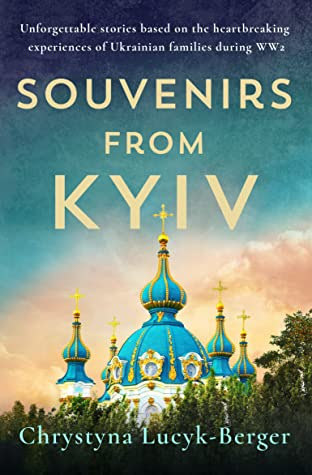
Souvenirs From Kyiv


Souvenirs from Kyiv / Chrystyna Lucyk-Berger


Now something different; this is a set of six linked stories set in Ukraine during WWII, written by an American with Ukrainian family ties. It's quite similar to many historical novels written about this period in tone and description, but it differs in its setting (this isn't a Paris WWII novel) and in its exploration of the little known political realities of Ukraine as it was being overrun by Nazis and Soviets alike.

The stories stand alone, but also connect. The first one centres around Larissa, a famed embroiderer with a shop in occupied Ukraine. A German officer comes in and wants her to make him a special shirt, embroidered with all her famous folk embroidery. This request, for a traditional shirt while the Germans are destroying Ukraine, is another example of the way folk culture is made into a quaint souvenir rather than respected in its own right. Larissa can not refuse, but she sews her resistance into the motifs. And her statements have consequences. I thought this story was very well done, and I related closely to Larissa and her decisions. I really liked this story.

Another focuses on Mykhailo, a Ukrainian who is a German solider on leave, travelling through Ukraine on Christmas Eve, hoping to get to his family. He doesn't, but he does end up being taken in by another family, and their words (along with all the things he sees from the train) change his views and also the actions he will take in future. This is a powerful story, and one to read as war rages in Ukraine at this Christmas season, to remind us of how our personal decisions can help change things. 

We also meet Marusia and her family who scatter to safety when Nazis come looking for her partisan brother. And there's Lida, a young girl forced to labour in a munitions factory in Germany. And a few more memorable characters, too. Many of these stories are based around interviews that the author did with her own family members -- she's a first generation American, with Ukrainian parents and family.

All these stories together create a wide view of some of the past events in Ukraine which people who don't already have a natural interest in the region might find very illuminating. The author really focuses on the personal and emotional costs of war, for individuals, families and the wider nation. I think it's a solid addition to the wide range of WWII stories out there, exposing a region which got the worst of both sides but is often neglected in discussions of this era. Ukraine's perspective in this war isn't often shared, so I think this is an important contribution to this genre. 


Thursday, November 10, 2022

Love in Defiance of Pain


Love in Defiance of Pain: Ukrainian Stories
Dallas, TX: Deep Vellum, c2022.


I recently read this as an ebooks, and really liked it. It's a collection of short stories by both established and newer Ukrainian writers (a list of all authors and translators can be found on the publisher's website). The paperback is available for sale at their website as well, at the price of $19.91 US -- that made me laugh as 1991 was the year that Ukraine declared its Independence from the SSR. 

Anyhow, there are 16 authors and many translators involved in this project, including some of my favourites like Oksana Zabuzhko and Katerina Babkina. I had already read a few of the stories, some of which appear in other collections by the authors but this gives a great overview of the different styles and themes of these writers. 

I think it's timely read, and one that will have something for everyone, from fantastical to historical to realist. I like to read short stories the way that Mavis Gallant recommends -- taking space between them and not reading them one after another like a novel. It was easy to set this down and think about the stories, and still really want to get back to the collection. Some of the stories are quite long, others fairly short -- it's a nice mix. 

This collection happens to be about Ukraine and Ukrainians but fits in with many of the topics that contemporary story writers in North America are also concerned with. They're modern, some playing with language, some with themes, but all worth your time to explore. Really recommend this one. 

The publisher also notes that for this book, "Proceeds from the sale of this collection will be donated to humanitarian efforts in Ukraine." Just one more reason to pick it up! 

Friday, September 23, 2022

Life Went On Anyway


Life Went On Anyway / Oleg Sentsov
trans. from the Russian by Uilleam Blacker
Dallas, TX: Deep Vellum, 2019, c2015
104 p.

Another book by a Ukrainian man, published by Deep Vellum, this one consists of short semi-autobiographical stories by Oleg Sentsov, a Sakharov Peace Prize-winning filmmaker & writer who was in prison in Russia while writing these. He was arrested and sentenced to 20 years for "terrorism" charges, created by sham Russian occupiers. These stories were shared by PEN International and others to draw more attention to his plight. 

Fortunately, he was released from prison in 2019 after a hunger strike, and returned to Crimea. He now serves in the Ukrainian armed forces.

This collection is light in the sense that it's reflective, mainly about childhood, and the selections are really short. You can easily read this in one go. The final story is the one that says something about Crimea specifically, but all together, the stories give a sense of life in Ukraine for his generation. The memories spur some philosophizing in the stories; the stories feel simple and straightforward, not overworked but honest. It's a small book but one that rewards a reader. 

Tuesday, August 30, 2022

In the Dark of the Night


In the Dark of the Night / Dniprova Chayka &Lyubov Yanovska
trans. from the Ukrainian by Roma Franko
Saskatoon, SK: Language Lanterns, c1998.
465 p.

Finishing off #WITMonth 2022 with another volume in the Women's Voices in Ukrainian Literature series by Language Lanterns. I really liked this one - it focuses on two writers, Dniprova Chayka (a pseudonym which means Seagull of the Dnipro), and Lyubov Yanovska. You can read a brief bio of each at the Language Lanterns website. 

The book is split about 30/70 between the two, with Chayka telling short stories of a more ethnographic bent, while Yanovska mixes the contemporary fashion for ethnographic storytelling with an emerging focus on psychological stories. I found both writers really interesting; they were both new to me. There are some stories here that focus on the miseries of rural Ukrainians at the turn of the 19th/20th centuries, but there was also a heightened focus on style, and on stories of artists and intelligentsia. I also found quite a bit of wry humour, especially in Yanovska's stories. Her style was intriguing and fresh, with asides to the reader, a story from 1909 that starts out in second person, and a 1911 tale about an alien coming to observe earthlings over the Easter weekend which is told in reportage fashion. Much of her work felt very modern and amused me with its black humour and stylistic technique. 

An example of the clever writing that I appreciated was found in the title story, by Yanovska: 

And perhaps everything would have happened as he thought it would, and perhaps everything would have come to pass as foretold by the cards, if only and if... in a word, if everything had not, unfortunately, turned out completely differently.

I especially enjoyed reading Yanovska's stories, with her urban and arts-focused characters, many of whom were painfully self-observant. Her approach to her characters was compelling and entertaining while also being descriptive in an 'ethnographic' way. The collection was balanced, with a variety of fantastical and realistic stories shared.

There are also some fine metaphors and observations that I marked down from both writers. There is a  focus in many of these stories on artists and artistic longings that remain unmet, and I found those very relatable and touching. My favourite story by Chayka was "The Shadow of Uncreated Creations", about a woman who holds artistic gatherings for young writers and painters and the like. One older woman there, who the younger people scorn for her coldness, is revealed to be an exquisitely sensitive artist, who sings powerfully but is always disappointed in how she falls short of her ideals. Highlighting the experience and disappointments of middle age alongside the judgements and expectations of youthful artistic hopefuls was really effective and moving. 

This is the second volume in this six volume series (I only have one left to read) and so far it's the lightest, or perhaps the most straightforwardly entertaining one. While there is plenty of despair, drama, and tragedy included, there are also lighter moments and livelier stories included. I really enjoyed this one! 


Saturday, August 20, 2022

Life Ceremony

Life Ceremony / Sayaka Murata
trans. from the Japanese by Ginny Tapley Takemori
NY: Grove, 2022.
256 p.


If you've read Murata before, you'll be ready for the weirdness of these stories. If you haven't encountered her before, well, get ready. Because these are strange ones! 

It's her first collection of short stories in English, and these 12 stories cover a range of situations, although all are imbued with her boundary-crossing sensibility. They approach social norms at a slant, turning them upside down and wondering why they exist and what for. Sometimes that can be uncomfortable to read, particularly in the title story (at least for me). 

I found the story that was most memorable to me was "A First Rate Material", in which engaged couple Nana and Naoki hold differing opinions on the use of human bodily materials to make household items (ie: Nana's human hair sweater or the many bone tables etc.) Nana thinks it's a wonderful memorial; Naoki is completely weirded out by it. 

The title story is creepy and nauseating, but you can definitely see her style and themes there. If you don't mind a bit of icky reading, you'll get through it. The other stories look at life in different ways as well, and there is a lot to think about after reading these. I found the collection a little uneven, with some of the stories very short and vignette-like, while others are longer and more cohesive. But if you are interested in weird stories that shake up social norms, this is the collection for you.