Showing posts with label sewing. Show all posts

Thursday, June 04, 2026

Crafting a Knock-Off


Crafting a Knock-Off / Barbara Emodi
Concord, CA: C&T Pub., c2026
232 p.


I love this series of cozy mysteries set in Nova Scotia, written by a Canadian craft legend :) When book 7 became available, I grabbed it! This details the further adventures of Valerie Rankin, middle aged craft and general store owner, as she once again gets involved in a mysterious death -- and like usual, goes off on many misguided suspicions before the truth is revealed. 

In this volume, she encounters Murray Nunn, a big talker who is trying to push business development and an export scheme. He won't leave anyone at the local craft fair alone, and while Valerie is talking to him, he suddenly drops dead. On camera. She has a wide range of suspects, from local craftspeople to those who have just arrived in Gasper's Cove for their own purposes, and even including her boyfriend's nephew -- which causes some relationship bumps. 

But Valerie must continue on her sleuthy ways no matter what, and with the involvement of the local RCMP and her crafting ladies, they eventually solve the mystery, and Valerie's fears of the end of her relationship prove unfounded. 

I love these books for their characters and the Nova Scotia setting -- and of course the inclusion of craft content! There are upcycled quilted coats, tartans and kilts, piecework sewing and craft fairs as integral parts of this mystery, and they are important. I thought this one was well constructed and entertaining. Always a treat to revisit Gasper's Cove! 


(Review first appeared at Following The Thread)

Sunday, October 26, 2025

Crafting with Slander: Gasper's Cove mystery #3


Crafting with Slander / Barbara Emodi
Lafayette, CA: C&T, c2025.
242 p.


I've missed posting in October (time just got away from me, again!) and so for the last week of the month I am planning to share some seasonal mysteries and thrillers. I'm starting with this light-hearted cozy, for a gentle start.

I'm going back a little in this series, as I had missed this one, the 3rd in the series, even though I recently reviewed #4! But it doesn't matter too much, as the stories do stand alone even if they are more entertaining when you read in order, since you can follow the characters. 

I really enjoyed this one. The set up was tricky and the solution unexpected. As the story begins, Gasper's Cove is being told that the larger town of Drummond across the causeway is going to amalgamate the community. The residents don't want this at all, but "Mighty Mike" Murphy, the mayor, thinks it's a great idea. (and the crafters start coming up with some wacky ideas to stop it, like blowing up the causeway that separates the two communities, or less violently, using their crafting skills to knit a giant barrier including a button up gate for emergencies.)

There is a municipal election, though, and Valerie's cousin Darlene decides to run. There are a couple of other local candidates, one who runs just to bring attention to the issues he is concerned about, and one more serious candidate, the son of a prominent local family hoping to use this as a stepping stone to bigger and better political roles. 

Valerie steps up as Darlene's campaign manager, and gets her crafters involved. They hand-stencil election signs, cross-stitch up some badges, and generally stump for Darlene. But then Valerie goes to complain to the mayor about some dirty tricks and finds him dead with one of Darlene's signs next to him. Concerned that Darlene is being framed, Valeried starts another round of investigations. 

This one was tricky and has some red herrings that were very convincing to me. There are also a few new characters added into the mix, and some moments where Valerie's nosiness gets her into some serious trouble. Thankfully, as always, Valerie prevails -- even if she starts by accusing a bunch of non-guilty characters! There was fascinating info about local Nova Scotia history, as always, and in this book it was focused on the famous painter Maud Lewis. Readers will always learn something even in these light and entertaining cozies. And as always, sewing and crafting talk is naturally woven into the story. Really enjoyable. 


(review first published at FollowingTheThread)

Thursday, July 31, 2025

Crafting a Getaway: Gasper's Cove Mystery #4


Crafting a Getaway / Barbara Emodi
Concord, CA: C&T Publishing, c2024.
240 p.

I found another volume in the Gasper's Cove mystery series by sewing writer Barbara Emodi! I enjoy this series so I snatched this one up. It's another episode in the mystery-solving life of amateur sleuth Valerie Rankin, resident of Gasper's Cove, Nova Scotia. 

There have been some changes in this story; Valerie is now the manager of the family hardware business, where she also runs her crafting workshops and studio. Her cousin Rollie has moved on to managing a local inn with his girlfriend. 

The action starts off with a mistake by Valerie (as it often does). She is planning a crafting retreat but realizes that she entered the dates wrong on her event listing -- she got them backwards, so instead of August 7 like she is planning for, the retreat has been advertised for July 8. Which is now. She only has a day or two to pull together her instructors and try to run it immediately, since the retreat guests are already in town. 

So she runs around, finding herself in just the right place every time to add some clues to the upcoming mystery. Her final stop, at the Inn (where the retreat is scheduled for August, and has no room now since there is a corporate event going on) is where she comes across the dead body of the marketing specialist from the corporate event. 

Valerie continues rushing around into multiple blind alleys -- it's her modus operandi in each book. But in this one, the plotting is a little more intricate and there are both more characters and more suspects. There are also tons of references scattered in about Nova Scotia ecology and history, which I always find so fascinating and a very enjoyable part of this series. Valerie also talks about craft, of course; she's taken on teaching the quilting class, which is not her specialty, so we hear all about that too. 

I really enjoyed this one. The story was more complex than the first books in the series - Emodi's writing style is growing and the setting is more developed after four books, too. The solution to this mystery was a bit out there, but it was a fun journey. 


Tuesday, May 27, 2025

The Wardrobe Department


The Wardrobe Department / Elaine Garvey
Edinburgh: Canongate, c2025.
231 p.


This is Elaine Garvey's debut novel, which I found serendipitously in my library's collection. It's the story of Mairead, a 22 yr old Irish woman who has left a suffocating home life to work at a small theatre in England. But the theatre isn't the dream life she was looking for - it's still just real life, a job with many attendant issues. 

She works in the wardrobe department, and the descriptions of the actual work are great - sewing up gloves, awkward fittings with actors they have crushes on, washing and pressing until all hours, sourcing stockings at sex shops for the cheapest options and so on. I loved this part of the book; it is so rare to find a book that goes into actual daily worklife, and manages to capture the every day nature of it, the way it makes up most of a life. And also the way that coworkers shape the day. Mairead works with two other young women, one posh and one more raucous and full of desire to live life. Their interactions are so realistic, and they help to shape Mairead's story. And her direct boss is tough but ultimately supportive. Some of the other characters are ones you'd like to throttle, though!

Mairead is awkward and introverted - she's not sure she fits in here but doesn't feel like she fits in at home either. But she still misses it and feels torn between two places. Then she has to go home for a funeral, and that part of the book is the real heart of the story. Her visit shows the reader the background for all the issues she's been having in London, her numbness, anxiety, constant worrying and so on. The family dynamics are finely drawn, between Mairead and her parents but also her wider family. There are some difficult moments in her life and that of her family that are hard to read about. 

But then there is a breakthrough in mother-daughter communication which shakes Mairead up, just as she is ready to board her plane back to London. And once there, she goes back to her daily round of work and home, but somehow her mother speaks through her in a key moment -- Mairead finds her steel -- and everything changes. Although much of the book has us following Mairead stuck in her life, the ending is hopeful, and I thought it ended on a high note. 

I really liked this one. If you enjoy slower paced character driven stories with a wonderful setting, you may also like it. Of course I also found the sewing content relatable and realistic, and appreciated the metaphors arising from stitching that appeared in other parts of the book.


And here's a nice interview with the author at the blog Word Herding, about her work in theatres and how it informed this book, if you want to learn more.


(review first appeared at FollowingTheThread)

Wednesday, April 30, 2025

A Sewing Novella: Sew Over It!


Sew Over It / Barbara Emodi
c2023
68 p.

I read this quick e-short this week when I discovered it on Hoopla thanks to my library. It's part of the Gasper's Cove mysteries by Barbara Emodi, also a writer of sewing books and a sewing blog. Her cozies are pretty fun, especially for other sewists, so I quickly checked this one out. 

This is kind of a prequel to the whole series, a short mystery (involving the murder of a sewing machine rep) that still satisfies, while it introduces us to Valerie Rankin and her world. In this book you meet all the characters who will make up the series, and you get a feel for the town and Valerie's position as a recent returnee. 

It's a little clunky in parts -- for example, Valerie's dog's name changes suddenly halfway in -- but it's a fun intro to the series. I found that in this story, the sewing puns and sewing content are in peak form, with comments that made me laugh out loud. I really enjoyed this, after having read the first two in the series. I'm falling behind, with book 6 coming out in October. I'll have to find book 3 and get busy!


(first reviewed at FollowingTheThread)

Tuesday, July 02, 2024

Stitches


Stitches / Glen Huser
TO: Groundwood Books, c2003.
200 p.

I picked up this short YA novel from my library recently -- I mean, just look at the cover! How could I not want to read this one? And I liked it, but do have a few caveats to that opinion.

The story follows Travis and his best friend Chantelle, as they move from fifth grade to junior high. Travis is different; he loves making puppets and wants to grow up to be a professional puppeteer. Chantelle has many physical disabilities and between them they are the outsider kids in their school. Travis has high hopes for changes in junior high, but while they do have supportive home ec and English teachers, who both encourage Travis' interest in drama and puppets, there is also more homophobic bullying from a group of boys he's known for a long time. But their teachers set them a challenge to present A Midsummer Night's Dream as a puppet show as their final project, and this keeps them going. 

The action in the story is mainly centred around the homophobic violence, which is never clearly resolved in the end. Travis' home life is rough, with a mother who's rarely around - he lives with his aunt and uncle (and the uncle is a mean loud mouth). He doesn't have anyone to confide in or to stand with him at home. Chantelle has older brothers who are rough types but at least support her and by extension, Travis as well, and they come in strongly at the end. 

There is lots of description of Travis and Chantelle sourcing fabric for their puppets at the thrift store, and making things like bags, puppet stages, and more. But I thought from the cover and description that there might be a bit more focus on that part of the story. 

The narrative tone is also a bit confusing. It doesn't feel so much like a young adult living the story, but an adult looking back at the events and telling them in retrospect. And the timing is a bit off; sometimes from one paragraph to the next, you are in the next school year without realizing it at first. I think some spacing/breaks in the typesetting could have helped with the transitions. 

I did like this one. It's set in rural Alberta and has some authenticity there. But I did feel a bit overwhelmed by everything being so dismal for Travis, from home to school, with so many aggressive characters and anger everywhere. I was relieved by the ending, with new hopes coming for Travis as he moves to the city to an arts-based high school. But I also felt that this novel, with important themes, could have been better.  


(review first published at FollowingTheThread.ca)

Saturday, April 20, 2024

Thread Me A Button for Poetry Month


Thread Me a Button / Jude Aquilina & Joan Fenney
Port Adelaide: Ginninderra Press, c2012.
73 p.


It's poetry month! So I thought I might share a little bit of poetry today. I discovered this book of poetry in a library collection online, and the adorable cover and title drew me in. It really is a collection of poems all centred on buttons! It's written by two Australian women, and it's surprising how much they can wring from a button. 

The book is set up in 6 sections, each with an average of 9 poems, ranging from haiku length to full page poems. There are some that are straightforward, some quite funny, and a few that are more serious and moving. 

There is a poem about a woman who lost her lover in the war, and for the rest of her life she wore one of his buttons stitched to a petticoat. There are some celebrating beauty, or relationships. In the section "In the Sewing Drawer" I found some of my favourite pieces, lots about the act of sewing. And this section includes what I think was the most memorable poem, for me, called "In the Light"; it's about the closing down of Mrs. Pearl Morris' haberdashery shop, and I found it evocative and bittersweet. 

This was a chance find, and a gem. I enjoyed reading through this accessible collection, which will appeal to anyone fond of buttons as part of sewing history, memorabilia or domesticity. Easy to read a few of these each night before bed to relax and enjoy some whimsical poems! 


Wednesday, November 29, 2023

Crafting for Murder: a crafty cozy for November nights


Crafting for Murder / Barbara Emodi
Concord, CA: C&T Publishing, c2023.
224 p.

This is the first volume in a projected series of cozy crafter mysteries, by well-known Canadian sewist Barbara Emodi. I just had to read it, having really liked her two sewing books as well as her long-running blog. 

It's a fun and light cozy mystery, with many of the expected elements of such -- a middle-aged female protagonist, a dog and cat, a job that leaves lots of room for investigations, and a whole group of side characters that spice up the story. 

Valerie Rankin has moved back to tiny Gasper's Cove, Nova Scotia, now that her three children are on their own and she's an empty nester. She's returned to where she grew up, and where she has many cousins of all sorts, and a family business -- a general store -- run by one of them. She helps out there, and also gives sewing lessons in the back room. But her big plan is to open a Crafter's Co-op in the upper room of the store, to promote local craft and make Gasper's Cove into more of a tourist location. 

This is where she runs into trouble. They find out that the building's upper floor needs quite a lot of fixing up before they can let people into it, pushing back her plans. She has to consult an engineer, who becomes part of the story. And, she was just interviewed about the Co-op on local radio, but her spot is a little overshadowed by the murder of the radio host the next day. 

This book is setting up a series, so there's a lot of scene setting and introduction of characters going on. The action can be a little slow because of it, and because Valerie always seems to get the wrong end of the stick on everything; she does tend to leap to conclusions. But it's still an interesting story, and very true to small town politics (even if two murders back to back in such a small place is a bit unusual). I enjoyed some of the side issues like her relationship with her best friend & cousin Darlene, and the discussion of crafting and what it means to people. 

The mystery part of it was puzzling, with lots of suspects and drama. The conclusion was unexpected but made sense within the story, especially as the reader looks back and sees all the subtle clues that were laid down (many of which I missed on first read!) I think this is a great light read and will definitely be checking out book 2 when it's published on Christmas Day this year!


(this review first appeared at FollowingTheThread) 

Thursday, June 29, 2023

Missing Pieces of Nancy Moon


The Missing Pieces of Nancy Moon / Sarah Steele
London: Headline, c2020.
416 p.

Looking for a cheery summer read? Try this one -- it's a typical kind of British family saga, in that there are multiple generations involved, family secrets, and a young woman at the heart of it all. But it's also particularly fascinating since it includes two women who are fashion sewists, lots of talk of dresses, fabrics and vintage sewing -- the structure of the book depends on it. 

As the book begins, Flo is at her grandmother's funeral. She was mostly raised by her gentle grandparents, so this is particularly wrenching for her. Also, her marriage is cracking up due to a miscarriage she had in the last year. All the sorrow is getting to be too much for her. 

She decides to stay at her grandmother's house after the funeral for some alone time, and wandering about, looking for an old sewing machine she knows must be there somewhere (Flo is one of the sewists in the book) she stumbles across a box of vintage patterns in her grandmother's bedroom closet. Flo has never seen it before, and as she opens it, she discovers a seamstress named Nancy - who is unknown to her. 

Nancy is from her grandmother's generation; the reader certainly knows a lot more about Nancy Moon than Flo does. It's a long trek for her to find out more, and that is what the book is all about. Flo's husband goes to American for a teaching gig, leaving her at loose ends; with the encouragement of her friend Jem, she decides to travel across Europe, following Nancy's path as much as she can from what she can decipher from the sewing patterns, which have postcards, ticket stubs and fabric tucked into the envelopes. She also decides she is going to duplicate the dresses that Nancy made so that she can wear them on her trip. 

While we don't see or hear much about Flo's process of making the dresses (pretty quickly I'd say) we do follow her to Paris, and then to Venice and beyond, as she tries to replicate Nancy's movements and research where and what and why. Each section, based on a location, moves back and forth between Flo's era and Nancy's, and we get to engage with both of them and their varied experience in different decades. It's also interesting to read it this way, as the reader can follow Flo's investigations into Nancy's story, and see whether she's on the right track or not. 

I enjoyed the descriptions of the dresses that open some of the chapters, and the discussion of style and fabrics and individuals who are highlighted because of the statements they make with their wardrobe choices. The author has included a gallery on her website that shows all the vintage covers of the patterns she discusses in the book, if you want a good look at the outfits that both Nancy and Flo are making. 

There a few moments in this book in which coincidences strain credulity, but overall it was an engaging read with some good character development. And the settings are also quite lovely to read about! If you like books about family secrets and sewing, I'd definitely recommend you give this one a try. 


Wednesday, February 22, 2023

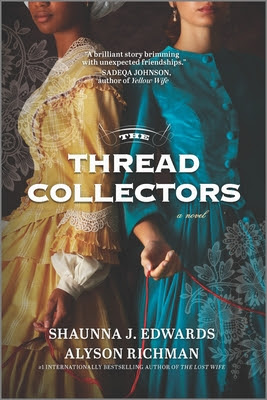
The Thread Collectors


The Thread Collectors / Shaunna J. Edwards & Alyson Richman
NY: Graydon House, c2022.
400 p.

This recent novel is co-written by two friends, aiming to give a different perspective on the American Civil War. It's set in 1863, and moves between chapters told from the viewpoints of our two main characters, Lily (a New York Jewish wife) and Stella (a Creole woman in New Orleans who is the mistress of a white man but in love with a black man). 

The dual perspectives add to this book. It looks at the Civil War from a woman's point of view, as well as those of the Jewish and Black communities; it examines love, family ties - or fractures, history, music, racism, and the title hints at how sewing and thread make their way through the story in meaningful ways. 

I can't summarize the plot, there's too much in it. However, the basic outline is that Stella's William has run away to join a regiment accepting black soldiers. To help him, she stitches a map from threads she's pulled from household items. These maps become much in demand and she finds herself surreptitiously making many for local families. All this while dealing with her family legacy of being claimed by a white man as a kind of mistress at the right age, as a way of staying alive. 

Lily, on the other hand, has her eyes opened to wider realities once her husband Jacob joins up and is sent south. She gets involved in war work to support him, which includes a lot of sewing and bandage making. She eventually travels south herself to find him when his letters stop. 

William and Jacob are both musicians and coincidentally end up in companion units, where Jacob befriends him -- unusual at this time. Their experiences and developing relationship make up a lot of the book, which we see from their eyes, not from a distance. This does mean that there are some horrific events included, so be aware. But they are all based in real events or stories, and it's important to remember that. 

The tone of the chapters varies slightly depending on who's telling it, but the book overall is well edited and the narrative is smoothly told. It's a bit long in some ways - some of the backstory could have been tightened up, for me anyhow. And there were some parts that felt a little coincidental, but were needed to keep the story going. These few small caveats were the only issues I had with an otherwise very unusual and compelling read about this time in history. I thought the characters were fascinating and complex. I was especially drawn in by Stella and her sister, finding their story rich and full of life. I enjoyed how Stella upcycled and used the fibres around her to work toward freedom for many, and how this process strengthened her sense of self. 

Definitely a great read for anyone who is interested in widening their view of American history, or loves a story of strong women swept up in big events. The sewing content is another plus for me!


(first published in slightly different form at FollowingTheThread)

Tuesday, December 06, 2022

The Wedding Dress Sewing Circle


The Wedding Dress Sewing Circle / Jennifer Ryan
NY: Ballantine Books, c2022.
411 p.

This was a very enjoyable novel, set on the home front in England, mid-WWII. It follows the fortunes of three women as they adjust to the new patterns of life in their small village. 

Grace Carlisle is the vicar's daughter, and she's trying to fix her deceased mother's wedding dress for her upcoming nuptials. But she's as uncertain about the wedding as she is about the repairs, especially after she runs into Hugh Westcott, a childhood friend and member of the local aristocracy who she hasn't seen in years.

Cressida Westcott is a successful, London based fashion designer who left the village when she was young and had no intentions ever to return. But her fashion house and her home have both just been destroyed in the Blitz -- she had a narrow escape. She has nowhere left to turn other than her old home. Her nephew Hugh is now in charge, and she can only hope that both Hugh and her niece Violet are more welcoming than her late brother was. 

Meanwhile, Violet is excited by the idea of her famous aunt coming to live with them -- but shortly after Cressida arrives, spoiled Violet receives a conscription letter. She's off to train for a position in the women's corps, but doesn't know what she will end up doing. 

The three women learn to be more empathetic, build their relationships, create meaningful activity that draws the women of the village together, and of course, find true love. 

It was a straightforward story with not too many surprises. It was pretty easy to see the direction that the story was taking as it went along, but it was an enjoyable read with interesting characters. When they start the Wedding Dress Sewing Circle, spurred on by Cressida's arrival and Grace's need for help from the ladies of the already existing sewing group, it livens up the village and allows for some great sewing talk. As mentioned in the notes to this book, and in the last book I read, Fashion on the Ration,  a Wedding Dress lending circle was actually a real thing in the war, started by Barbara Cartland (yes, the romance novelist) who was upset to think that women in the services would have to marry in their ugly uniforms. There is a lot of fascinating historical content in this book, which was so intriguing. 

The parts I was most drawn to were the fashion bits; I thought they were the most unique parts of the story, and of course the whole idea of clothing availability and design in wartime is of interest to me -- I just read a whole book about it! There is info about the clothes rationing schemes rolled into the story quite naturally, and Cressida, as a designer, is asked to participate in the (real life) design challenge given to a handful of fashion designers by the British government when they were trying to figure out how to make Utility clothing more appealing. The scenes at the challenge event were fun to read, especially since Grace was one of Cressida's models -- it was entertaining to see our characters inserted into an historical moment. 

And there was also a bit of historical detail shared at the top of each chapter; the explanation of the design requirements for a piece of Utility clothing was my favourite bit.

If you enjoy a sweet historical romance with a Happy Ever After and lots of period colour, as well as a lot of fascinating fashion tidbits, I'd recommend this read. 

Monday, November 28, 2022

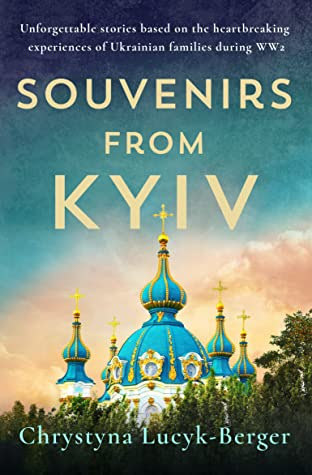
Souvenirs From Kyiv


Souvenirs from Kyiv / Chrystyna Lucyk-Berger


Now something different; this is a set of six linked stories set in Ukraine during WWII, written by an American with Ukrainian family ties. It's quite similar to many historical novels written about this period in tone and description, but it differs in its setting (this isn't a Paris WWII novel) and in its exploration of the little known political realities of Ukraine as it was being overrun by Nazis and Soviets alike.

The stories stand alone, but also connect. The first one centres around Larissa, a famed embroiderer with a shop in occupied Ukraine. A German officer comes in and wants her to make him a special shirt, embroidered with all her famous folk embroidery. This request, for a traditional shirt while the Germans are destroying Ukraine, is another example of the way folk culture is made into a quaint souvenir rather than respected in its own right. Larissa can not refuse, but she sews her resistance into the motifs. And her statements have consequences. I thought this story was very well done, and I related closely to Larissa and her decisions. I really liked this story.

Another focuses on Mykhailo, a Ukrainian who is a German solider on leave, travelling through Ukraine on Christmas Eve, hoping to get to his family. He doesn't, but he does end up being taken in by another family, and their words (along with all the things he sees from the train) change his views and also the actions he will take in future. This is a powerful story, and one to read as war rages in Ukraine at this Christmas season, to remind us of how our personal decisions can help change things. 

We also meet Marusia and her family who scatter to safety when Nazis come looking for her partisan brother. And there's Lida, a young girl forced to labour in a munitions factory in Germany. And a few more memorable characters, too. Many of these stories are based around interviews that the author did with her own family members -- she's a first generation American, with Ukrainian parents and family.

All these stories together create a wide view of some of the past events in Ukraine which people who don't already have a natural interest in the region might find very illuminating. The author really focuses on the personal and emotional costs of war, for individuals, families and the wider nation. I think it's a solid addition to the wide range of WWII stories out there, exposing a region which got the worst of both sides but is often neglected in discussions of this era. Ukraine's perspective in this war isn't often shared, so I think this is an important contribution to this genre. 


Wednesday, August 25, 2021

Threads of the Heart

The Threads of the Heart / Carole Martinez
trans. from the French by Howard Curtis
NY: Europa, 2012, c2007.
399 p.


As mentioned in my last Thursday's post, I just started this one last week, and I finished it quickly. I was drawn to it by the description -- some magical embroidery in there is just what I needed to put this on my TBR, and then I found a copy at a thrift store. It was meant to be! 

It was written in French, but is set in a remote hill town in Spain. There are elements of magical realism; the previously mentioned embroidery, for example. It is basically the story of a family, told by Soledad, the youngest surviving child, in her own adult years. 

Frasquita is the mother, the woman who has inherited a gift that is passed on from mother to daughter in her family. There is a blindfolded ritual in the night, and the daughter must then wait to open a box in which her gift resides. Frasquita's gift was sewing, and her gowns can make someone beautiful for the first time in their lives, or hide a pregnancy, or stitch life back into someone on death's door. Her skill attracts the attention of a local aristocrat, however, and he becomes locked into a cycle of rooster fighting and bets with Frasquita's husband José with his ultimate aim being to gain Frasquita. 

This is a middle aged woman with four children by this time, and an unusual patience for her lumpish husband. But José's greed gets the best of him and he gambles away Frasquita. This moment sets her on her own road, and she takes her children and a cart, and sets off walking all across southern Spain and into Africa, dragging her children behind her for years. They encounter civil war, revolutionaries, a kindly Arabic woman who rescues them, and much more. The stories are larger than life, political, romantic, dreadful, fantastical, until finally Soledad decides to end this legacy of the family curse herself. 

Sewing is not only a plot element, it's also a strong metaphor for a lot of what goes on in this book. When Soledad is still young, Frasquita is dying. And this is what Soledad says:


I found this an engrossing read, definitely in the tradition of magical realism, but with a starker setting. It's Martinez's first novel, and it's a strong debut. Apparently it is also going to be made into a film, and it would be interesting to see if that ever shows up in the English world as well. 

If you are also drawn to this kind of storytelling, and the idea of stitching the world in place appeals to you, give this one a try yourself. Just allow yourself some time to get into the rhythm of the book, and you may find that this lengthy book flies by. 

Saturday, February 13, 2021

The Grace Kelly Dress


The Grace Kelly Dress / Brenda Janowitz
NY: Graydon House, c2020
336 p.

I've never read Brenda Janowitz before, and the blurb by Emily Giffin on the front didn't bode well since I don't usually like her books. But the dress element of this book convinced me to pick it up. And I am glad I did! It was a poignant and enjoyable story of three generations of women, and one dress. 

The story moves between three women: Rose in 1958 who is creating The Dress, Joanie in 1982 who wore it after her mother did, and Rocky in 2020 who is getting married but doesn't want to wear her mother's dress. 

The chapters are all short, and each woman is quite different so it's easy to keep them sorted. Also, Rose is a seamstress in Paris, Joanie is a college student, and Rocky is a contemporary software developer, so they're distinct in their interests, surroundings and behaviours, too. 

Of course I loved Rose and all the time spent in Madame Michel's Parisien atelier, where she works. Rose is very skilled, she loves sewing and designing; her focus and her sketches catch the eye of Julian, Madame Michel's assistant, and is called upon to assist him in keeping the atelier running after the unexpected death of Madame Michel, which he is trying to keep a secret. Lots of drama! 

Joan is a young college student, a sorority member and recently engaged to a fraternity dude, but she's starting to question a lot about her life. She tries very, very hard to be 'good' to make up for the loss of her older sister, who died at age twenty. This character was a little weak to me, because in parts it felt like she was living more in the late 60s than the early 80s, with her sorority and her pearls and her innocence. But she certainly experiences some of the early 80s when she leaves campus in search of the truth about her sister. 

Rocky is a bit rough around the edges, unlike her sultry sister Amanda. She likes logic and order and things being straightforward. She wants a simple wedding, and isn't thrilled about wearing the elaborate Grace Kelly dress from her mother -- but doesn't want to hurt her mother by turning it down, either. There are a bunch more side stories in Rocky's chapters; Amanda is gay and longing for the last girlfriend she ditched, Rocky's fiancé is South Korean but was adopted by a Jewish family and he's now searching for his birth mother, there are mother issues between Rocky and Joan. 

But through all three of the stories, the dress, and all the details of making it, shine through. I loved how Rose takes the inspiration from the Grace Kelly wedding dress that was the ideal in 1958 and updates it for a younger client. She talks about details like shortening sleeves, updating necklines, adding lace motifs, and about how to construct a dress like this (in separate parts, skirt held up with underpinnings and cummerbund to cover the bodice and skirt join. As a sewist, a reader can picture this and understand how it makes a gown like this work on the body).

Joanie adapts the dress to her taste in the 80s (think poofy Princess Diana sleeves) and Rocky eventually comes to see how she can make it work for her, too. (no spoilers...) It ends with a fairytale-like omniscient narrator telling the story of the dress' future, and it works, and it's touching and sweet. 

If you like stories that move between characters, and don't mind the sentimentality of a book centred around love and weddings, and of course you like to read about sewing, give this one a try. You can't go into it cynically or it just won't work, but if you're looking for a gentle read with some great sewing content and an interesting set-up, you might just find it's exactly what you need. 


(this review was first published at Following The Thread)

Monday, December 28, 2020

Natalie Fergie's Sewing Machine


The Sewing Machine / Natalie Fergie;
read by Ruth Urquhart and Angus King
Rearsby, UK: WF Howes, c2017
audiobook

I listened to this delightful book, which added to my enjoyment -- the book is set in Scotland and the primary reader, Ruth Urquhart, is wonderful! She reads with a regular Scottish accent, which isn't hard to understand, and gives each character their own personality so it's easy to tell who's who. The Scottish accent would not have been in my head if I'd read this myself, and it's so integral to the story that it was a real pleasure to listen to this one, especially while sewing. 

It's one of those stories that moves back and forth from present to past; this time with three storylines. We start with Jean, who works at the Singer plant in 1911 Clydebank, right as a strike is fomenting. She marries one of the strike leaders so afterward they have to move to Edinburgh to make a new life. 

Then there's Connie, whose mother keeps a record of everything she sews on her Featherweight, by stitching a line and a fabric scrap onto a page of a notebook, with information on what she's made. Connie finds these and continues the tradition. After a family tragedy, Connie gets a job as a seamstress at the local hospital, where she meets her husband, and a young nurse in need of assistance who becomes integral to the story.  

And then we have Fred, in modern day Scotland. He's just lost his job as a banking consultant in London, and his beloved grandfather Alf (Connie's husband) has just died, leaving Fred his flat. So Fred moves back to Scotland and tries to make a life while also trying to find a job. He starts to clear out the flat and finds the old sewing machine, and somehow he takes to it and begins sewing small things for the boys next door, discovering a liking for this hobby. He also meets an artist who deconstructs old sewing machines to make her art works. I really liked this reversal of expectations, that it's Fred who takes up sewing, and it's a young woman who is the mechanic/artist. Fred, however, feels a lot younger/more immature than his stated age of mid30s, I'd have placed him mid20s at the oldest. 

The story moves between these three situations, even back and forth in each storyline as well. As noted, I was listening to this so it had potential to become confusing -- however, I didn't find it was hard to follow. The only thing I had trouble with was trying to figure out how all three characters were connected; I thought one thing, then changed my mind as the story progressed, then saw it in the final chapters. 

I did listen to it in two long sessions though, which probably helped keep things straight! I don't think this is one of those books that you can pick up and put down over and over without losing the thread. 

I loved the setting and the historical content, and the narrator did a bang up job with it. I even looked her up afterward to see what else she's narrated! Fred is likeable though not as compelling to me as Jean and Connie -- their stories are so rich, and their connections to sewing are lovingly described. Anyone who has sewn anything at all will recognize some of their experiences and conversations, which added to the richness of the story for me. However, I think even if a reader didn't know anything much about sewing, the historical and family tree elements will grab them. The characters are interesting and many-sided, and their lives feel very situated in time; the details of everyday life are fascinating, and Scotland comes to life in the way this book is constructed. 

I really enjoyed this book, both the storyline and the way it interweaves before finally revealing family secrets, and the great narration. Small things like Fred's neighbours or Connie's father's friends are also memorable, not just the main characters. For me, everything hung together and made a satisfyingly complex story, with just a few obvious coincidences that I forgave for the sake of plot. The sewing content is fabulous and with no mistakes to distract -- Fergie clearly knows her way around a sewing machine. Recommended for those who love family stories with heart, and a bit of history on the side, too. 

(this review first appeared on Following The Thread)

Sunday, March 22, 2020

Purcell's Poison Thread

The Poison Thread / Laura Purcell
NY: Penguin, c2018
351 p.
This chilling book was a captivating read -- set in Victorian England it features seamstresses, gothic terror, poverty, phrenology, single daughters trying to break out of their bounds, and everything Victorian that I love. 

Dorothea Truelove is a young woman who is wealthy, lovely, single, and obsessed with phrenology.  She is convinced that the shape of one's head will predict characteristics, particularly criminal tendencies. (I feel like Dorothea would be a true crime podcast fan in our own days) She's not much interested in the men that her father keeps inviting to dinner in order to meet her, being far more focused on her own research. 

Ruth Butterham is poor; her father is an artist and her mother takes in sewing. Ruth helps her with sewing, since she seems to have an unnaturally precocious talent for embroidery. In Ruth's exhaustion and bitterness, she focuses on her detail work with great emotional turmoil. And because of this, she comes to believe that her needlework can affect the person wearing it -- that she can injure and even kill from a distance, stitching her intentions into the item she is creating. This kind of sympathetic magic is believable in this Victorian setting, and is unsettling and creepy. 

Ruth's life is a miserable one; after her father dies (early on in the book) she is apprenticed out to a dressmaker who turns out to be totally off her rocker. The abuse and terror in this household takes up much of Ruth's story, and is quite visceral and violent -- beware of that if you are not keen on situations of abuse. 

But when Ruth ends up in Oakgate Prison, her case interests Dorothea, and their stories begin to converge. Dorothea adds Ruth to the roster of female criminals she is interviewing and examining for head shape. Is Ruth delusional, mad? Or is there something to her story? And do Dorothea's criminal theories hold up? Or are they each simply saying what the other one wants to hear?

For sewists, this story will fascinate for its details on the stitching, embroidering and dressmaking. Ruth makes herself a protective corset (the English title of this book is actually The Corset), and then makes another for her nemesis later on in the book, which is not intended to be protective at all, quite the opposite. The sewing and the precision of description is strong in this book, and the way that Purcell weaves together all the stories is convincing, and creepingly evil. 

If you are in the mood for a Victorian gothic replete with fabric and thread, featuring women, betrayal, and mystery, this is the book for you. You should have a higher tolerance for terrible events, though. Definitely a terrifyingly dark read! 

Sunday, June 30, 2019

Midnight Dress


The Midnight Dress / Karen Foxlee
NY: Knopf, c2013.
288 p.

This is an Australian YA novel that I read recently; I picked it up mostly because of the title ;) 

As the story opens, Rose and her nomadic father are stopping off in the small town of Leonora (think Cairns, along the coast in the north of Australia). She's used to moving on whenever her father decides they've had enough of any one place. But Leonora gets under her skin -- she starts school, and meets Pearl Kelly, one of the popular girls, who inexplicably becomes her friend. Pearl is one of those girls who makes things happen, and she organizes the Harvest Festival float for the school. She ropes Rose in to be her fellow planner of this major event in the life of their small town.

But as part of the festival, there's also a dance and Pearl convinces Rose that they should visit Edie Baker, a recluse and rumoured witch who was also one of the best dressmakers around in the past. They want to stitch up a midnight blue dress to wear to the festival, to outshine everyone.

Here is where the story got really interesting for me. Edie is a cranky old woman who doesn't want much to do with these young girls. But she sees something in Rose, another misfit, and offers not to make a dress but to teach Rose to make it herself. Her house is full of old materials and supplies, and she starts Rose off on the work. While the amount of work and skill required is a bit condensed here, Rose does learn and the details of her hours with Edie are wonderful. There is a tinge of magical realism in the story as well, mainly centred around Edie and sewing, which is lovely. 

The book starts with the dramatic event that the whole story is leading up to, and then goes back to trace how the characters got there. I had figured out the twist by halfway through, but the descriptions both of Edie's house, sewing, and the landscape around Leonora were so fascinating that I didn't really care that the mystery wasn't all that mysterious. 

The emotional arc is quite tumultuous, and I had some problems with it. Why are there always dead girls, for example? There are some elements of the 'romance' plot that I didn't feel comfortable with, and the tragic opening scene seemed to be avoidable by the end. But the story is rich and grounded in its place, and had some great characters to follow. 

It was an absorbing story, and the magic of stitching was the thread I loved following. 

(this review first appeared at FollowingTheThread)

Monday, May 27, 2019

Patrick McGrath's Wardrobe Mistress

The Wardrobe Mistress / Patrick McGrath
London: Windmill Books, c2017.
314 p.
I recently finished this unsettling story by a master of the gothic/grotesque. Actually this book was much less grotesque than his early books, and I was most drawn to it by the wardrobe part of it. So I was pleased to find that it had a lot more theatre, sewing, and women's lives in it than simply gothic gore.

Joan Grice is a wardrobe mistress at a small London theatre. It's 1947, it's the coldest winter in memory, and post-war rations are still making life miserable. On top of this comes the sudden death of Charlie Grice, 'Gricey', Joan's husband and a generally beloved star actor.

Joan and her troubled daughter Vera (who is married to a much older theatre producer) suffer though Gricey's funeral together, but then Joan is rather on her own in her small flat. And there she begins to discover that Gricey was not entirely what he told her he was. She feels unmoored as she begins to uncover more and more about his inexplicable, hateful hidden life.

There's also a new man stirring things up -- a younger actor who had stepped in to Gricey's role as his understudy -- and whom Joan can't seem to separate from his role. Then Vera gets cast alongside him...

Added to all this literal drama there's an overtone of the supernatural, and this is where McGrath's love of the gothic shines. Joan and Vera's mental stability is challenged, their security in normal everyday life is challenged, and when it all shakes out it wasn't at all what I'd expected, culminating in a shocking conclusion. Dark, creepy, and yet fascinating, this story incorporates Joan's knowledge of sewing as she remakes some of her husband's fine clothes for the young and impecunious actor taking over Gricey's role(s) in multiple ways.

She regarded him critically, and in her mind's eye she saw him as he'd look when it fitted him properly; and, yes, for just a second she closed her eyes and Gricey was there.
Then she was all business. Out with the tailor's chalk for it was too broad in the shoulder, too deep in the chest. A pin here, a pin there, tighten up the trousers at the back, take it in a touch at the seat, and give him an inch of trouser cuff. She knew what she was doing when a man stood before her in a costume requiring alterations...
Then she was done. She left him to get dressed, and when he emerged he was a scarecrow once more. The suit lay on the bed, pinned and chalked and ready for the tailor, herself.
If you like an unsettling post-war England setting, with a dash of marital upset and dark developments, alongside political commentary that is still relevant to today's happenings, this is a book for you. It has a literary style, with a chorus commenting on the narrative; if it is confusing at first just keep going, you'll figure it out. It adds to the sense of dislocation and unreality that underpins the plot. And if you are also a sewist, well, you'll appreciate some of the details too. But don't expect sunshine and light from this one!

(this review first appeared at FollowingTheThread.ca)