Showing posts with label fantasy. Show all posts

Thursday, February 12, 2026

House of Many Ways

House of Many Ways / Diana Wynne Jones 
NY: Greenwillow, 2009, c2008.
338 p.

This is book three in the Howl's Moving Castle trilogy, but it was written quite a few years after the first two and honestly didn't need Sophie or Howl in it at all. It could easily have been written without them, with no huge loss to the storyline. This is definitely even less connected to their world than book two was! 

Still, I liked this. There were lots of neat ideas in it, and the main character, Charmain Baker, was interesting to me as a bookish, stubborn girl. As the story opens, she is being sent off to keep house for her Great-Uncle William while he is away. There's nobody else to do it, so Charmain heads off to the very odd home of her great uncle, who is also known as the Royal Wizard Norland. 

This house has doors that open to different places, secret passages, magical water and food and so forth, and as Charmain finds out, also an apprentice, Peter, who just shows up at the door one morning expecting the Royal Wizard.  

Charmain gets involved (long story) with the King and his daughter, who are searching for something called the Elfgift, which will save their kingdom. The King is sifting through books in the royal library, and as Charmain is very good with books, she begins to assist him. These scenes in the dim, creaky library are wonderful, quiet and reeking of research. I enjoyed them! 

Howl's crew gets involved when the Princess calls in Sophie, now a feared sorceress, to help them in their search. Of course, where Sophie is, Howl and Calcifer and her child are not far behind. 

I liked this one, I thought the titular House was appealing, the villian (an insect like creature called the Lubbock) was suitably creepy, the plot was pretty good and Charmain was interesting. It felt a bit too farcical in some parts for me, as chaos is not my favourite plot device. But overall it was an enjoyable read. The creative set-up and the sneaky conspiracy that took a while to figure out were entertaining. I'm glad to have read all three titles in this trilogy now, although I'd probably only reread Howl's Moving Castle. 


Wednesday, February 11, 2026

Castle in the Air

Castle in the Air / Diana Wynne Jones 
NY: Greenwillow, 2008, c1990.
383 p.


This is book two in the loosely connected Howl books by Diana Wynne Jones. It is not a sequel exactly; Howl and Sophie show up in this one, even if you don't know it immediately, but the main action follows other characters. 

It begins in the Howl universe, but south of the land of Ingary. We meet Abdullah, a carpet seller in the Rashpuht bazaar. He's young, not that successful, and spends a lot of time dreaming of being a hero. One day, a stranger sells him a magic carpet -- and the adventures begin. 

He meets the Sultan's daughter, Princess Flower-in-the-Night, but she is stolen by an evil Djinn before Abdullah can do anything. He heads off in pursuit on his magic carpet, meeting a rather disreputable companion along the way, a rough character who turns out to dote on cats and whose skills as a thief are particularly useful. They discover that there is a castle in the air where many kidnapped princesses are being held, and the scenes in the castle (Howl's Moving Castle, stolen by the Djinn) are my favourite part of this book, funny and full of fabulous women. The princesses range from small children to mature women, but they are all interesting and clever. 

Calcifer, Sophie, and Howl (and their small infant) all turn out to be important to the story, and have been woven into the tale more than first appears. This was funny and charming, with many disguised identities and misdirections. The power of constancy and true love is highlighted as well, with many delightful pairings showing up. 

It is over 30 years old so there are a few things that might not have been included today, but overall, it was a fun read with a satisfying happy ending. 
 

Sunday, December 21, 2025

The Wood at Midwinter

The Wood at Midwinter / Susanna Clarke
London: Bloomsbury, c2024. 
64 p.

This is a short story bound in book form, beautifully illustrated and with a lovely cover, perfect for gift giving - it's a very short read, but with the elements of magic and mysticism that can be found in Clarke's other works. 

Since it is the Winter Solstice today I thought I would share this one now. It's the story of Merowdis Scott, 19 and a bit of a misfit. She isn't obedient enough to be accepted as a nun, she's turned down a marriage proposal, and really feels herself only in the woods. 

The story has an edge of the fantastical, as Merowdis talks to the animals in the forest, and the question of Christmas and a child born at midwinter arise. The atmosphere in the story is evocative, and it feels old somehow. There is a clear drive in Merowdis to exist in the woods, and one day while wandering she encounters a strange figure and her life is changed forever. 

I liked this one; it's a bit uncanny and the writing is lovely. But it is awfully short, and I don't feel like there was enough development of Merowdis for the reader to feel truly engaged with her story. The illustrations are nice, the book itself is very prettily done, but it is very brief. I would have liked to have a bit more context for this story and character, to really understand her and the concepts brought up in the narrative. But I do like Susanna Clarke's writing, and am always eager for more, so it was nice to read at Christmastime. 

There is also an author's afterword in which she talks about the inspiration for the story, and mentions Kate Bush's music as one of them - that was interesting, and added something else to the book. I'm always waiting for more Jonathan Strange & Mr Norrell so this brief tale set in their universe gave a small taste that I appreciated. 


Tuesday, November 25, 2025

The Little Broomstick

The Little Broomstick / Mary Stewart 
William Morrow, 1972, c1971.
192 p.

This charming children's book by Mary Stewart is redolent with magic. Young Mary Smith is staying with elderly relatives in Shropshire, and is lonely and bored. She goes out to help in the garden some days just for something to do. And one day she follows a mysterious black cate with green eyes and finds a little broomstick. Conveniently for her, Tib the cat had also led her to a rare flower in the woods called a fly-by-night. And all three of these together launch her onto a great adventure. 

Mary flies off, rather wobbily, on her little broomstick. It takes her straight to Endor College, a school for witchcraft where she is quickly enrolled. But she discovers that the spells taught to the students are mean-spirited and tricksy, and the teachers are generally pretty nasty. And then Tib disappears and Mary decides she is going to find him and break whatever mysterious magic is going on here. 

There is some evil experimenting going on, on all the pets and familiars who have arrived with the children. The heads of the school are running it for their own benefit and are trying out all sorts of dark magic. But with her innocence and some fortunate assistance, Mary ends up undoing the spells in one fell swoop, and then fleeing the school. 

The scenes in which she is escaping are exciting and scary. She has to use her wits to figure out how to escape from Endor and the magical landscapes to cross over back to her own world again. She has Tib and his brother cat, and another boy to help her but it's touch and go. This was a well constructed story with appealing characters, both good and bad, as well as the requisite oblivious adults supposed to be taking care of her. Lovely cats, lots of magical magic, and a funny scene with the broomsticks when she arrives at Endor for the first time -- a stableman approving of her old fashioned broom rather than all the new-fangled ones students purchase from the Harrod's catalogue (with descriptions). 

This was a good read, really reflective of many of the 'witchy' books from the 70s that were written for children. This one has great atmosphere, not surprising given the author, and an appealing heroine. Really enjoyed it. 

Monday, November 24, 2025

Solstice Wood


Solstice Wood / Patricia A. McKillip
New York : Berkley Pub. Group, 2006.
278 p.

I reread this book recently, after having first encountered it probably 15 years ago or so. I remembered it fondly, as McKillip is a favourite author. Upon rereading, I realized I didn't really like it as much, unfortunately! 

It's set in upstate New York, and is much more based in the real world than many of her other novels. In this one, Sylvia Lynn is called back to her childhood home when her grandfather dies. She doesn't want to go; Lynn Hall is a portal to the world of the Fae, and Sylvia finds it uncomfortable there. But she must, so she does, and meets up with old friends, family and of course Fae. 

There are some wonderful parts to this story. I loved the Fiber Guild, a group of women who get together regularly and work on fiber arts. Not just as stitching, though, but as a way of binding the walls holding the world of the Fae and of the regular world apart. This seems both logical and magical to me, I loved the concept. But McKillip undercuts this in the end, which confused me and made me wonder why.  

There were also some good characters here, including the changeling who takes the place of Sylvia's nephew - he had more depth than many of the other 'normal' characters. I liked the way she shared his perceptions, it felt like an outsider's observations. I also liked the character of the grandmother, but she did seem awfully dense considering she ran the Fiber Guild. She didn't clue in to the changeling until Sylvia said something, she didn't even clue in to the big secret of Sylvia's parentage - which was obvious to the reader almost immediately. 

What I didn't like as much was the narrative style; it's told from five different voices. While this conceptually makes sense -- trying to get at the truth from a variety of perspectives -- it does divide up this short book in ways that mean you don't really get into a character that deeply. And I wasn't really convinced by the conclusion. If the Fae are dangerous, or at least disruptive, why would the traditional arts of keeping the worlds separate no longer be needed? I felt that the concept wasn't as strong as some of her other books, but then most of her novels are fully fantasy, set entirely in another world. And I think I prefer those ones. 

Sunday, November 23, 2025

Howl's Moving Castle


Howl's Moving Castle / Diana Wynne Jones
NY: Harper Trophy, 2001, c1986.
329 p.

I recently read this for the first time, as part of the Literary Sewing Circle I run on my sewing blog. I can't believe I missed this as a young reader - I would have really loved it. But I enjoyed reading it now and digging into it for all the Literary Sewing Circle posts! 

It's different in many ways from the Studio Ghibli movie version. Same basic outlines but the book focuses more on Sophie and questions of ageism, women's experiences, and so forth, while the movie really hones in on the anti-war messages. Different angles on the same story! 

I usually love stories featuring three sisters, and this is no exception. Sophie is the eldest, but this is a fairytale setup so she is convinced it's not worth trying to make her fortune since it will clearly be the youngest, Martha, who is able to do that. This lack of self-belief shapes her life strongly, especially in the beginning, and it's only when she is turned into an old woman by the Witch of the Waste and has to leave home and find a new life for herself that she really comes into her own. 

But her two sisters are not evil stepsisters either. They are all quite close to one another, and all play a role in the story. They show determination in finding the right path for themselves despite their mother's fumbled decisions at the start. 

There are many nods to fairy tale tropes here but also humour and sarcasm. Great mix. There is so much creativity shown in building the world of Ingary, and some fascinationg characters. Howl himself is complex, not a character I'd feel would be the hero of a story - and in some ways he's not at all, it's really Sophie. But he is interesting because he can be a bit of a self-centred, whiny jerk at times, while also showing great kindness and care at others. 

I found this a fun, engaging read with lots of neat little references to literary tropes and also to sewing and making -- after all, magic is a form of making, too. One of my favourite characters was the fire demon Calcifer, who responds at one point to a comment, "I don't think of myself as evil!". And he really isn't. There is heart to this imaginative story, and I loved it. 

Friday, August 15, 2025

The Dallergut Dream-Making District


The Dallergut Dream-Making District / Miye Lee
trans. from the Korean by Sandy Joosun Lee
Toronto, ON : Hanover Square Press, 2025, c2021.
298 p.


Part two of the Dallergut Dream Department Store duology, this Korean book is whimsical almost to a fault. I read the first one last year, and decided to continue the story with this new volume. 

It continues main character Penny's story. She's now been a reliable employee at the Dallergut Dream Department Store (a place where sleepers go to purchase new dreams) for a year, so she is being given new privileges, namely the opportunity to travel to the lower town, the shopping district for dream makers. This includes a look at the Noctiluna's Laundry, which was an intriguing addition. 

There are employee interactions, both smooth and prickly, there are new experiences for Penny as she tries to bring back shoppers who have dropped off the radar, and there is also a huge dream festival created by Dallergut to close out the book. 

I found this one a little twee; the beginning was especially hard to connect to as it was a lot of 'telling', creating new locations and so on. The last half of the book was a bit more fun and natural feeling, especially once all the staff got in on the Festival planning. That element was energetic and fun. 

I don't know if this is the conclusion of the story, or if there will be more to come. But I'm not sure I'm invested enough to read another in this series anyhow; it's a bit soporific, ironically enough. 

Tuesday, October 31, 2023

Starling House

Starling House / Alix E. Harrow
NY: Tor, c2023.
320 p.

If you are looking for a dark, enchanted, gothic fairy tale set in a depressing Kentuckian coal mining town ironically named Eden, look no further. The story of Opal, her little brother Jasper, and the mysteries of Starling House and it's last inhabitant, Arthur Starling, will be what you need. (and what a beautiful cover!)

Opal struggles on her own to support herself and her brother once her mother dies in a car accident. They've been on their own, living in a motel, for years now. Opal sees that Jasper has potential, that he should get out of Eden and make something of himself. But to do this, she doesn't talk to Jasper at all, rather she secretly applies to get him into a fancy school full of rich white people. It's vital to her that she find the money for this project so she'll do any crummy job necessary. When her temper gets her fired from her convenience store job, she's desperate for any income. 

She's been dreaming of Starling House for years - it's decrepit, avoided by locals, left to go to ruin in its own spooky grounds. But now she's drawn to it, in a way she can't explain. She enters the gates and knocks on the door...she's met by the gruff and strange Arthur, who finds himself hiring her as a housekeeper against his own wishes. And she loves it - she loves cleaning up the rooms, finding her way around the house, feeling like it is responding to her care. She also loves the excellent salary Arthur pays her, and finds that despite his odd behaviour and (at first) off-putting looks, they are starting to get along in their own way. 

There are so many tropes in the story - an orphaned girl, a 'godmother' of sorts, a prickly prince, monsters and an Underworld. A haunted house. Dreams and myths and women facing difficult obstacles. And true love to solve it all. At one point, Beauty & the Beast is mentioned, and it's a bit of a hint to the structure of the story, but this is much more. It's a magical invention of misty, dream monsters who cause havoc in the real world, and imprison the Warden of Starling House in their responsibilities to guard the house. Until they don't. 

It's beautifully imagined, with a detailed backstory that brings up class, misogyny, abandonment, trauma, anger and more. The writing style is a mix of earthy and florid, depending on what's going on and who's in the forefront, which I really liked. 

There are some flaws for me; the relationship between Opal and Jasper didn't feel quite right, with Jasper not getting much airtime at all. And Opal's obsessive need to find him a place at a prestigious university, without even asking him, was a bit strange - it felt controlling, not necessarily wholly altruistic. If she wanted him to leave that bad, why didn't they leave together? This is explained in part, in the story, but it didn't convince me. 

Otherwise, I really enjoyed this one. There were some side characters like the motel owner and the local librarian, who I loved, and some scummy locals too, who felt real. I'd describe this as eerie, spooky fantasy, with many influences of dark fantasy in it. It's not horror, despite the few moments of bloody encounters found here and there. But it's just right for my level of 'horror' tolerance, and it's the perfect read for a Halloween night. 


Wednesday, June 09, 2021

The Midnight Bargain


The Midnight Bargain / C.L. Polk
NY: Erewhon Books, c2020.
375 p.

This one got a lot of attention when it was chosen as a title for Canada Reads. I was a little surprised by that -- genre fiction doesn't get a lot of attention in the CanLit world. So of course I had to read it, although by the time I realized that I was WAY down on the holds list at the library. But I did finally get my hands on it, and enjoyed it. 

It's set in an alternate world, one in which the main character lives in a country where women do not run businesses or work, they marry well -- and at that point, any inherited magic they have is controlled by donning a metal collar, putatively so that any children they may come to carry will not be possessed by spirits their magic may attract. But this dulls and destroys women's capacity for a full life, and our main character Beatrice Clayborn is having none of it. 

As the book begins, she is on display during Bargaining Season, the yearly ritual of marrying off eligible young women. She is supposed to act sweetly and snag the best catch she can, especially since her family is deeply in debt. Things do not go quite as planned. Beatrice finds it very hard to cooperate, as all she wants is to improve her magical skills, through collecting certain books that only magical women can decipher. She discovers that the sister of one of the eligible bachelors from overseas has the same goal, and rather than compete, they come to a tentative agreement to share their hidden treasures. 

But the eligible bachelor in question is threatening to overturn all of Beatrice's plans...because he's so dreamy. He's tall, dark, rich and handsome, and also of a sympathetic persuasion. Beatrice finds for the first time that the question of marriage vs. magic is a real conundrum for her. But as the season progresses, more and more happens until Beatrice is faced with an existential decision. Or is she???? 

There is some fun Jane Austenish writing here, lots of Regency inspired social norms (and clothes!) and also magic of the sorcerous kind. Women's rights and autonomy are key to Beatrice's struggle throughout the book, and it's why magic is so important to her. But there's also a good romance going on, and thankfully, she finds a happy ending in which she can get what she wants -- it's a little tricky but it works. I had a lot of fun reading this and am glad I gave it a try. C.L. Polk is a new author to me, but I'm intrigued enough now to search out some of their other works. 

Thursday, April 22, 2021

The Memory Theater


The Memory Theater / Karin Tidbeck
NY: Pantheon, c2021.
240 p.

I just finished the newest novel by Karin Tidbeck, The Memory Theater. And I loved it! It's so dreamy and magical and dark and satisfying. 

Long time readers might remember that Tidbeck's earlier novel, Amatka, was one of my top picks in 2018. It's much more dystopian speculative fiction than this one but equally imaginative and absorbing. I'm using Amatka as my pick for my online Literary Sewing Circle right now, as a matter of fact, so if you are another reader and stitcher, check out the LSC and read along. 

This book is quite different from Amatka in some ways --but it has many of the same themes and concerns; identity, making of the world, and so on. 

For Tidbeck readers, you'll recognize some elements from her short story collection, Jagannath. One of the stories there shows up in the first part of this book. It's quite delightful for the reader of both to recognize it. 

The novel begins in a place called The Gardens, a magical place outside of time, where faerie aristocrats live the same day over and over again, in parties and games. The corruption is evident however, in their cruelty to their servants - children they've stolen away from the world. They scar and torture them, and worse. One of these Ladies discovers Time, and so is cast out into the world to make her own way. 

In a conventional story, Augusta would see the error of her ways and come to embrace the time-bound beauty of the world. In this one, no such luck. Augusta is a terrifying psychopath and never changes. Her one aim is to find her way back to the Gardens, and she will do literally anything to get there. 

Thistle is one of the child servants, and along with his friend Dora (a child of one of the Masters) escapes from the Gardens with the help of a mysterious traveller named Ghorbi. They escape to the crossroads of the world (slightly reminiscent, to me, of the Wood Between the Worlds in the Narnia books, though here it is a desert) and find the Memory Theater, a troupe of actors who play out moments of life in all worlds to keep them from disappearing. 

Dora and Thistle are in pursuit of Augusta, not because they really want to find her for herself, but because she's the only one who knows Thistle's real name -- when he gets that he'll be free. The quest is enlarged with all of these other characters and the deep friendship between Dora and Thistle themselves. It's dreamy, vague and magical, and I found it so absorbing and powerful. Tidbeck is my kind of writer though -- I like books in which I'm not given every bit of a story in exhausting detail, rather, an atmosphere is created that holds the story and engages the imagination. 

In some strange atmospheric way, this story reminded me of Susanna Clarke's Piranesi, quite strongly in the first half. And elements of Alice in Wonderland, Narnia, Jonathan Strange & Mr. Norrell, faerie lore and folk tale, and even Station Eleven resonate with this story. I love a book that seems to be talking to other books even as it is its own strange being.

I was enthralled by this story and read it very quickly. It's one that will stand up to some rereading.

Monday, January 18, 2021

The Once and Future Witches

NY: Redhook, c2020
516 p.

I really loved Harrow's first book (The Ten Thousand Doors of January) so snapped this one up when it came out. An author I liked, witchy suffragettes and three sisters as main characters-- so many of my favourite things! 

I liked this book. Didn't quite love it as much as the first one, but still really enjoyed the creation of this alternate past when women had magical gifts that were suppressed and needed to be restored to the world -- enter the Eastwood sisters, Belladonna, Amaranth & Juniper. These three are quite different from one another, and they are slightly estranged due to their traumatic upbringing. 

But as Juniper finds her older sisters, and begins to fight for both votes and magic, they must come together to save women's magic in the world. I really liked the prickly relationships between these sisters, and the way their individual preoccupations built a complete story. They are each quite different -- bookish, maternal, or completely wild. But they each have magic in their blood, and discover its importance while also discovering that their kind of magic isn't the only kind there is. 

The story includes a nod to other communities outside of the sisters' world. Belladonna begins a relationship with Cleo, a black journalist with a different magical tradition. The women in her family and community are clearly acknowledged, and come to save the day a time or two. There are also a couple of sympathetic male characters, although there are a heck of a lot more awful ones. It really expanded the story to have other communities acknowledged, even though the Eastwood quest was clearly the central theme and focus. 

The story started out really strongly, lots of energy and power -- the middle was a bit more of the explanatory background and strategizing part, so a bit slower -- and then the ending features the big showdown between the Eastwoods and the vile politician trying to eradicate women's magic forever. Unfortunately, the ending really annoyed me, and diminished my appreciation for the story. It didn't seem to match the sentiments of the rest of the book, with women standing up and claiming their witchy heritage -- it fell to the cliché of a witch's end.  

But the characters were wonderful, and the combination of women's rights, folklore, and fairy tale characters and elements was beautifully done. Looking forward to Harrow's next book! 

Monday, December 14, 2020

Piranesi

Piranesi / Susanna Clarke 
London: Bloomsbury, c2020
245 p.

I was a huge fan of Jonathan Strange & Mr. Norrell, Susanna Clarke's blockbuster novel, as soon as it first came out. So I was always hoping she'd publish something else besides the delightful short stories set in the Strange & Norrell world that came out soon after the book. 

Now she has! This is a much different novel, shorter and with a more 70s feel to it somehow. Clarke said it arose from an idea she'd been working on for years and years, so perhaps that is why. 

Piranesi is the main character; when we meet him, he's living alone in a boundless 'house', a world of marble rooms with pillars and statues (so many statues) and porticos and antechambers. It goes on forever, and the lower levels are regularly washed with tidal floods. He survives in this cold classical world by eating seaweed and sea creatures and sea birds who flock in and out of the towering roofless spaces. 

Once a week he meets with The Other, another human being who intermittently appears, and discusses life in this strange world. He believes he and the Other are the only humans alive -- and he carefully tends and cares for the 7 skeletons he's found in the chambers he's explored so far. 

But are things really what they look like? And who is The Other anyhow? The answers slowly start to reveal themselves in a strange and very English/70s counterculture way. It's fascinating to read along and realize that what you expected is not what is there, and things you thought you'd figured out are all upside down. 

Piranesi is a compelling character and his experience is central from beginning to end. I think Clarke has created a really believable, fantastical world and has considered all the individual ramifications of life in these settings. It's a quiet, philosophical book, one that demands readers consider what is due to one another as human beings. It made me question things, it was shiveringly original, and I can't stop thinking about the House. 

Definitely worth waiting for, and something I'd read again. 

Friday, December 13, 2019

The Ten Thousand Doors of January


The Ten Thousand Doors of January / Alix E. Harrow
NY: Redhook, c2019
374 p.
I have to start by saying how much I loved this book. It was a popular one, lots of buzz, but I really loved it anyhow ;)

In the early 19th Century, young January Scaller lives with wealthy Mr. Locke, while her father is off on exploratory expeditions to feed Mr. Locke's collections of rarities. Mr. Locke is convinced he can make January into a young lady, despite her rude beginnings -- nurture over nature. The fact that January has browner skin certainly plays into his fantasy that he can 'raise' her up despite her father's influence.

January, however, has other ideas. When she finds a strange book that hints at the existence of other worlds, some of her early experiences begin to make more sense to her. Doorways into many worlds are now open to her, to the chagrin of Mr. Locke and his secret society of magical doorcrashers.

With hints of classic fantasy novels like the Earthsea Trilogy or The Magician's Nephew, Harrow creates a new and wonderful world of magic and familial love. The characters grip the reader; their circumstances drive the plot. The magical aspects of this novel are well developed and fully integrated into the story, making them seamless and necessary to the narrative. 

Alongside the magic, a good dose of bookishness and the power of language will draw in book loving readers. The writing is strong, developing complex characters who I really started to love, and the style is quick moving despite the complexity of the story. 

With a viscerally real setting, strong characters, and a beautifully told story of love, loss, and longing, this is a marvellously made debut novel. Speaking of doors, I think this book is one of the rare ones that meets all of Nancy Pearl's Doorways of reading -- character, writing, plot and setting are all equally strong and interwoven. As long as someone is open to fantasy, I think they'd like this one! 

******************************************

Readalikes:

Jo Walton's Among Others is another fantasy novel about a young girl in strange circumstances who depends on books to keep her going.

Seanan McGuire's Every Heart a Doorway is a darker tale of children who've been in other worlds and can't readjust to this banal one when they return.


Saturday, June 22, 2019

Trail of Lightning

Trail of Lightning / Rebecca Roanhorse
NY: Saga Press, c2018.
287 p.
And now for something really different! This dark apocalyptic Indigenous fantasy novel is unique and fascinating. It's a fast read, with lots of horror, romance, and creativity on show. 

I don't usually read things considered horror, but this is horror lite -- there was only one part I had to skim because it was too gross for me. Maggie Hoskie is a monster hunter: she is therefore also an outcast. She lives in Dinétah, formerly the Navajo reservation; now that there has been catastrophic climate change and most of the coastal areas of the US have disappeared, Dinétah is its own country. It was saved from flooding by a wall put up in the old days, not from good intentions. But along with its new independence has come the return of monsters and gods of Navajo legend. 

Maggie tracks and kills monsters who prey on humans, often children. She was taught & mentored by a demigod, who is now her nemesis. Let's just say she has trust issues. 

In this beginning story in the Sixth World series, there is a lot of setup, a lot of explaining this world and who is who, and how Maggie fits into it all. All of this is not boring or an info-dump, however. Roanhorse is endlessly creative and uses horror and fantasy tropes, but turns them into something new with the addition of a strong female sensibility and her Indigenous setting. The premise for the series is clearly established and the interaction between a wide variety of characters is so well done. 

There's potential romance as Maggie meets a city boy who has returned home to Dinétah; there is also betrayal and violence as she comes into contact with her nemesis in the end. Throughout the book she must balance her powers with her need to connect with her very human associates. Including many other strong women.

This was a great read, original and fast-moving, and followed up with book two already, though I haven't got to that one yet. Definitely recommended for fans of speculative horror fiction. 


Thursday, March 21, 2019

The Final Moomin Tales

c1965; trans. by Thomas Warburton
And now we come to the book in this series that I found most unsettling. In this one, Moominpappa is going through a midlife crisis, and decides to move the whole family to an island he's seen on a map. He wants to take over the lighthouse on this island and live at the edge of the sea.

The core of this book is loneliness and anomie. It was almost frightening in the sense of isolation between characters and the comfortable settings of the previous books. It's like a long dark night of the soul for the Moomin universe. At least that's the sense I get from it.

Thankfully, Little My is in this one, quite happily exploring the strange island and living in the moment, fully herself as usual. Tough, cynical, practical, ironic, Little My is always fully herself. She exists; she does not have an existential crisis of any kind.

Each of the Moomins is trying to find a reason for living, a purpose of some kind. Moominpappa is restless and unhappy, Moominmamma tries to make everyone comfortable as best she can, and subdues her own longing to go home, back to her comfortable house and garden - until she discovers an unusual artistic talent. Moomintroll, meanwhile, makes himself a snuggery in a patch of scrub forest on this odd island where even the trees move away from unknown things in fear. And he encounters sea horses on the night beach, as well as the reappearance of The Groke, who has followed them there. It's an unsettling read, and one that I found many-layered, with multiple readings possible. It's complex and disturbing, and yet on another level, it's a kind of Swiss Family Robinson story that child readers might enjoy -- Jansson is always an astonishment. 


c1970; trans. by Thomas Warburton

This final entry into the Moomin series does not feature the Moomins at all; or at least, it features only their absence and influence, and their home in Moominvalley.

It follows various characters who arrive in Moominvalley expecting to find the Moomin family, and particularly the welcome of Moominmamma -- but nobody is there (because they are still all on the island in the sea). Is the comfortable Moomin world gone forever?

Snufkin, Fillyjonk, Mymble, Toft, Grandpa-Grumble & the Hemulen all gather in the Moomins house and try to make it their own, while waiting for the Moomins to show up -- from where or when they aren't sure.

They have to form their own social understandings - who is sleeping where, who is responsible for what in this unintentional community, how long they'll stay, and so forth. Each of them has their own reasons for coming to Moominvalley, and Jansson reveals each character through their behaviour. It's an interesting look at the various other occupants of Moominland, and an interesting structure: a Moomin book in which the Moomins never show up. Until there is a hint of a return in the spring....

Throughout a long dark winter, however, the six lonely characters must find a way to help one another without the cheer of the Moomins (perhaps reflective of a depressed, post-war Jansson). Thrown on their own devices they come to a sense of community and help one another grow and develop, to the point that if and when the Moomins return they can meet them on an equal level, not as supplicants for emotional support. 

It's another sophisticated story, full of different levels to explore. There are quiet mystical moments, parties, petty arguments, and a bit of introspection going on. Everything is off kilter in these last two books, but in the final pages of this one there seems to be a hope that normality and cheer will return. 

What a series! Finnish weirdness at its best, thoughtful, surreal, funny, dark... so much to explore. The skill with which Jansson both wrote and illustrated this whole series means it's something that can be read repeatedly, with new insights from the familiar characters each time. Highly recommended for adult readers; you'll have to judge for yourself if these books are something your children would like to read. 


Saturday, March 16, 2019

Moomin Short Stories

c1962; trans by Thomas Warburton
This collection of nine short stories is a lovely entry into this series.

It features a range of characters, all experiencing the kind of longings that Jansson draws so well. From Moominpappa going off with the Hattifatteners in The Secret of the Hattifatteners, to Snufkin being interrupted in his Spring-time song making by a little forest Creep who just wants a name of his own in The Spring Tune, to an anxious Fillyjonk who survives imaginary disasters daily in The Fillyjonk who Believed in Disasters, characters are looking for meaning. And they are often forced, in a way, to look after one another even if they hadn't planned on it in the first place. 

There is a lot of melancholy and a search for meaning in much of this book. But there is also dry wit, and humour -- there is Little My  dominating everyone in A Tale of Horror, and the Moomins experiencing (and trying to comprehend) their first Christmas when they unexpectedly awaken from their hibernation in The Fir Tree. The contrast between what the characters know and what the reader knows in these stories results in much amusement. 

The last story, The Invisible Child, was a straightforward story of a little girl who becomes invisible due to neglect and is restored to fully visible by the kindness and attention of the Moomins after she's dropped off at their house by Too Ticky. Once she's fully a visible and lively child again, she gives Little My a run for her sarcastic money. I really enjoyed this one for its satisfactory completeness, no loose ends or aching sadness here. And of course I do love anything with Little My in it! 

There are a couple of other stories in the book, also worth reading, with many of the same themes. One features Moomintroll himself, another a neighbouring Hemulen. Nearly everyone gets a look in here.

All in all, this is a quite philosophical look at many states of being, through the lens of Moominvalley characters. These are complex and thoughtful stories that appeal on many levels, so that children and adults can both read and engage with them in their own ways. Jansson is rather a genius in this way, and this collection is striking. 

Next up, the conclusion to my Moomin adventures. 

Wednesday, March 13, 2019

Moomins in the Middle

These two Moomin stories right in the middle were the best ones, in my opinion, and the two that I most enjoyed and am most likely to reread often.

c1954; trans. Thomas Warburton
Perhaps this is because they both feel a bit lighter, and have a wider cast of characters. They feel funny and charming, and they both feature my favourite character in all of Moominvalley, Little My. 

In Moominsummer Madness, there is another pesky flood. The Moomins end up finding a temporary home in what turns out to be a floating theatre. There are mistaken assumptions, new friends, humour, and the best ever image of Little My floating down the river in Moominmamma's sewing basket. 

Alongside the Moomin family we follow the adventures of Snufkin, Little My, the Hattifatteners, the Fillyjonk, Hemulens, Mymble and more. We really get to see a wide variety of the characters Jansson created, and learn more of Snufkin's hatred of park keepers and his unexpected talent for babysitting. 

This one is so surreal and charming and such fun. It was the first Moomin book I read, as I own it in hardcover, and then reread as I was trying to follow the series order. I really enjoy this volume. 


c1957; trans. by Thomas Warburton
Moominland Midwinter is almost the exact opposite, both seasonally and structurally. It focuses on Moomintroll and Little My, the only two members of the family awake during the winter season -- Moomins hibernate, you see. Little My is her usual pugnacious self and throws herself into winter sports. Moomin wakes unexpectedly and experiences a cold and quiet time of year without his usual friends and relations (aside from Little My of course). There's the Groke, and the poor squirrel who encounters it; there's Too Ticky who is spending the winter in the Moomin's boathouse, and the creature who's living in her closet. And the Hemulen who skis over to Moominvalley and tries to organize jolly winter sports because that's what Hemulens do -- they are very extroverted and participatory. 

Poor Moomintroll must find his place in this strange winter land, and wonders if he should wake up Moominmamma or just go back to sleep himself. It's a new look at Moominvalley, and a very enchanting one at that. 

These two together make a satisfying and complementary read. I'd definitely recommend reading them together, and visiting Moominvalley in all seasons. 

*******************************************

In Moominsummer Madness, it's Snufkin who finds Little My in the river, and he tucks her into the brim of his large hat to travel along with him. From that vantage point, Little My makes her usual sarcastic and straightforward comments. It's one of their exchanges that inspired a wall quilt I made featuring Little My. You can tell I'm a fan. 


Saturday, March 09, 2019

More of the Moomins

c1948; trans. by Elizabeth Portch
This third book in the Moomin series, Finn Family Moomintroll, was the first one translated which sparked the Moomin madness that resulted in their level of popularity outside of Finland.

It's also cheerier and lighter, funnier and full of more characters than the first two. The cover shows many of the new characters who became recurring elements of the Moomin stories. 

In this one, Moomintroll & Sniff find a top hat in the hills and take it home. Unknown to them, it's the Hobgoblin's magical hat, and has mysterious properties that will change whatever is inside of it. 

Hijinks ensue. Until of course the sensible Moominmamma comes up with a solution that suits them all. 

I really loved this one. The mellow nature of the Moomin household comes through; they welcome everyone who shows up, in a matter of fact way. Even little Thingumy & Bob, who steal Moominmamma's handbag for a brief spell. The wonderful Snufkin appears here, and the story has so many calm, teachable moments among the episodic effects of the Hobgoblin's hat. It's a delight, and one I'd definitely share with young readers who like weirdness of this sort. 


c1950; trans. by Thomas Warburton
Book 4, The Memoirs of Moominpappa (also known as Moominpappa's Memoirs and The Exploits of Moominpappa) details the years before Moominpappa met Moominmamma. He tells his life story to his family and friends in chapters about his childhood and his youthful adventures with Joxter and The Muddler (who just happen to be Snufkin and Sniff's absent fathers).

I found this one slightly less effective as it's a lot of telling, and recollection by Moominpappa, amongst the daily adventures of the younger crowd. In the previous book, things were continually happening. In this one, there is a lot of listening going on. 

It's still amusing, and it gives a stronger background to all of the characters that play a role in these stories. The Moomin world is fleshed out a little more, and we find out about some unexpected connections. 

This one has more adult appeal than kid appeal in some ways -- a little more philosophical, a bit more idea driven. It's also charming in the best surreal Jansson way. 

Thursday, March 07, 2019

Discovering the Moomins

c1945; trans. by David McDuff
I've only discovered the Moomins as an adult; very recently in fact, when I read the entire series in ebook format at the end of last year. Tove Jansson was Finnish but wrote in Swedish, and these have all been translated, more than once. 

I've been utterly enchanted with them, and think I would have loved them as a child. Just my thing; weird, unpredictable, funny, melancholy, with nature, songs and friendships high in the mix. 

The Moomintrolls are a family of trolls who look vaguely hippo-ish: Moominmama, Moominpapa & little Moomintroll, whose family is the centre of a larger circle of characters in this odd little world. 

The Moomins & the Great Flood is the first book in the series; I found it a bit different from all that follow, in some key ways. First, it's very short in comparison, only 52 pages. Next, and more vitally, it's much more fantastic and dream-like than the following stories. It's a little fairy tale on its own; the Moomins' home is flooded in a great spring flood, with Moominpapa away with the Hattifatteners, a group of silent nomadic creatures. Moominmama and Moomintroll flee into a forest to escape and come across flower fairies, shadowy creatures, and dangerous serpents; they reach a safe house where an old man has a garden full of sweets but realize the false nature of this temporary security and keep moving. They sail across the sea in an armchair and finally find Moominpapa up a tree where he's escaped the flood, and together they settle into their new house in Moominvalley where they will live for much of the rest of the series.

You can tell from this that it's a plot-filled short novel, with dream like logic and magical coincidences. It's slightly creepy in the best way, and is quite unsettling. It was also the last of the 9 Moomin books to be translated into English and is apparently considered to be more of a 'prequel' than the start of the series. It was weird and wonderful in a very Finnish way. 


c1946; trans. by Elizabeth Portch
As to the next book, it starts the series proper. Many of the recurring characters are introduced in Comet in Moominland. And still in this one, the world is unpredictable and unsafe -- young Moomin and his friend Sniff travel at great length to an observatory in the mountains to get the truth of an ominous prediction about the arrival of a comet that is going to land right in Moominvalley and destroy everything. It's a Frodo & Sam kind of journey with perils and encounters with new creatures along the way. In the end, the comet does not destroy Moominvalley (though it does in the comic book version of this tale) and the family is restored, along with their friends, to safety. 

The tone of the book is dark, with the looming destruction of their comfortable world in the forefront. The characters' roles seem reversed, with the children going on a journey to find out what is happening and the parents at home seemingly not taking things as seriously. 

I've read that both of these books were written in wartime and reflect the uncertainties and terror of the war years, along with Jansson's own resultant depression. I only found this out after reading the whole series, but it really makes sense, as these two are definitely the most unsettling of the series (although I'd make an argument that the eighth book in the series was more terrifying to me as an example of an existential crisis). Reading them as an adult is perhaps more of an intellectual experience, with the implications of political and social thought in its context standing out for the reader. As a child, I think I'd have been more likely to simply engage with the characters and the fantastical events for themselves, and fully enter this imaginary world. 

But I really, really liked this whole set of books -- some particular titles more than others but as a whole they are quite wonderful. I only wish I'd discovered them sooner. 

Thursday, November 22, 2018

Two Childish Fantasies

The Enchanted Castle / Edith Nesbit
London: Fisher Unwin, c1907.
352 p.
read via Open Library

To fill up a couple of spots on my Century of Books list, I went for some children's books. I started with this lovely story that I'd never read before, even though Nesbit's Five Children & It was one of my favourite childhood reads. 

Fortunately I found a nice readable copy with original illustrations on Open Library, and settled in to enjoy a story by the master of what I like to call realistic fantasy. In all of these books, the magic that the children run across is tricky; it isn't what it seems, it takes their wishes very literally, and there is always something in every situation that they didn't expect - usually not a good thing either. 

The setting is doggedly pedestrian, usually children stuck alone on a summer holiday somewhere with only some old relative - or in this case, the poor French teacher - looking after them.

In this novel, three siblings are staying at the sister's school during a holiday period - they can't go home as another sibling has chicken pox, so these were last minute arrangements. Gerald, Kathleen and Jimmy are plucky children who like to pack lunches and go exploring around the countryside. One day as they hike into the grounds of the local big house, which is quite castle-like, they find a sleeping princess who must be awoken with a kiss. Turns out she's only the housekeeper's niece, but until they discover that she seems quite royal indeed - especially when she puts on a magic ring and turns invisible. 

The simple logic of magic in Nesbit's world is so funny and clever; the children puzzle out how the ring works and can estimate how to solve the problems it's causing by mathematically determining the duration of its effects. They encounter lovely, dreamy magic and some fairly terrifying bits; they learn to be careful what they wish for, and they inadvertently repair a doomed love affair among the adults around them while they are at it. 

Of course, since it is over one hundred years old, there are some bits that are dated and not in tune with our present expectations, like the incident where Gerald paints his face and pretends he's a fortune-teller. But there isn't much here that is egregiously offensive. 

This is heavily influenced by classical mythology, with a scene where the children frolic with Greek gods who are statues by day. There are magic rings, hidden rooms, ghosts, American millionaires, and sandwiches and cakes galore. It's so very British, and a total delight. I like Nesbit's wry descriptions of characters and the way she makes the fantasy in her books both ridiculous and pragmatic at the same time. Definitely an enjoyable read for 1907!


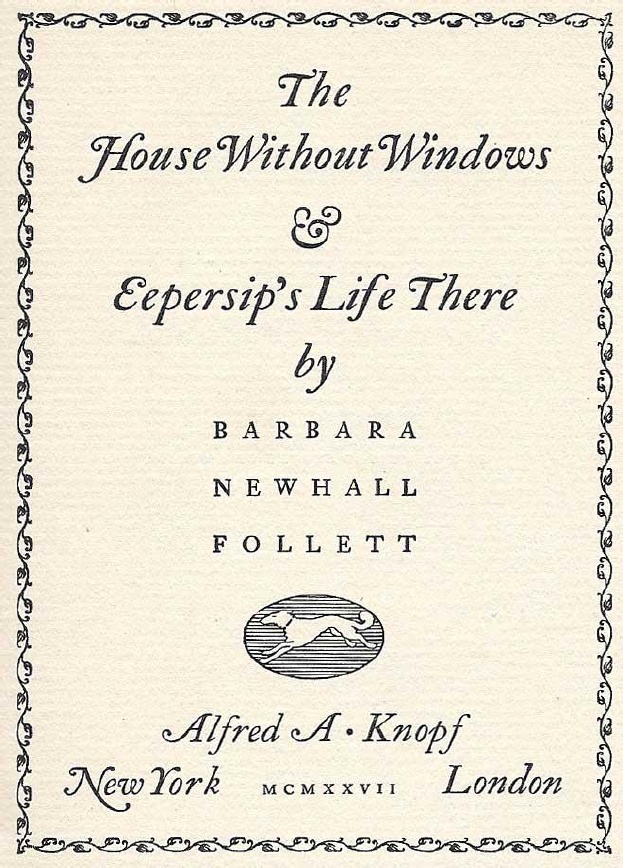
The House Without Windows / Barbara Newhall Follett
New York: Knopf, c1927.
52 p.
read via Scribd

Now on to my second try, a mercifully short novella about Eepersip, a young girl who runs away and lives in the forest and at the seaside among all the wild animals, making her clothes out of ferns, flowers, or seaweed. 

It's immensely florid in writing style, and plotting is very slight. Eepersip decides that living in civilization is not for her, and just walks away into the hills one day, leaving her parents to search for her ever after. She eludes them and when she finds out later that she has a little sister, she returns home to lure that sister away to live with her in the woods as well. That only lasts a few weeks and the little girl goes home to Mummy -- Eepersip is quite disappointed by this but all I could think of was thank goodness for that poor mother! 

The most interesting thing about this book is the actual circumstances of its writing (although the name Eepersip is surprisingly earwormy). There is a historical note included in the document that I read (linked above); this book was first written by Follett when she was 9, then rewritten from memory at 11 and published with the assistance of her father. She was apparently a girl who was intense and a bit of a prodigy; she loved nature and writing, and though she'd been married in her early 20s, one day she just up and disappeared, walked right out on everything like Eepersip had, and was never heard from again. And never tracked down. Eerie echoes of her first story. 

But unless you are reading this for its historical curiosity value, it's not really worth reading at all. Very influenced by the period and by the youth and idealism of its very young author, and therefore not of lasting interest.