Showing posts with label Classics challenge. Show all posts

Thursday, April 23, 2020

The Voyage Out

The Voyage Out / Virginia Woolf
NY: Grafton, 1978, c1915.
382 p.
And now on to Virginia Woolf's first novel, The Voyage Out. It's not hard to understand why this one is fairly hard to find in hard copy (my copy, the paperback above, came from my usual sources of secondhand bookshops). It is really not that good. 

You can feel that Woolf is already interested in the themes she continues to explore -- there are long drawn out days of boredom, parties, every shade of interactions explored -- there are also different things like South America, shipboard life, and very strange and emotionally constipated explorations of first love. 

There is also the first appearance of Clarissa Dalloway and her husband Richard, as they hitch a ride on the ship from one Eurpean port to another. The shipboard life was interesting but once the characters arrive in South America and take a house in a spot full of English people, the book became interminable to me. I did finish it, unfortunately -- I have seldom been so angry about an ending that felt ridiculous, unnecessary, and emotionally manipulative. 

So what's the plot? Rachel Vinrace is 24, her father is the ship's captain, and she has been raised as if in a convent -- she is extremely naive, inexperienced and socially awkward. Her aunt and uncle have been asked along on this trip, and it's her aunt (who doesn't particularly like her) who serves as chaperone in South America. There is a hotel full of English and European guests near their house there, and they interact with all the odd characters including a duo of young men, one of whom Rachel falls in love with. 

The repeated scenes with Rachel and Terence acting like they are dimwitted and rhapsodizing about love - are we in love? we are in love. what is love? - etc. were so tiresome and overdone. I am sorry, Virginia, but these characters felt like stage actors in some strange late modernist play. 

Most of the rest of the book focuses on the cast of characters in this hotel; who are they from the outside, from their own inner view, their class, their relationships, their habits of killing time -- everyone seems like they are simply in a waiting room here. The writing shows some brilliance and the roots of much of Woolf's work. But the characters were only middling and I was so bored so much of the time! 

It's the ending that really made this book unforgivable for me. That was what we got for sticking it out? Really? I felt so annoyed by the conclusion, upset and disappointed by where she went. So as you can likely tell by now, this is definitely NOT my favourite Woolf, and in fact I wouldn't recommend it. A novel cut down by half and focusing mainly on the sea voyage would have, in my opinion, been so much stronger. 


Friday, March 27, 2020

Tell Me A Riddle

Tell Me A Riddle / Tillie Olsen
NY: Laurel, 1976, c1961.
128 p.

This brilliant collection is made of four classic short stories:  "I Stand Here Ironing," "Hey Sailor, What Ship?," "O Yes," and "Tell Me a Riddle".

You may have read one of these stories anthologized in some textbook for high school or university -- I had never come across one of them, so found this little paperback a real gem of a discovery. 

Tillie Olsen tells four stories of motherhood and women's lives in poverty, with no romanticism. There is no noble suffering, just the realities of women having to live for others; the five children in the first story, or a husband's wishes, as in the last. These are stories of families who are scraping by, making do, and about what it does to them.

In the first story, a woman (not sitting still, never sitting still) muses about what she might have done that has caused her oldest daughter to have such troubles already. In the second, an alcoholic friend of the family is staying with them between ports - his addictions colour their lives while he is there. In the third, a daughter in this same family experiences growing up and losing her best friend when they hit middle school; while they are still at the same school, she's white and her friend is black. And it does matter, now. 

The final story, the title one, is the longest, and Olsen's masterpiece. It's the story of a Russian emigré couple, now in their elder years (incidentally, they are the grandparents of the family from the previous two tales). The husband wants to sell their house and move to a retirement community with his fraternity. The wife, meanwhile, does not. She wants to stay in her home and finally have some peace and quiet. To settle, to rest. And then she gets seriously ill. This story is genius; told sparely, with piercing insights and enough pathos (but not easy sentimentality) to bring you to tears, it is brilliant. I'd recommend that you find this one and read it however you can. 

While I don't always read a lot of short story collections, I'd most definitely recommend this one. It's one I'll be going back to.

Saturday, December 29, 2018

Challenges Past, Challenges Ahead

Photo by Gaelle Marcel on Unsplash

Here is the roundup of the Reading Challenges I participated in this year - it felt like I read a mountain of books for these challenges, and I discovered some great new stories that I might not have otherwise. That's always a good thing! I usually participate in challenges only if I am really planning to read in that vein anyhow: I have so much to read that I don't really need to be prompted :)

But here's how I did with the Challenges I read for this year, and then a little about what I think I might join in on next year as well!


Challenges Done:


The Canadian Book Challenge: this one runs from July 1 to July 1, and as I'm the host of this particular challenge, I read along quite regularly! I've already hit the 13 titles that we aim for in this challenge but I keep adding each Canadian title I read. You can join in too anytime before July 1 for this year's go round.


The Classics Club Challenge: I joined in on this one last year - it's a five year challenge to read 50 classics (books selected by you, which have been published at least 25 years ago). I read more than I thought I had this year -- I'm now at 18/50 -- and have until 2022 to finish up.


RIP XIII - I had to join in on the by-now-classic spooky reading challenge this fall as it was Year 13, and what better for spooky books? I read a couple of fabulous modern gothics, my favourite kind of spooky read, and a couple of surprise finds too.


Women In Translation Month: this runs all throughout August and is more of a readalong than a challenge, really. The goal is to read and share as much of your reading of women in translation as possible. This year I really tried to review or share a booklist every day in August, and I read some fabulous stuff.


A Century of Books (ACOB): this Challenge was created by Simon at Stuck in a Book and was intended to be a one year challenge; I began four years ago. This fall I really got the urge to finish it off by the end of this year, and I did. In a final push this fall I read the last few titles I needed to complete this challenge, and found one of my faves of the year that way! I am so glad I have finally completed this challenge!!


Although the Literary Sewing Circle is a book club/sewalong challenge held at my other blog (Following The Thread) it's also a reading challenge that anyone is welcome to join in on. I'll be starting the next round in mid/late January with a great Canadian read.


Challenges to Come:

Well, this is going to be a short addition, because as I completed my list above, I realized that all I'm planning on doing in 2019 is continuing on with all of the challenges above!

Unless I find a really intriguing one that has escaped my attention so far, I am planning to keep on with the Canadian Book Challenge, the Classics Challenge, will definitely be reading lots more Women in Translation this year, and I'm going to start up another Century Of Books Challenge list -- I did it this time in four years, so my goal is to complete this round in 2 years -- I aim to be finished by the end of 2020.

What about you? Do you love challenges? Or not?

Thursday, November 01, 2018

The House of Mirth

The House of Mirth / Edith Wharton
New York: Library of America, 1985, c1905.
347 p.

You know how it is when you finally read a classic, being dragged to it with the expectation that it will be a dry, "good for you" read, and you end up loving it, not being able to put it down, and being overcome with sobs at the end? No? Well, that was me and The House of Mirth. It really wasn't at all mirthful.

I expected to despise Lily Bart and her rich New York world. And while I did find Lily herself a bit annoying, and many of the side characters, especially the men, really irritating chumps, I was won over by the texture and the depth of the storytelling.

Not much summarizing needed for this classic: Lily Bart is a New York socialite who is closing in on 30. Her  beauty and charm is fading, and she needs to make an advantageous marriage soon, before it's too late. She has her sights on Percy Gryce, and is likely to hook him, too -- but her indecision once again arises and he slips through her fingers.

Part of this may be attributed to the fact that Lily is pulled between her high society lifestyle and her secret, deeper self which is more introspective and more interested in a non-wealthy acquaintance, journalist Laurence Selden. He doesn't step up, though, and Lily begins to spiral down the ladder of social significance, slowly, step by step. From being sought after and a queen of society, her dependence on men and need for income leads her to being a companion, then a secretary to the demi-monde, then a milliner and then to no work at all. From the heights to the depths. In Lily's journey to the bottom she comes to a realization:
Lily had an odd sense of being behind the social tapestry, on the side where the threads were knotted and the loose ends hung. 

But all along Wharton skewers the expectations placed specifically on women in this setting. As Lily says to Selden: 
Your coat's a little shabby, but who cares? It doesn't keep people from asking you to dine. If I were shabby no one would have me: a woman is asked out as much for her clothes as for herself. The clothes are the background, the frame, if you like: they don't make success, but they are a part of it. Who wants a dingy woman? We are expected to be pretty and well-dressed till we drop -- and if we  can't keep it up alone, we have to go into partnership. 

Lily notes the small niceties of society that make it next to impossible for a woman to be herself, or to truly befriend another woman unless, like Selden's socially conscious cousin Gerty, that woman has given up on 'society' completely. It's quite shocking to realize that this book, written in 1905, is still relevant in many ways to our world today. It's beautifully written and even though I knew what was coming, the final pages still brought me to tears. The frustration of a woman's life is unbearable to me even in fiction.

This is a strong and fresh read that still feels relevant, and which is written beautifully. Full of thoughtful characters caught up in tangled social situations that they can't seem to see their way clear of, it is compelling and frustrating and irritating and powerful. I'm glad I finally read it, for pleasure and not as a classroom assignment; it was worth the wait. 


Tuesday, February 13, 2007

Mary Barton


I started Mary Barton last week, and found I could hardly put it down. The plot is straightforward; Mary Barton is a beautiful young woman with two suitors. One, Jem Wilson, is an old family friend, an honourable working man who's been in love with her since childhood. The other, who turns her head for a while, is a rich mill owner's son, Henry Carson, whose intentions are only a bit of dalliance. Added to this story is a study of the social conditions of Manchester and its workers; some statements about the treatment and lives of the poor must have appeared shocking to her middle class readers. It really was a social novel, and I found myself comparing the ideas in it to her later North & South. She does not appear to have seen much change in the years between the two novels. I found this story very thrilling, with cliffhangers galore, until the closing chapters when Mary becomes ill. They drag a bit, until Gaskell seems to decide on a closing idea. And what a closer it was; Jem & Mary move to Toronto. I have to admit that reading "Toronto" at the end of a 19th century Manchester novel was a bit jarring for me; the images just butted up against each other strangely. When I'd finally wrapped my head around it, I gave myself a good laugh imagining them meeting all the Who's Who of 19th C. Toronto society, such as Susannah Moodie. [n.b. It was strange for me because I live near TO and so imagine it as it is now.] This was her first novel, and the authorial voice interrupts many times. I actually enjoyed it; I know many people find it irritating. She seems to have mostly gotten over that habit by her final novel, Wives & Daughters, one of my all time favourite books.

Sunday, February 11, 2007

The Man who was Thursday


I hardly know what to say about this G.K. Chesterton book. It is a surreal classic; subtitled "A Nightmare". The main character, Gabriel Syme, is a young poet/policeman who befriends an anarchist poet in an attempt to infiltrate a secret anarchist organization in which the leaders go by the names of the days of the week. Syme talks his way into being elected as "Thursday" and then is whirled into a manic world of espionage and excitement. One by one the other members of the Council reveal themselves as policemen also, until they realize that everyone but the all-powerful Chairman Sunday belongs to the police and they've all been set to watching each other instead of real anarchists. The action mounts frenetically from Syme's first steps, which are quite logical, to a whirlwind of wild events - duels, car chases, mob shootouts, elephant chases, balloon escapes - until it culminates in a costumed garden party in which they are all dressed allegorically as their Day of the Week, and Sunday appears as a huge deity-like being. It is very strange, and very like a dream, in which nothing really makes sense but you feel there is something representative about it all. Unfortunately, although I can sense there is something here that I'm missing, I'm ultimately just not interested enough to puzzle out the meaning of this dream. It's a weird little book; I can't say whether I liked or disliked it. It's a book for sustained study - but I can't be bothered unravelling this allegory.

Tuesday, February 06, 2007

The Moonstone

I've finally finished The Moonstone; I don't know why it took me so very long. But as I read it in small bits, I was able to enjoy it longer! I thought it was great fun, and the solution to the theft suitably 'sensational' for a Victorian thriller. The best part of it was the ability of Wilkie Collins to delineate each character so well. The multiple narrative voices were quite distinctive. I must admit to a fondness for Gabriel Betteredge, an aged family retainer with a prediliction for his pipe and for Robinson Crusoe. His storytelling was wonderfully done - I enjoyed his asides, especially the one in which he says : "Nota bene: A drop of tea is to a woman's tongue what a drop of oil is to a wasting lamp."
And Miss Clack was simply hilarious. He was mocking a certain kind of self-righteous Christian woman, and he had it so spot on. The image of Miss Clack throwing tracts in at cab windows made me laugh out loud. And her justification for continuing to try to force her Aunt Verinder to read improving literature (ie: "Satan among the sofa cushions", he he) is one of the best explanations of fanaticism that I have read. She says, "Once self-supported by conscience... the true Christian never yields ...We are above reason;...we feel with nobody's hearts but our own...for we are the only people who are always right." [Substitute for "Christian" in this quote any fanatic, whether religious, political or intellectual]. Wilkie Collins was so prescient.
My next Collins read is Armadale, as part of the Chunkster Challenge. Can't wait to get to that one.
Funny story:
Library patron: "What are you reading right now?"
Me: "Oh, just some Collins."
Library patron: "Jackie?"
Me: "No, Wilkie."

Thursday, January 18, 2007

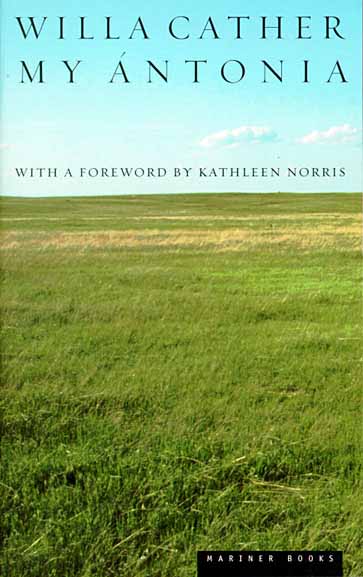
Reading My Antonia


This is my second Classics Challenge read, and I can't believe it took me so long to read this! It's a touching, elegaic novel of early immigrant life in Nebraska. It is written in a stately, formal style which gives a poetic gloss to these lives, but it also feels as if the narrator is looking back over a gap of many years. I found the reminiscent tone a bit distancing -- I liked the book, but was never fully engaged in it.
The story details the lives of the Shimerda family, recent Bohemian immigrants, but from the viewpoint of young neighbour Jim Burden. Maybe that was the difficulty; I would have preferred the story from Antonia's side of things. But, perhaps Willa Cather felt she should or could not tell the story from a Bohemian girl's viewpoint, and she instead made Jim into a semi-autobiographical character, using her own life experience to shape the telling. The novel is really about Jim's experience, not Antonia's, and so that might be why it is titled MY Antonia, and not simply Antonia. It is the story of her life mediated through Jim's understanding.
I am glad I read it; I enjoyed the characters of Antonia and her friends Lena, Tiny and 'the three Marys'. And it is nice to get another of those "should-reads" off my life list!

Tuesday, January 09, 2007

A Challenge ended, a challenge begun

I've finished Miss Marjoribanks, the last on my challenge list for the From the Stacks reading challenge from Overdue Books. It's also first on my list for the Classics challenge from A Reader's Journal. A good start to the year; feeling as if I've accomplished something but still have lots ahead to read. As for the book...I enjoyed reading the story of a young woman whose sole purpose in life is "to be a comfort to dear Papa". Lucilla Marjoribanks is 19 when she returns to her widowed father's home from her schooling, to take on her rightful role as a leader of Carlingford society. She takes charge of her small town, arranging both social life and various marriages to her satisfaction. Most of the book covers her first year as society's new queen, while the final quarter skips ahead to the 10th year of her long reign. It is then that Lucilla's father dies, and she finally marries and changes her sphere of influence from Grange Lane in Carlingford to the village of Marchbanks, on the estate of her great-grandfather Marchbanks. (A specialty of English spelling; pronounciations that are not evident. Marjoribanks is said 'Marchbanks'. For more on my prediliction for odd English spellings see my husband's post about our bookshop name.)
This novel was originally serialized, as were many in the 19th century, and it shows, with many repetitions of plot lines and unnecessary padding to the story. But it was an amusing read, and Lucilla's masterful social machinations were entertaining. Recommended to Anglophiles everywhere.