Showing posts with label Korean. Show all posts

Sunday, August 02, 2026

Reading in Translation Month: Japanese & Korean Books read since August 2025

I have been attempting to read more women in translation year round, ever since I started participating in #WITMonth way back in 2015. Some years I get a lot read and reviewed, sometimes I don't get much read, sometimes I read a fair bit but don't review! 

This year I've read a lot of Japanese and Korean books - here are the ones written by women that I've both read and reviewed since last August. Some of my unreviewed titles will be showing up this month as well :)


We'll Prescribe You Another Cat / Syou Ishida


Thursday, July 09, 2026

Every Day I Read, by Hwang Bo-Reum


Every Day I Read / Hwang Bo-Reum
trans. from the Korean by Shanna Tan
London: Bloomsbury, 2025, c2021
240 p.


This is a beautiful book on reading, by a Korean writer. It is a series of small essays on a wide variety of topics related to reading - choosing books, paying attention, finding time to read and so on. The chapter headings are like prompts that she starts from, writing a short essay on each -- some more effective than others, but I enjoyed them.

I really liked this. It felt really simple but her love of the act of reading came through. It would be a great choice to read as a group project: there are 53 chapters, so you could read the intro and then read one a week for an entire year. I would do this as a reread! I'd love to hear people's individual responses on each theme in the book. 

I found it engaging, even with the sometimes overly serious statements about reading hard, important books. The author is just 30, and most of us who read regularly will have thoughts about these issues. The short chapters were perfect for listening to as an audiobook, which I did, although I want to reread it in book format as well, to go over the chapters a little more slowly. I felt like I was listening to a fellow reader who was reaffirming the joys of a reading life - nothing new but lots to nod along to, and nice to hear the thoughts of someone who was deliberately investigating their own reading life. There are also reading suggestions sprinkled throughout, but some of them aren't available in English so you'll have to pick and choose there!

It's light but satisfying. I would suggest it, when you are in just the right mood for some reading about reading. 


Wednesday, August 20, 2025

The Healing Season Of Pottery


The Healing Season of Pottery / Yeon Somin
trans. from the Korean by Clare Richards
NY: Algonquin, 2024, c2023.
272 p.


This recent Korean novel was really enjoyable. It falls into the healing fiction category, but it has a little more depth as well. This storyline is another example of the midlife crisis at 30 that I've been noticing in Korean novels of this kind recently. 

Jungmin has burnt out at thirty, and abruptly quits her job as a tv writer, ending up as a recluse in her small apartment for months. Spring comes and she finally stumbles out into the world, coming across a pottery workshop that she at first mistakes for a cafĂ©. The people inside are very welcoming, and somehow Jungmin finds herself joining some pottery classes. 

The regular schedule gets her out of her apartment, working with her hands provides her some calm and relief, and the small core of students she meets there give her new friendships and social interactions. She even ends up taking in a cat for one of them. 

The author clearly knows how to do pottery, and the details of the actual construction of pottery gives lots of opportunity for metaphors for life. I thought this worked very well. It's a nice change from the cafes, cats and bookshops that populate most of the books in this genre. Although there are cats and coffee here too ;) 

Through the year of making pottery and making a new place for herself in the world, Jungmin gets a sense of what she wants to do next, and what will be meaningful for her. There is a small thread of romance in the story, but she is not saved by falling in love or finding a relationship; she makes her own path, particularly focused on her work life. I really appreciated that, and felt that it gave integrity to this story. We also get a little bit of insight into the other characters and their big changes - they all have something that they are facing up to. I thought the interactions between the characters were lovely, each one an interesting person and no nastiness going on. Even when a heavy incident from Jungmin's past  arises again, there is a resolution to the lingering bitterness. The reader is left with a sense of uplift and a feeling that these characters are going to be okay. 

The translation is a little noticeable at times, with many Korean words left untranslated, to give the flavour of the original, I assume. A small glossary would have been nice to include, but there is always google. Some of the choices definitely reflect the UK English of the translator, as well. And I found it interesting that this book talks about celebrating Christmas in Korea (they have a pottery booth at a Christmas fair) and various other elements of contemporary life like international travel, the business world and more. I really liked this one. 


Saturday, August 16, 2025

Counterattacks at Thirty

Counterattacks at Thirty / Won-Pyung Sohn
trans. from the Korean by Sean Lin Halbert
Toronto: HarperVia, 2025, c2017.
240 p.

I like workplace novels; there is something that intrigues me about the daily life of other people. So when I saw this Korean book, I knew I had to read it. 

Kim Jihye is around 30 but she's still an intern at a small college. She can't quite figure out where she's gone wrong, career-wise, but just goes along with the role and its menial tasks and hopes for the best. Then a new intern shows up, Gyuok Lee. He's about her age but doesn't seem to mind being an intern, in fact he is so calm and helpful everyone loves him. But Jihye has seen him before. 

Gyuok Lee is a rebel, he quietly stirs people up to some kind of rebellion, some kind of striking back against an oppressive system. Jihye, however, is a rule-follower, and is shocked to find she is drawn to Gyuok's ideas. One of the benefits of their internship is that are allowed to take one free class a term at their college. Jihye has never taken advantage of it, but Gyuok says they should take the most expensive one, which turns out to be a beginner ukulele class. In this class they meet two other disaffected men. 

Gyuok uses this small group to stir up small acts of opposition to those who use power to oppress, from the smallest example (their boss who doesn't do much work but burps and farts all over the office) to larger, corrupt organizations. We don't see the actual acts they perform, after the first couple, but  they do escalate to bigger efforts, until they are all briefly arrested at one of them. And when they find the full background of  the others, this little band breaks down. 

This was an interesting novel, and an interesting concept. It seems to combine the darker side of Korean fiction with the lighter, "healing novel" side. There is a bit of both and they balance each other so that this book ends up somewhere in the middle. Jihye is pushed out of her rut - she moves on to a better, real job and is able to use her skills and experiences creatively. The other three sort of fade out, until Gyuok reappears, calm as ever, at the end. There is a small romantic thread going on but I was pleased that it wasn't the focus, and that Jihye finds herself by finding a new job and creating new experiences, not by falling in love. There are thoughtful issues in this story and a hopeful conclusion. I liked all that. I did find that the plot was a little loose at times, and the pace of the novel was a little uneven. But the two primary characters were well drawn and moved the story. This is one of a number of Korean novels I have read recently that focus on being thirty as a turning point in life, it's like middle age crisis hits at 30 in Korea.  

In any case, I thought this was a good read, with thought-provoking points and a strong main character in the very ordinary Kim Jihye. 
 

Friday, August 15, 2025

The Dallergut Dream-Making District


The Dallergut Dream-Making District / Miye Lee
trans. from the Korean by Sandy Joosun Lee
Toronto, ON : Hanover Square Press, 2025, c2021.
298 p.


Part two of the Dallergut Dream Department Store duology, this Korean book is whimsical almost to a fault. I read the first one last year, and decided to continue the story with this new volume. 

It continues main character Penny's story. She's now been a reliable employee at the Dallergut Dream Department Store (a place where sleepers go to purchase new dreams) for a year, so she is being given new privileges, namely the opportunity to travel to the lower town, the shopping district for dream makers. This includes a look at the Noctiluna's Laundry, which was an intriguing addition. 

There are employee interactions, both smooth and prickly, there are new experiences for Penny as she tries to bring back shoppers who have dropped off the radar, and there is also a huge dream festival created by Dallergut to close out the book. 

I found this one a little twee; the beginning was especially hard to connect to as it was a lot of 'telling', creating new locations and so on. The last half of the book was a bit more fun and natural feeling, especially once all the staff got in on the Festival planning. That element was energetic and fun. 

I don't know if this is the conclusion of the story, or if there will be more to come. But I'm not sure I'm invested enough to read another in this series anyhow; it's a bit soporific, ironically enough. 

Saturday, December 21, 2024

The DallerGut Dream Department Store

Dallergut Dream Department Store / Mi-Ye Lee
trans. from the Korean by Sandy Joosun Lee
Toronto, ON : Hanover Square Press, 2024.
287 p.

Just finished this charming little read -- part one of a two part series. It's definitely in the vein of all the Japanese cat/coffeeshop/cozy reads lately, even though it's Korean. It's set in a small country that exists in our sleep, where sleepers can go and pick out the kind of dream they want at many dream shops. And they pay in the emotions they experience thanks to that dream. 

The story starts with the introduction of Penny, our main character who is getting ready for her interview at Dallergut Dream Department Store. Dallergut has a good reputation and she really wants to get a job there. Luckily for her, and for the reader, she does get hired, and as she learns her new job, we follow along with her. This gives us a sense of the story in a natural way; as it's all new to Penny, the author can be more descriptive and explicit about the strange and unusual things she encounters. 

Along with the quirky Dallergut himself there are many Dream Designers, superstars of this world. From the flamboyant to the reclusive, each is famous for a certain type of dream -- whether a flying dream, memories of lost loves, dreams of success or more, people can choose a designer dream to suit their needs. And, the employees of the dream department stores are thrilled when one of the designers appears. 

Penny becomes an assistant to Dallergut & gets to go with him as he visits many of these designers. Maxim specializes in nightmares, but  is also a young and handsome man, who finds Penny easy to talk to; it's a nice area for development in the story. But I found one entertaining moment in this book to be the big gathering of important dream designers, which is in a winter chalet, home of winter dream specialist Nicholas -- aka Santa. 

This brings a bit of seasonal charm to the story and I loved the frosty themes in that section. I liked the book as a whole, although it was on the edge of twee for me. Lots of creativity in building that world though, and some really fun characters developed. I think I will most likely read the second one!  


Friday, October 25, 2024

A Magical Girl Retires


A Magical Girl Retires / Park Seolyeon
trans. from the Korean by Anton Hur
NY: HarperVia, 2024, c2022.
147 p.

Someone mentioned this on IG and I thought it sounded fun - and my library had it as an ebook! So I read it :) 

It was okay - a little short with a bit of an abrupt conclusion, but still a fun read. It's steeped in a timely setting: the main character, a 29 year old woman, has lost her job during the pandemic and is facing mounting credit card debt and climate anxiety. She decides to jump off a bridge in Seoul. 

But her guardian angel rescues her -- actually it's Ah Roa, a clairvoyant magical girl on a mission to find the greatest magical girl of all time. Usually magical girls are discovered much younger, but our heroine might just be a late bloomer, and the GOAT. 

As her life is upended and she begins to meet other magical girls and learn the tricks of the trade, she's faced with an end-of-the-world scenario that she manages to deal with almost accidentally, driven by her fear of Ah Roa's imminent destruction (there's a little side romantic theme going on there too). And she discovers her particular talent at the vital moment. But also wonders if she really wants these powers or not. 

As noted, the ending is a bit sudden or abrupt, at least to me. I wasn't positive I fully understood her powers. But the overarching story is entertaining and creative, and brings up lots of serious topics in an engaging and frothy way. A short but rewarding read. 


Saturday, March 09, 2024

Snowglobe


Snowglobe / Soyoung Park
trans. from the Korean by Joungmin Lee Comfort
New York : Delacorte Press, 2024, c2020.
372 p.


This YA dystopia is set in a future Korea after climate disaster has reduced most of the world to constant sub-zero weather. We’re talking -50 on an ongoing basis. Chobahm lives in a small settlement with her mother, twin brother and grandma. Now that she is finished school, she works at the local plant – nearly everyone in every settlement spends their days generating electricity on a human hamster wheel. Other jobs are few and far between - some postal clerks, some train engineers but not much else.

 To keep people satisfied with their cold and meager lives, 24 hour-a-day reality tv is streamed from Snowglobe. That's a glittering city enclosed by a dome, with a temperate climate thanks to geothermal vents -- all run by one powerful family. Everyone in Snowglobe is either an actor or director, with actor’s full lives continually televised. Chobahm’s dream is to move to Snowglobe and become a director someday.

But Chobahm has a startling likeness to Goh Haeri, the star of her favourite show. And when Haeri disappears, her Director appears with a life-changing offer – Chobahm can accompany Director Cho to Snowglobe and take on Haeri’s role, with nobody else knowing there has been a change. But dreams can harbour dark sides, and Chobahm quickly finds out that Snowglobe is not as idyllic as she’d believed. Skewering reality tv, surveillance capitalism, and corrupt governing bodies, this fast paced novel is full of dramatic plotlines and strong characters. It ends with a cliffhanger – book two of the Snowglobe duology is due out next spring. I found it engaging, quick moving and creative. Very plot driven but with some fun characters to follow as well. 

Wednesday, October 18, 2023

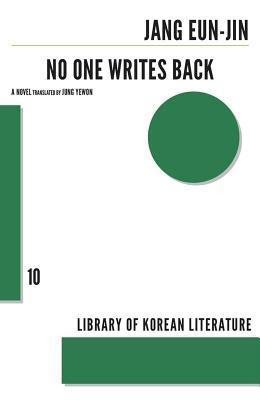
No-One Writes Back


No One Writes Back / Jan Eun-Jin
translated from the Korean by Jung Yewon
Funks Grove, IL: Dalkey Archive Press, 2013, c2009.
203 p.


This isn't an epistolary novel, but it does revolve around letters, both the writing and sending of them, and it also involves travelling. 

I first saw it mentioned by someone during a Women in Translation month. I found it in my library's online collection so decided to read it, and I'm so glad I did. It's a thoughtful and reflective read, with a lot to discover. 

Jihun left his home 3 years prior to the opening of the story; he brought along an MP3 player and his blind dog, Wajo. They've been travelling ever since, and as they go, Jihun lets chance lead him. If on any day he gets into conversation with a stranger, one who is willing to give him their address, he'll mentally assign them a number, and write them a letter. And each day as he leaves the random motel he's chosen for the night, he finds a payphone and calls his friend at home, who has agreed to check in and see if anyone has written back. If just one person writes, he will go home. But the title alerts us: no one writes back. 

We enter Jihun's story near the end of it -- one morning as he heads out with Wajo, a woman selling her book as a street vendor follows him. She sticks to him like a limpet and though mostly unwilling, Jihun ends up with a new travelling companion. She's number 751, and as it turns out, the last number he has to memorize. Her liveliness and engagement with life and the people around them drags him from his remote world of numbers into one of emotion and feeling. When they escape a crisis at a hostel, and then Jihun realizes that Wajo is getting old and sick, he comes to understand that it's time to head home. 

In the final pages of the book, we discover why Jihun left home in the first place, and why no one wrote back. And those final pages turn the whole story on its head and deliver a shock that should affect every reader. It's so powerful, and seems unavoidable once you know the whole story; it makes you go back and reread earlier bits in the light of what you've just read. It's beautiful, and melancholic, and so worth reading. This was an unexpected story, different from what I thought I was getting, and I highly recommend it. 

'Life is bearable when you have someone to write, and someone who writes you back. Even if it's just one person.'

Wednesday, August 16, 2023

White Book by Han Kang


The White Book / Han Kang
translated from the Korean by Deborah Smith
London: Portobello Books, 2018, c2016.
161 p.


I had to get this book via Interlibrary Loan after I saw someone talking about it on their book blog, but I don't remember who mentioned it, I'm sorry! 

In any case, they were correct - this was a beautiful read, poetic and striking. It's made up of short, reflective pieces, quite lyrical, on a range of topics. It explores the colour White, with a list of white things, and well as having this idea shape many of the other sections, as white objects lead to reflections on things in the narrator's past.

The narrator is living in Warsaw on a writer's residency, and wanders the city, thinking of her sister, a baby who had died at birth in tragic circumstances, but whose death made it possible for the narrator to exist. The short chapters build on one another until we have an idea of the full story. 

These reflections are sharp, involving grief over her family history, and death in a broader sense; she visits WWII memorials as she walks the city. The events are softened and blurred, rather like the whiteness of fog, by the introspective meditations of the author. 

The chapters are interspersed with black and white photos in soft focus, often of domestic themes. The first one is of a woman sewing something on her lap. These images evoke the feeling of memoir and veracity of this fictional story. It also feels like the book has shades of Sebbald in the use of photographs, and walking through cities. 

This one has been nominated for and won many prizes, and I can see why. It's a fragmentary, dreamy read that lingers in the mind. The language is poetic and measured, the concepts are deeply resonant and visually rich. Read this if you are looking for a slower paced, meditative journey through personal history, which sheds light on universal concerns. 


Tuesday, August 15, 2023

Violets


Violets / Kyung-Sook Shin
trans. from the Korean by Anton Hur
NY: Feminist Press, 2022, c2001.
218 p.


San is a young woman, 22, estranged from her mother, living in the city and looking for meaning in her life. She's taken a typing course, but can't seem to find the work that she wants with that qualification. One day she sees a Help Wanted sign in the window of a florist shop, and decides to try it out. Luckily she is hired immediately, and begins working in a place that is all hands on, focused on earth and real things. She begins to learn flower names and settles in, despite being introverted and the kind of person who doesn't talk much, going straight home to her apartment each day. 

Her social round is focused on the shop; it's mute owner, the other florist, Su-ae, and varied customers. She has to deal with a businessman who is sexually inappropriate (and he turns up again), and develops a crush - obsession really - with a photographer who shows up one day to take photos of violets for the home magazine he works for. 

This obsession spirals, until San is putting herself in sexually dangerous situations and floundering in her lifestyle, despite having Su-ae (who is much more grounded) staying with her for a while. Her new closeness with the more extroverted Su-ae brings back memories of being rejected by her childhood friend Namae after a burgeoning romantic moment, and the hurt feels fresh again, driving her recklessness. San is full of repression, from her desires, to her voice, and this reflects the misogyny she experiences as a young woman in Korea, especially one who isn't naturally interested in men and their desires. 

It's slightly slow-paced, but with an increasing sense of dread. Many of San's experiences are laden with overpowering and dangerous metaphor as well as reality. The work in the flower shop and at the farm that supplies them gives her sustenance, nature as healer, but even then she focuses not on the gentle and beautiful but an unusual carnivorous plant. This is very much her personality. And the book doesn't give her, or the reader, an easy out. 

I found this a difficult read; there is so much despair in the character and in the story arc. It's very moving, as well as troubling. The writing style is fluid, not reflecting San's isolation or despair structurally, and I found that made it a bit easier to understand the flow of the story, in a really good translation as well.

Sunday, August 21, 2022

The Old Woman with the Knife

The Old Woman With the Knife / Gu Byeong-Mo
trans. from the Korean by Chi-Young Kim
Toronto, Ontario : Hanover Square Press, 2022, c2013.
280 p.


When do you know it's time to retire, if your day job has been working as a stealth assassin for many years? Do you take advantage of your increased invisibility as an aging woman or do you call it quits and relax at home with your dog? 

This is the question that plagues Hornclaw, who worries that she's losing her edge. For example, her reflexes are slightly slower. And there is the fact that she's letting an emotional attachment to a stray dog develop; she's getting soft, even if she does name it Deadweight. But she figures she'll do one or two more jobs then think about a change. Unfortunately, there's a young and cocky new employee at her agency that seems to have it out for her, and she just can't back down. 

The story of these two, and how and why the antipathy between them exists, makes up the book. But we only get it in bits, between a lot of action -- her weak point is a doctor who saved her from an injury once, and this doctor's family gets caught up in the vendetta against her. Will this emotional attachment be the end of Hornclaw's career or will her experience prevail? 

I found this a quick and entertaining read. Despite the characters all being ruthless contract killers, and the inclusion of quite a bit of violence (not too gory), it feels like a lighter read. But aside from the action and dark humour, there is an undercurrent of thoughtfulness. Questions of aging, identity, power, women's roles and what society thinks women owe the world, and human connection all rise up. It's a great combo, and made this a memorable read - I'm still thinking about it and trying to decide what I think of the ending. Hornclaw is a cantankerous old woman and a remorseless killer, but she's still a compelling character that I couldn't help feeling compassion for. 

I'd recommend this to anyone who wants to dip their toes into translated fiction but reads mostly genre; it moves along and has strong plot as well as a couple of strong characters to draw you in, in addition to the intriguing setting. 

Saturday, August 21, 2021

The Disaster Tourist

The Disaster Tourist / Yun Ko-Eun; 
trans. from the Korean by Lizzie Buehler
Berkeley, CA: Counterpoint, 2020, c2013.
200 p.

I picked this up a while ago, having not reviewed it yet since I'm not quite sure what to say about it! It's a strange little book. Yona has been working at Jungle for 10 years -- it's a company who arranges tours to areas that have suffered disasters. The more terrible the disaster, the keener the tourists are on visiting the aftermath. 

Her office work has been going along smoothly for a long time, but now she's experiencing harrassment from a new, predatory coworker. Jungle doesn't want to deal with it, so they give her the "opportunity" to do a site visit to a small island that they are reconsidering their partnership with. The returns haven't been great, since there is only an underwhelming sinkhole at the island resort. She's to pose as a tourist and give a full report on the situation. 

Of course when she gets there, all sorts of things begin to change. Jungle doesn't seem as supportive as she'd like; meanwhile, the hotel where she is staying seems to be involved in a plan to create a new disaster to up their value in the eyes of the tourist trade. 

Yona has the chance to take on a new position with the island tourist organization, but is it really any better than her work with Jungle? How responsible is she for the actions of the company she works for? And will either one care about her as a person, or is to going to be left to her own devices in the looming disaster ahead? 

Lots of interesting questions posed here, and I liked the oddity of the setup. It doesn't seem too farfetched, really, but does allow the character to be put into some surreal situations. The structure of the story works, too, with a slow build that keeps you reading and horrified by what you are imagining is coming next. 

I found it interesting and appreciated what it was doing. I also liked the style, I thought it reflected the character well. However, I also found it really dark, and parts of the narrative made me uncomfortable. The aesthetic is one I find in a lot of Korean books in particular, and it just doesn't mesh with my current state of mind. So emotionally, I didn't love this story. But that's not a reflection of the book - objectively I think this is a fresh take on a topical theme, and it was unexpected and well-done. Just not what I was looking for right now. 

Friday, August 20, 2021

Winter in Sokcho

Winter in Sokcho / Elisa Shua Dusapin;
trans. from the French by Aneesa Higgins
Rochester, NY: Open Letter Press, 2021, c2016.
160 p.

I love the cover of this book, and I've been wanting to read it since it was mentioned last #WIT Month. I finally got a copy, and it was a quick read. It's fairly short, and the writing style isn't too complicated. 

The unnamed narrator is a French-Korean young woman who is working at a B-grade guest house in Sokcho, a small tourist town on the border of North and South Korea. She seems to be suffering from anomie; the town is cold and mostly deserted, her boyfriend is off to the big city for plastic surgery and a bright career in modelling, and her mother wants her to come home every minute she has off work. 

A guest arrives -- the guest house is only half full so she notices this large, quiet French man, who goes to his room and doesn't eat what she offers or engage with the other guests. He turns out to be an illustrator/graphic novel writer, and he wants her to show him the "real" Korea. Not such a great mix, as he is laconic and she's withdrawn. There's talk about the state of life in Korea with a war that's never really ended; echoes of colonialism in their relationship, and a strange sexual tension that isn't really straightforward. 

So many people have loved this book. Sadly, I'm not one of them. I thought it was an interesting set up, and well structured, but I just didn't connect with either character or their dilemmas. I found them both unpleasant and self-absorbed, and just wasn't sure what the point of the book was in the end. The ending was cleverly done, and with the edge of danger that seemed to exist in our narrator, for sure. But I guess it just wasn't the book for me right now - I didn't even try to figure out that ending once I'd finished. I hope if you pick it up, it will be better timing for you!

Thursday, August 12, 2021

Translation Thursday

 It's Translation Thursday! Each Thursday this month I'm going to share the translation I'm currently reading plus a few more on my reading list. Here's today's list:

Currently Reading:

Winter in Sokcho / Elisa Shua Dusapin
trans. from the French by Aneesa Higgins


To Read:

No One Writes Back /Jang Eun-Jin
trans. from the Korean by Jung Yewon


I'll Be Right There / Kyung-Sook Shin
trans. from the Korean by Sora Kim-Russell


Bluebeard's First Wife / Ha Seong-Nan
trans. from the Korean by Janet Hong

Sunday, February 16, 2020

The Starlet and the Spy

The Starlet & the Spy / Ji-Min Lee;
trans. from the Korean by Chi-Young Kim
NY: Harper, c2019
192 p.
In 1954, Marilyn Munroe visited US troops in Korea. This much is true. And this is what sparks this novel of the Korean War, and the effect that Marilyn's visit has one one particular Korean woman, Alice J. Kim, who works as a typist and translator for the US Army in Seoul. 

Alice has a long and tragic backstory, having been caught in the North during the war. With a story of terrible things, of camps, and escapes, and bombs and betrayal, and of a young child given into her care and then lost, Alice is trying to recover and behave normally, hiding her secrets and the two lovers she left behind in the war. Unfortunately for her, one of them was a US spy who turns up again, just like a bad penny. 

She is roped into travelling with Marilyn during her visit to keep her organized and to translate for her. The tenuous relationship they form, and the similarities they share, change both their lives. 

Unfortunately, I found that the presentation of Marilyn was very vague and surface driven -- Marilyn is as distant and starlet-like as she is in her films. You don't get a feel for her as a person at all, just as her historical persona. Thus, the connection between she and Alice feels unreal and unconvincing. Alice herself is a strong, tragic figure who is living in brutal reality; the comparison with the vague woes of Marilyn, in need of sleeping pills, seems trite. 

The story is dark but also has a cinematic feel; it feels a bit distant from the interiority I prefer in a novel that is so based in personal experience and perception. The best parts of the book illuminate daily life in Korea both before and after the war, the daily preoccupations of different characters, and the effects of civil war and foreign interference. 

So as a whole it's a brief read that sheds light on a troubled moment in history, and does that quite well. As a romance or celebrity novel, it falls short. Marilyn Monroe feels like an unnecessary prop to a more important story, in the end.

Friday, August 10, 2018

The Hen Who Dreamed She Could Fly

The Hen Who Dreamed She Could Fly / Sun-Mi Hwang; translated from the Korean by Chi-Young Kim
New York: Penguin, 2013, c2000.
134 p.

This little fable, prettily illustrated by Nomoco, is a very quick read that seems straightforward on first view.

A laying hen, having named herself Sprout, finds a kind of freedom after surviving a cull of non-productive hens. She's outside of the coop, in the farmyard, as she's always dreamed.

But the other animals - the rooster, hen and flock of ducks, alongside the guard dog, don't seem to want her there. She tries and tries to fit in, hovering at the edges of the farmyard society and taking the scraps of what's left. Until finally she realizes that this just isn't enough. She follows a wild duck from the barnyard out into the fields and there gains her heart's desire -- to hatch a chick.

Unfortunately the chick is from an abandoned duck egg, and Sprout must raise this duckling on her own, with only her own love for it to guide her. 

All the metaphors of sacrificial motherhood as the highest calling are found here. Sprout protects Baby from the stalking of the wild Weasel and the mockery of the farmyard society which she briefly tries to return to. She gives up everything, she's hypervigilant, she subsumes her own brief life and hopes of freedom in her care for Baby. She raises him, allows him to strike out on his own with a flock of mallards who appear on the lake and finds the apotheosis of her sacrifice when he flies south with these ducks of his own kind.

I'm sure there are many parallels to the acceptance of multiracial norms in Korea that I'm missing - perhaps a social bias about adoption - and certainly an attitude of maternal sainthood. While this book has been compared to animal stories as varied as Charlotte's Web to Animal Farm, I don't think there is a bigger message here other than that maternal relationship as the whole of life's meaning. 

It's a very short book, an easy read, with a definite fable-like tone. I do feel like I'm not grasping the full implications of her metaphors and references, perhaps because of my lack of familiarity with the social structure she's reflecting, and perhaps because the glorification of motherhood is not a theme I connect with at all. If anyone has read this and has another take on it, please share! 

It's still a charming book for the characterizations of all the different animals, and the realization that 'enemies' like the Weasel and Sprout herself have personhood in common (again, this comes via the maternal theme). Sprout's desire for freedom and her unquenchable independence did save the story from becoming only a maudlin paean to maternity. It's a lovely physical object as well, and the illustrations add an extra touch. Despite my reservations about elements of the theme, it's worth exploring.


Tuesday, August 07, 2018

The Hole

The Hole / Hye-Young Pyun; translated from the Korean by Sora Kim-Russell
New York : Arcade Publishing, 2017.
198 p.

I picked this book when it came into my library, intrigued by the cover. Then I realized that this very cover meant that I was reading the title as *hole, colouring my experience of the story. But the main character was a bit of an *hole so there it is.

It's a short, dark, and eerie story of Ogi, a man who is in a car accident and ends up in a coma, and then when he awakes finds that he is paralyzed. He's taken home when his mother-in-law decides to move in and care for him.

But the car accident has also killed his wife, her daughter -- and as the story progresses, she is not caring for him much at all. She is focused on finishing the yard work that her daughter started, digging a hole that keeps getting bigger and bigger.

But as Ogi tries to practice moving so that he can get out of his room and see what's going on, he finds out that life with his wife wasn't as ideal for her as he'd thought it was.

This was a dark read; I've seen some comparisons to Stephen King's Misery, as one example. I've never read that so can't compare for myself, but I think there's that sense of foreboding, isolation and being in the power of another person who doesn't necessarily have the same view of what's good for one as one does oneself, in both books. I wasn't a huge fan of this book, though, for that same reason. I could admire the structure and the increasing sense of the world closing in down to one small dot - but I didn't love the darkness and the violence and the despair. The conclusion was surprising, and made sense in retrospect. But I have to say this wasn't really the book for me in the end.