Friday, January 28, 2022

The Sentence

The Sentence / Louise Erdrich
NY: Harper, c2021
387 p.

I read this last year and it was one of the best of the year for me. As promised, I'm finally getting around to sharing my thoughts on it! 

I'll always read a Louise Erdrich book, without even having to know anything about it. But this one was especially interesting. Written during and about the pandemic, it has an immediacy to it, an urgency that overrides her usual considered pace and tells the story in a rush, with lively contemporary characters. I loved it. 

There have been a few books I have seen lately set during the early months/year of the pandemic, but this is the only I've read that feels natural and life-like. Erdrich has a good sense of character and of course a very skillful style, so the book moves forward smoothly and naturally.

It starts with Tookie, a woman who survived years of imprisonment by reading intensely -- and now that she is out of jail, she's found a job at a Minneapolis bookstore run by 'Louise'. Tookie is a complex and many-layered character, and somehow she made a connection with Flora, a former regular at the bookstore. Flora has died, but she hasn't left the bookstore. At first Tookie is the only one to realize it but the other employees eventually notice as well. 

Tookie's marriage and relationship with her step-daughter are also complex, and lovingly described. She is a real book person, and I appreciated her interactions with varied customers -- those are the kind of book discussions I love to have as a librarian, with our patrons. But Tookie also has many repressed issues to manage as a woman, an Indigenous person, a wife and mother, and from her own childhood. She's also quite sarcastically funny, which makes her a wonderful character I couldn't get enough of.

Tookie's journey would have been enough for a story, but add in the bookstore haunting, her intriguing fellow employees and their stories, the vital role of books, and of course the appearance of the Pandemic and months of panic and isolation, as well as the explosive political moment of Black Lives Matter, and this book is bursting with deep ideas to explore. As the publisher's write-up starts, "The Sentence asks what we owe to the living, the dead, to the reader and to the book." I think that sums up the intensity of the storyline, which is aided by the strong writing and the vital, breathing characters. 

A bonus is the seven page reading list shared at the end. If you love books and believe in the power of reading, and are looking for a novel for our moment, this one is highly recommended. 

Saturday, January 22, 2022

The House Without the Door

The House Without the Door / Elizabeth Daly
Harrisburg, PA: Superior Reprints, 1945, v1942
254 p.

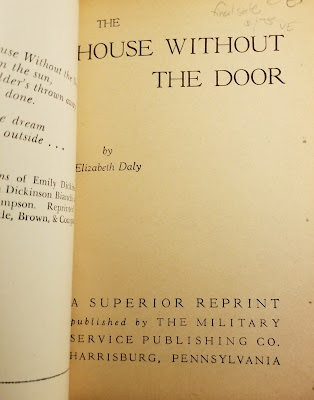
This little find was unexpected and irresistible when I saw it in a used book store. The fact that I was on a classic mystery reading streak was one part of it, but the actual physical book itself was another temptation in this case.
 

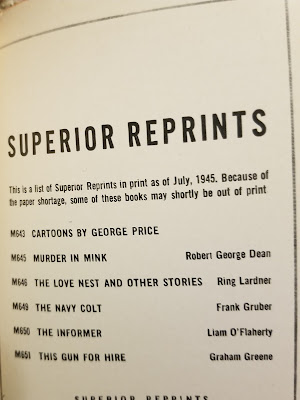
Look at it! It's so intriguing. Published by a wartime reprint house, it's small enough to tuck into a pocket, and warns that titles in this series may soon be out of print due to paper shortages - talk about stimulating demand. 

As to the story, I found it a middling read. It's a part of a series featuring Henry Gamadge, a documents specialist. His occupation is unusual enough to appeal, and in this book he's newly married, with his wife Clara playing a role in the research for the case. He's in the tradition of gentleman sleuth, and is prized for his discretion and detecting skill.

As this story begins, we meet Mrs. Vina Gregson, a widow who was acquitted by the courts of her husband's murder, but the court of public opinion hasn't been so kind. She now has lots of money with which to dress nicely and live well, but she's basically in seclusion, afraid to go out in public. And she's just started receiving threatening letters, she assumes from the person who really killed her husband. So she calls in Gamadge. 

Now to me this is the Poirot Conundrum -- why are detectives always called in to cases where their findings are not really going to be complimentary to the client? I'm not sure why this happens so often in mysteries, but here we are again. Gamadge starts to investigate Mrs. Gregson's stepchildren, relations and even her house staff, and abruptly orders her to decamp to a country rest home he knows of, where she'll be safe and isolated. 

This country residence is quite intriguing, being run by two women who seem to be a couple. I'd have liked to read more about them! They aren't thrilled with his sending a notorious murder suspect to them but they do owe him a favour, so they take her in. But is she really safe there? Time will tell. 

There's quite a bit of thrilling intrigue here, with poisons and pistols, rich people's dinner parties, dead bodies and more. But it's a bit opaque and complicated, sometimes illogically so. There are a lot of characters, and since I had never heard of this series or read any of the earlier books, I felt that I was missing enough of the character backstory that it made Gamadge harder to warm to. 

I can't say I enjoyed the story enough to seek out more of this series, but it was okay, and had some compelling bits that made it worth reading. I did enjoy the physical book a lot - it's in fabulous shape for a book published on wartime paper in 1945. And that just added to the reading experience. 

Friday, January 21, 2022

The Circular Staircase


The Circular Staircase / Mary Roberts Rinehart
NY: Carroll & Graf, 1991, c1908.
362 p.

Another classic mystery in the pile of older books off my shelves that I've been reading lately, this one was entertaining but certainly dated and reflective of its decade. It's been reprinted hundreds of times, including versions with rather bizarre covers. 

The Circular Staircase features Miss Rachel Innes, a spinster who rents a country house for the summer on the advice of her adult niece and nephew. She's never been inclined to leave the comforts of the city before, but the children need a rest. She's a tough woman who is quite independent, so when it turns out that Sunnyside isn't as sunny as expected, she doesn't run away.

The house is full of mystery and intrigue; shortly after they settle in, the owner's son is found shot dead at the base of the staircase. A detective is called in, but doesn't seem to have much authority - he works alongside Rachel and treats her like an equal rather than as a suspect. As an amateur sleuth, she is definitely in control of her living space. 

The mystery is a bit convoluted and I think a wee bit unlikely. Her niece and nephew seem to be connected to the dead young man in every way possible, with every action making them look more suspicious. Rachel is certain that HER relations aren't involved, so hides and conceals evidence at every turn. How in the world she has free rein to do so, the reader isn't quite sure. 

I liked the tenacity and toughness of this female spinster lead though, she was funny at times and didn't take any crap. Being asked to vacate early so the family could return unexpectedly, she says a flat no, since she's paid for the full summer rental. But that self-centred stubborness comes out in other ways that aren't so complimentary. However, as the reader might expect, she takes great risks and in the end solves the puzzle herself. 

In any case, it's a good read in the sense that it's considered a foundational American mystery. It sets up some mystery tropes that are carried through future mystery writing -- some of those not the strongest or most loved of tropes, but there you have it. But there are some nasty racist scenes and commentary in it. There's a black servant who Rachel hires to stay on when they arrive and the poor guy doesn't get a break. Dialect and thoroughly revolting descriptions appear whenever he is mentioned. It really soured my reading of this one, despite knowing that a book exists within its historical moment (this moment wasn't so hot apparently). 

So it's an interesting read, if you remember that it was written over 100 years ago and allow for that. There are some unique and satisfactory elements, but the claim that this novel is an early feminist mystery is a weak one, for me.

Tuesday, January 18, 2022

The Scarlet Pimpernel


The Scarlet Pimpernel / Baroness Orczy
NY: Signet Classics, 2013, c1905.
288 p.

Another mysterious classic! I read this years and years ago, and decided to revisit it recently. I still enjoyed it a great deal, with its romantic storyline featuring a brilliant mind hiding behind inanity, and star-crossed lovers. 

If anyone doesn't know by now, The Scarlet Pimpernel is the code name for a heroic Englishman rescuing French aristocracy from the guillotine, under the noses of the French revolutionaries. He has a whole spy network, and has never yet been caught - he is the master of disguise. 

But he's also an English fop, keeping his secret identity a secret even from his beautiful French wife Marguerite. She can't understand why he no longer seems interested in her, having been passionate when they were married. And he can't trust her, having heard that a word from her had led others to their deaths. 

There is the dual storyline going on here - the marriage and its miscommunications, and the whole French-English spy thriller bit. Both are exciting and dreamy and romantic and all that. I find this adventure romance style both old-fashioned and very swoon-worthy. 

Leaving aside the moments in which Marguerite is totally clueless thanks to the narrator's need for a story, the characters are appealing and the story is a fun one. 

However, what I didn't see as a young reader was the fairly appalling representation of a Jewish man at the end -- it was painful to read this time around. But I still do love Sir Percy Blakeney and his place in the literary tradition of genius spy/sleuth disguised as a bit of a fop. The ending satisfies the romantic reader and the intrigue is tied up neatly. 

Monday, January 17, 2022

Why Shoot a Butler?


Why Shoot a Butler? / Georgette Heyer
NY: Dutton, 1973, c1933.
262 p.

This is one of Georgette Heyer's Golden Age mysteries -- not as charming or witty as her better Regencies, nor as successful as a mystery as those by other Golden Age writers. It was, however, a fun enough read for a lazy afternoon. 

In this story, Frank Amberly, a very manly lawyer, arrives at his aunt's house in the country, where instead of a relaxing break he gets himself smack into another murder mystery -- it's happened to him before, and the police are aware of his reputation. 

Taking a 'shortcut' across the countryside on his way to his aunt's manor, he comes upon a young woman in distress, alongside a sports car with a dead butler inside. She swears she is innocent, and he believes her and gets her out of the way before reporting the body. 

For the rest of the book he is simultaneously suspicious of her and protecting her from police investigations. He's very snide, and high-handed, and wouldn't get away with behaviour like interfering with the course of justice and overriding local police investigations anywhere but in a book like this. 

It's light and quick but somehow drags at the same time. The dialogue is good, the plot alright, although it does go on a bit. A great number of the characters seem flat and not fully fleshed out, but our arrogant hero dominates while the tough, secretive, lovely heroine is appealing. The romance in the book doesn't exactly seem foretold, and the conclusion is a bit hurried, to my mind. There are multiple deaths, and numerous villians, a thrilling car chase through the dark countryside leading to an even more hair-raising boat chase at the shore -- like I said, it's a fun read for an afternoon. 

It certainly shows its age, though, in some of the characterizations; quite stereotypical in many ways, only a few characters really live. Still, it is Heyer writing it so it does have its pros. Not a must read, but a pretty good one overall. 

Wednesday, January 12, 2022

The Railway Children


The Railway Children / E. Nesbit
[Ashland, Or.] : Blackstone Audio, Inc., 2009, c1906.

Another children's book! This time a classic. Somehow I got into the groove of reading kid lit over the break. I have a lot of favourite Nesbit from when I was young, but this wasn't one of them. Somehow, the idea of a realist story of three siblings whose family loses all its money and has to move to the country didn't appeal as much as stories of sand fairies and magic carpets when I was a child reader.

But I decided to read it now, since there was an audio version in my library. I really enjoyed the narrator, who didn't try to sound twee or sweet, just crisply English. 

It's the story of Roberta, Peter and Phyllis, three siblings who face a crisis when their father mysteriously disappears and their mother moves them to a drafty country house, and becomes far too busy writing stories for magazines to play with them any longer. They entertain themselves by haunting the railway line that runs near the house, and visiting the station regularly. They make friends with the station master and porter, with an old gentleman on the train, and with various townspeople. 

It is an episodic story, with adventures happening regularly - the children have to warn an oncoming train about a landslide around the corner; they celebrate the porter's birthday; they rescue a schoolboy who has broken his leg inside the railway tunnel. And much more.

Throughout, the sibling relationships are realistic, with lots of arguments and boy/girl stereotypes too. It is quite of its time in some ways, with adults talking about the strength of boys and the weakness of girls, and the angelic mother. But it's also lively and fresh in others, as when the children's father states near the opening that girls and boys are equal and encourages Roberta, the eldest, in her interest in trains. 

It was a little soppy for me in parts, and the habit of the narrator talking to the reader, especially as the end got nearer, was a bit trying. It gets a bit meta in the end, with the children and their story-writing mother saying things like 'if this were a story, then x would happen' and the mother sweetly saying that God knows the right end to a story. 

But I did enjoy it in the main, and found the ending touching. I still think this wouldn't have appealed to me much as a child; I would always go for the magic in the other Nesbit stories. As an adult, I appreciated it but didn't make that connection you can make when reading as a young reader. 

Tuesday, January 11, 2022

The Story of Holly and Ivy


The Story of Holly and Ivy / Rumer Godden
NY: MacMillan, 2005, c1958.
64 p.

My favourite of all of Rumer Godden's stories about dolls, this small Christmas story follows Holly, a 6 yr old orphan being sent to a country home for the Christmas holiday as everyone else in her orphanage has been spoken for by local families. She tells herself that she's going to visit her grandmother in the country, and gets off the train randomly in a small town with the name that she has made up for her grandmother's village. 

She enjoys herself in the afternoon, walking the Christmas market and gazing into the window of the toy store, but as night falls she knows she can't be found by the policeman making his rounds. She scurries into an alleyway and finds a warm shed on the back of a bakery to curl up in. 

She can't help going back to the toy store in the night, though, to gaze at the doll she wants more than anything, and there she finds a key on the ground that she puts into her pocket. 

In the early morning, she is found by a policeman outside the shop, along with the shop boy who is anxious to find the key he dropped. And this coincidence leads to a surprising and heartwarming conclusion in which everyone gets everything they had wanted, with no bureaucratic claptrap to interfere with it all. Simpler times! 

This is a story that feels heavy with Christmas magic to me, though, and it's one I love. The picture book edition, illustrated by Barbara Cooney, is especially delightful if you can find it. The illustrations are just so perfect. 

That concludes my Christmas reading; on to other books and reviews shortly.

Monday, January 10, 2022

The Fairy Doll


The Fairy Doll / Rumer Godden
NY: MacMillan, 2007, c1956.
52 p.

Over Christmas I revisited some stories by an author I really enjoy, Rumer Godden. I remember reading some of her doll stories when I was a child, and so I got out a collection and reread a couple of Christmas themed ones, which were charming, though a wee bit dated in some ways. 

The Fairy Doll is the tale of Elizabeth, the youngest of a family, who is treated impatiently because she is clumsy and not as quick witted as the older children. When Great Granny comes to visit, however, she suggests that Elizabeth needs her own Fairy to help her, and gives her the Fairy Doll from the top of the Christmas tree. All year long Elizabeth is helped in her struggles by a 'ting' in her mind showing her what to do, thanks to the Fairy Doll, and gets better at school, at her errands and finally learns to ride her bicycle. 

But then tragedy - the Fairy Doll is lost! But Elizabeth keeps on doing better at life. Was it just herself all along? This is a sweet story about the power of self-confidence and the realities of getting older. There are odd little moments, as when 6 yr old Elizabeth is sent alone to the shops to pick up items for Mother and gets muddled, and is mocked for this by her siblings when she gets home. A different time indeed! 

If you haven't read any of these "doll stories" before, Christmas is a good time to do it. They are sweet but not overly sentimental; I think Rumer Godden isn't capable of pure syrup. I enjoyed this story but my favourite is still The Story of Holly & Ivy, another seasonal tale.