Thursday, January 25, 2007

Thirteen Literary Characters I Would Like As Friends

Over at A Reader's Journal last week, I read Booklogged's Thursday Thirteen post, and although I've never done a list as such, the theme was just too good to pass by. So without further ado, here is my Thursday Thirteen list of thirteen fictional characters I'd like to be friends with:

  • Lottie Wilkins - at the centre of Enchanted April, Lottie is the sweetest and most genuinely nice person I can think of. She would be a good influence!

  • Elizabeth Bennett - because who wouldn't want to be part of Lizzie's circle?? Austen quiz : which heroine are you?

  • Cassandra Mortmain - after reading her diary (otherwise known as I Capture the Castle) it would only be polite to be friendly with this clever and observant young woman.

  • Amelia Peabody - this intrepid heroine of Elizabeth Peter's mystery series would be intimidating but always entertaining, and good to have on your side.

  • Mary Russell - the heroine of Laurie King's Sherlock Holmes mysteries, she is a scholar and a strong independent woman who also snags Sherlock. Sigh.

  • Molly Gibson - the focus of Wives & Daughters, Molly is impetuous but always a very loyal and dependable force of friendship. You'd know you could count on her to get you out of a scrape

  • Anne Shirley - I'd love to be friends with Anne with an 'e', but only in her childhood. Sadly, as she grew up and turned into a respectable doctor's wife with a houseful of children she became, alas, dull.

  • Hagar Shipley - the 90 year old narrator of the fantastic Canadian novel The Stone Angel, Hagar is irascible but a marvellous raconteur. She'd have a few good stories to share.

  • Valancy Stirling - another L.M. Montgomery heroine, this time of The Blue Castle. Poor Valancy needs a friend; but she stands up for herself and ends up living in the Muskoka woods and married to her true love, so hopefully her luck would rub off. (speaking of LMM heroines, which would you be? I took this quiz, and it turned out I was Kilmeny. Hmmm.)
  • Amber Darke- another nature lover, the 'plain' sister in Mary Webb's A House in Dormer Forest is a charming person who is utterly unappreciated by her strange and suffocating family. But her good qualities shine through; she has strength of character to share.

  • Helma Zukas - the librarian who stars in Jo Dereske's Miss Zukas mystery series, Helma is wonderful. She is uptight and detail oriented but so funny in a dry way, and we could share work stories...

  • Laura Ingalls Wilder - (ok, so she's real. But we all know her as Laura in the books...) Because she'd know what to do if you were snowbound in a sod hut somewhere with only green pumpkins to eat...hmm, perhaps not so useful, but I once corresponded with one of her descendants, and if Laura was anywhere near as interesting she'd be a great friend.

Tuesday, January 23, 2007

The Gospel of Two Mess-iahs

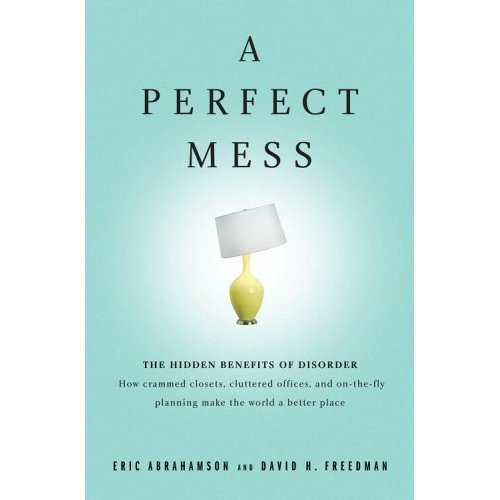
I’ve interrupted my fiction jag to read the book A Perfect Mess : the hidden benefits of disorder by Eric Abrahamson and David Freedman. As a self-confessed right brainer, how could I not want to read a defense of messiness? It was intriguing; their thesis is that the obsession with orderliness and absolute organization is self-defeating, as in most cases the costs outweigh the benefits. Their arguments range widely, from filing systems to business systems. Being business writers, they give many examples of business structures (a few too many for this non-business reader), although one example of a wild & woolly Boston bookstore organized by publisher is enough to tempt any bookish person into a trip to Boston! I was especially interested to read the results of a study which showed that people who keep clean and tidy desks end up spending about 32% more time looking for documents than people who keep a moderately messy one. Vindication! They also mention a Japanese filing system developed by a man named Noguchi, who calls it hyper-organization. It seems to be essentially a vertical storage of desk piles. Works for me. They do make clear in the book that they are talking about moderate mess. Too much mess can shade into pathology (there is even a disorder called disposophobia), but they point out that too much order can also become pathological (ie: OCD).
The book wanders a bit between subjects, talking about messiness in relation to home organization, medical discoveries, boxing, corporate structures, and art & literature. They even talk about the conundrums of categorization, a topic dear to my heart. Part of their argument is that the randomness of mess allows for increased creativity, as connections can be made between dissimilar information in close proximity. The book itself is an example of this, as the plethora of examples can strike sparks in the reader’s mind which may seem unconnected to the text itself. However, I would have liked a more in-depth look at some of the topics they raise. Perhaps experts in some of the fields they look at will be inspired to produce a deeper study on this theme.
Nonetheless, it was an interesting read. It was refreshing to read a questioning of this current focus on "getting organized". I’ve been uncomfortable with the corporate feel of self-help, with its apparent recommendations that people should tidy their lives up and progress quick-march toward their Goal. To me this is a fear based approach to life; if we just get organized enough, we will be immune to the random nature of life, for good or ill. The climate may be collapsing, wars may be raging, but by god, my closet is tidy!
I say, leave room for serendipity and the vagaries of chance. Read this book for some reassurance that mess does not always equal disorder.

Thursday, January 18, 2007

Reading My Antonia


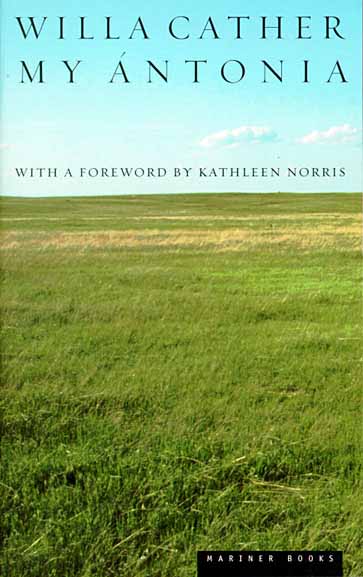
This is my second Classics Challenge read, and I can't believe it took me so long to read this! It's a touching, elegaic novel of early immigrant life in Nebraska. It is written in a stately, formal style which gives a poetic gloss to these lives, but it also feels as if the narrator is looking back over a gap of many years. I found the reminiscent tone a bit distancing -- I liked the book, but was never fully engaged in it.
The story details the lives of the Shimerda family, recent Bohemian immigrants, but from the viewpoint of young neighbour Jim Burden. Maybe that was the difficulty; I would have preferred the story from Antonia's side of things. But, perhaps Willa Cather felt she should or could not tell the story from a Bohemian girl's viewpoint, and she instead made Jim into a semi-autobiographical character, using her own life experience to shape the telling. The novel is really about Jim's experience, not Antonia's, and so that might be why it is titled MY Antonia, and not simply Antonia. It is the story of her life mediated through Jim's understanding.
I am glad I read it; I enjoyed the characters of Antonia and her friends Lena, Tiny and 'the three Marys'. And it is nice to get another of those "should-reads" off my life list!

Glassy-eyed Chunkster reading


I've finished one of the books on my Chunkster list -- The Glass Books of the Dream Eaters by Gordon Dahlquist. I really don't know what to say about this hard-to-categorize novel with the unwieldy title. I found it an entertaining light read, though due to that very lightness, the 700+ pages could have been cut to something more along the lines of 400. It is a quasi-Victorian, Gothic, Adventure, Science Fiction story written by a man who has previously written plays and produced small films. It shows; the book is full of 'action sequences' and visual images you can imagine on-screen via computer animation. I don't quite get the write-ups that describe it as "darkly erotic". I don't really consider ladies of the evening prancing about in silk underclothes in front of one way mirrors "darkly erotic", but maybe it's a man thing. Anyhow, though the execution sometimes falters, the plot is vastly creative and original. An evil cabal with the alchemical power to turn dreams and memories into blue glass, oh yes, and plans for world domination, are brought to their knees by the fumbling and originally unplanned actions of three outsider individuals. These three are: Miss Celeste Temple, recently cruelly jilted by one of the newest Cabal members; Cardinal Chang, a hired assassin who unwitttingly gets mixed up in the middle of things by a client; and Doctor Svenson, nursemaid to a Germanic princeling. I found Miss Temple annoying at times, and not fully believable (especially when she's delightedly admiring herself in her aforementioned silk underclothes, in a strange and unknown house, while sinister masked women & men are lurking outside the room -- and she knows this). But I read on while all three developed into startlingly competent co-conspirators. After about the sixth capture, near death and miraculous escape, I gave up rolling my eyes and just gave myself over to the graphic-novel style exploits. It was entertaining, and I loved the character of Dr. Svenson. His progression from meek though spying employee to ruthlessly efficient killing machine was well done. If this were made into a movie, which I have no doubt it will be, I don't really care who plays the others, but I see Paul Bettany as the moral Doctor who bows to cruel necessity and saves the day, over and over and over. Overall, a fun read, but too long. It would have benefitted from a little of the ruthless cutting down that most of the characters suffered.
Warning to all Black Adder fans: Dahlquist must use the word "cunning" fifty times in the first chapter. Beware of letting Baldrick colour the character of Miss Temple!

Sunday, January 14, 2007

A Duality of desires

I am swimming in books right now. What with my new purchases and the books I've put aside to read for various challenges, I have enough to keep me busy for months. So, what do I do? Read everyone else's blogs and add even more books to the list! I've come across two casual challenges which are quite intriguing, and who am I to resist a challenge? Although I am focused on the ones I'm currently signed up to, both Kailana's O'Canada Challenge and Kate's Reading across Borders are too tempting to ignore.
They are both year long reading goals, and although they seem to be completely opposite in intent, I think they balance nicely. I read a lot of Canadian authors, but it would be nice to be conscious of it this year, and keep track of the Canadiana I'm reading. I also try to read outside of my national milieu, but I find most of the books I read in translation are from Western Europe -- French, Italian, Portugese, and lately German. These have been good, but for the sake of variety I'm going to try to read from countries outside my usual purview. An inspiring quote comes from Marcel Proust:
The true voyage of discovery would be not to see new things but to see through new eyes.
This is what international literature provides for me, so I will gladly join this challenge, but I will trust to serendipity to bring me the titles over the year. I will commit to reading at least 10 translations from languages I don't usually read, by the end of the year. (Starting with Kristin Lavransdatter which I'm reading for the Chunkster Challenge). I'll keep track of them by posting in the sidebar. So far I have found many more than 10 great suggestions from other participants!

Saturday, January 13, 2007

"Books are not rolls..."

One of my favourite bookish quotes comes from Clifton Fadiman:
"Books are not rolls, to be devoured only when hot and fresh."
As a librarian and a former used bookstore owner, I concur with this sentiment. There is a great deal to be said about buying used, and finding those out-of-print or generally unavailable treasures. But, being a used book dealer meant we were always on the lookout, going to sales at churches, libraries, yardsales and so on, always looking for a book with resale value. And we did not shop in other bookshops, more because of a lack of time and some book fatigue than through any policy.
Today for the first time in forever, I went to a used bookstore not my own, for the sole purpose of seeing if there was anything I WANTED TO READ! It was very novel. And it seemed the Literary Gods were with me. To the sheer enjoyment of looking around at books just for my own pleasure was added the joy of finding quite a few to purchase.
I found:
1. Princess Priscilla's fortnight / Elizabeth von Arnim in a strange 70's paperback edition I had no knowledge of. This is a novel I've been searching for, for nearly 10 years now.
2. The Scent of water / Elizabeth Goudge This should help me finish up all of her books.
3. Mariana / Susanna Kearsley I'm so excited to find the one book I haven't read by this Canadian author, who writes like Mary Stewart or Barbara Michaels.
4. Icefields / Thomas Wharton A Canadian historical novel, set in the glacier fields of Alberta, which I read ages ago and wanted to own.
5. The Yellow Boots / Vera Lysenko An early Ukrainian-Canadian novel that I just learned about recently -- there it was, waiting for me.
6. Dictionary of the Khazars / Milorad Pavic A very strange looking Serbo-Croatian novel that I know next to nothing about; but it looks fascinating.
Ah, the joy of book purchasing. I do it so rarely. We own so many books already, and I work at the public library, so purchases are a rare pleasure. I was very lucky today; now I'm off to make a pot of tea and read the first chapters of all my new books!

Tuesday, January 09, 2007

A Challenge ended, a challenge begun

I've finished Miss Marjoribanks, the last on my challenge list for the From the Stacks reading challenge from Overdue Books. It's also first on my list for the Classics challenge from A Reader's Journal. A good start to the year; feeling as if I've accomplished something but still have lots ahead to read. As for the book...I enjoyed reading the story of a young woman whose sole purpose in life is "to be a comfort to dear Papa". Lucilla Marjoribanks is 19 when she returns to her widowed father's home from her schooling, to take on her rightful role as a leader of Carlingford society. She takes charge of her small town, arranging both social life and various marriages to her satisfaction. Most of the book covers her first year as society's new queen, while the final quarter skips ahead to the 10th year of her long reign. It is then that Lucilla's father dies, and she finally marries and changes her sphere of influence from Grange Lane in Carlingford to the village of Marchbanks, on the estate of her great-grandfather Marchbanks. (A specialty of English spelling; pronounciations that are not evident. Marjoribanks is said 'Marchbanks'. For more on my prediliction for odd English spellings see my husband's post about our bookshop name.)
This novel was originally serialized, as were many in the 19th century, and it shows, with many repetitions of plot lines and unnecessary padding to the story. But it was an amusing read, and Lucilla's masterful social machinations were entertaining. Recommended to Anglophiles everywhere.

Sunday, January 07, 2007

Booklist : Imagined letters


To celebrate the world of one-to-one communication, via snail mail, here are a few of my favourite novels that are made up solely of correspondence.

1. Fraulein Schmidt and Mr. Anstruther / Elizabeth von Arnim

A lovely book by one of my favourite authors, this is a one-sided correspondence. It consists of letters from Fraulein Schmidt, a young German lady who has been wooed and left by a travelling Englishman, Mr. Anstruther. He never answers her letters, but the engaging voice of Fraulein Schmidt carries us through from their first meeting to his eventual marriage to another, English, woman. Quite wonderful.

2. The History of Emily Montague / Frances Brooke

First published in 1769 and considered Canada's first novel, it contains many short notes and letters carried back and forth between many people. It resembles the modern 'email novel' in its quick exchanges, but due to the fact that it is actually set in 18th century New France, the rapidity of exchanges is dependent on exhausted servants dashing about delivering messages. Using the 18th century epistolary novel form in a New World setting results in a love story that is also very socially revealing.

3. Anne of Windy Poplars / Lucy Maud Montgomery

Also known as Anne of Windy Willows, this is the only book of the "Anne" series to be written in the epistolary format. It is made up of letters between Anne and her fiancé Gilbert, in a year that Anne is off teaching on the other side of Prince Edward Island. The letter strategem probably results from the fact that LMM wrote it out of sequence, going back to fill in those years when her public demanded yet another book about Anne. Still, I'll read anything by LMM, and this format allows her facility at describing eccentricities to shine.

4. Sorcery and Cecelia; or, the Enchanted Chocolate Pot / Caroline Stevermer & Patricia C. Wrede

This novel began as a writing exercise between two writerly friends, but it worked so excessively well that it turned into a very diverting YA novel. It is the story of two cousins, Kate and Cecelia, in a Regency England where magic is an accepted fact, with the Royal Academy of Wizards based in London. It describes their adventures both magically and romantically, as it the year of Cecelia's 'coming out'. Quite clever and amusing; if you like Regencies you'll like it. If you like fantasy, you'll like it. If you like both, you'll love it. And the good news is, it's the first book of a series.

5. Something Drastic / Colleen Curran

A comic first novel by a Montreal playwright, this is a series of letters from Lenore to her boyfriend who has left her, fleeing to Florida. It moves from Lenore's shock to her new friendships with the woman next door and the feminist professor upstairs, which lead to her 'finding herself' and being no longer dependent on her former boyfriend's presence. Lenore's voice is very distinctive and very funny, whether describing feminist gatherings or her job singing and waitressing at a 'period' restaurant recreating New France. There are two follow-up novels if you get addicted to Lenore, which is likely.

Friday, January 05, 2007

Spicy ponderings

As the New Year begins, resolutions creep up on your consciousness. I make very few resolutions, as it's too depressing when you've broken all of them by the end of January. But, general goals for the year are okay. One of my general goals this year, as always, is to get just a little better organized. This takes me of course to my spice drawer. It is one of the only places I feel tidy and organized regularly.
Now that I've moved and have a whole new kitchen to set up, I have a bit of a conundrum, which is calling my professional skills into use. The drawer I had my spices in at our previous abode was perfectly sized to hold all my 22 spice jars in perfect alphabetical order. The new drawer is much larger, allowing for different configurations. So how do I organize them? Which classification scheme would be of most use? Alphabetization is straightforward and easily accomplished. But would it be more useful to organize them according to place of origin -- or by use (cooking or baking) -- or by format (whole or ground)? It reveals once again the slippery nature of classification. Every time something is slotted into a particular place, it is a judgement call. This applies whether it is spices, or genres of books, or individuals you are talking about.
In this case, I'll stick to the ABC's. It's proven useful in the past. And as every librarian knows, a system is only worth following if it's useful to its users.

Tuesday, January 02, 2007

Oddly enough

"there are half a million more women than men in this unhappy country
of ours . . . So many odd women - no making a pair with them."

George Gissing's The Odd Women is a fascinating social document, although not perhaps a Great Novel. It is a study of those "odd women" of British society, circa 1890. It follows the careers of 5 women who are struggling to find their place within this society. There is Mary Barfoot, and Rhoda Nunn, who together run a school to train young women to self-sufficiency in work as clerks. There is also a trio of sisters, Virginia, Alice and Monica Madden. Virginia and Alice are two 'old maids' who struggle in menial, slave-like child minding positions, and turn to drink to survive. Their much younger sister Monica dooms herself by marrying a very much older, incompatible, jealous man rather than turn out like them. The social criticism is still sharp and relevant today, although tempered by the fact that Gissing was not a complete suffragist; he felt that most women were weak minded and useless, but it was society and weak minded men who were partly to blame. The novel is hampered by the feeling that the characters are too nearly representative than individual, but it is absorbing and even distressing at times. It does make you realize how fortunate we are today, even with so much change left to accomplish. It is well worth reading for a picture of life in 1890's England, for these women so often overlooked.
And is it only me, or does anyone else see an inspiration for a tv show in this story of two single women, named Mary and Rhoda, making their living in the big city?

Monday, January 01, 2007

Best Books of 2006

Alright, I'll also weigh in with my favourite reads of the year. I read about 130 books on average, some are forgettable, and some are not! I can't rank them specifically; the ones I recall as great have atmosphere, excellent writing, or especially memorable characters. My top recommendations from my reading of 2006 are:
FICTION
  1. The Madonnas of Leningrad / Debra Dean
  2. Doctor Bloom's Story / Don Coles
  3. The Pink Carnation series / Lauren Willig (pure fun)
  4. Restless / William Boyd
  5. North and South /Elizabeth Gaskell

NON-FICTION

  1. Encyclopedia of an ordinary life / Amy Krouse Rosenthal
  2. All the fishes come home to roost / Rachel Manija Brown
  3. The Shoebox bible / Alan Bradley (a memoir worth reading if only for the one scene where he wanders down the street inside a cardboard box...)

There are so many more I enjoyed but these are the tops.

Graven Images: From the stacks Read No. 4

Audrey Thomas' Graven Images is one of those books that just appeared in my collection somehow; I was intrigued enough to read it, even though I'd never heard of it. It was written in 1993 and I've just read it in mass market. Makes me wonder how many others I've missed completely over the years. It was a good, fast read but not so compelling that it will stay on my keeper shelf. Plot synopsis: Charlotte doesn't get along too well with her mother, whom she calls The Aged Pea. To make peace, Charlotte goes to England to track down some details of their family history. She takes a friend along, but they split up while in England, so the friend doesn't actually appear too much. Charlotte doesn't really find much information, but goes home again happily. The plot is a bit vague, and the story is written in snippets of flashbacks and factual asides. It is easy to see that a great deal of research went in to this book, and while most of it is entertaining, and the writing quite striking in parts, it doesn't hang together as a novel. The big secret of the novel is laid out temptingly on the back of the book, as Charlotte's mother tells her: "I saw something -- as a child."
"What did you see?"
"I don't want to talk about it. Ever."
Of course I was imagining all sorts of horrible family secrets, but when it was revealed in the last few pages of the book, it was anticlimactic; I was reduced to flipping over the blank pages, wondering where the crisis was. But, as an intriguing family story with lots of Canadian Anglophile atmosphere, it was worth reading.
And oddly, Charlotte weighs in on my latest fixation, the value of handwriting. She is at the British Museum, looking at manuscripts, and says, after commenting on the penmanship of Andrew Marvell, Byron, Lewis Carroll, etc., "I came away cheered, uplifted, somehow connected to all those people..." And as for typewriters, "those machines will tell us nothing about the writer." I guess that's why I like handwriting; it gives us the soul of the writer.